Best eSIM for Japan: Plans and Prices Compared

This article contains affiliate links. If you buy through them, we may earn a commission at no extra cost to you. Ad revenue can influence which products we cover, but the comparison criteria and verdicts are decided independently from official specs and published sources. Read our full disclosure.
An eSIM is now the default way to get online in Japan: no counter to find at the airport, no pocket WiFi to return, no physical card to swap. The awkward part is that the plans look almost identical on the surface. Half a dozen providers sell “unlimited data for Japan” at roughly $25 to $30 for a week, and the marketing copy barely differs between them.
What differs is the fine print — how much full-speed data you actually get before throttling, whether you can share the connection, and which Japanese carrier’s towers you end up on. This comparison uses figures published by each provider, checked on 27 July 2026.
Verdict
For a normal trip with a normal amount of use, Ubigi is the practical choice: on the rates each provider listed on 27 July 2026 it was the cheapest at every duration where it competes, at $25.00 for 7 days of unlimited data against $27.00 for Airalo and $27.50 for Holafly, plus the only genuinely cheap fixed-data plan for light users at $16.50 for 10 GB over 30 days.
Two things override price. If the connection has to cover a laptop or a companion’s phone, read the hotspot rule first — Holafly caps sharing at 1 GB per day, while Airalo allows unlimited devices inside its 3 GB a day. For long stays or travel well outside the big cities, Sakura Mobile offers a docomo line and its unlimited au plan states no fair use policy, but it prices in yen.
All four are data-only: no Japanese phone number and no SMS.
How to choose

“Unlimited” means four different things
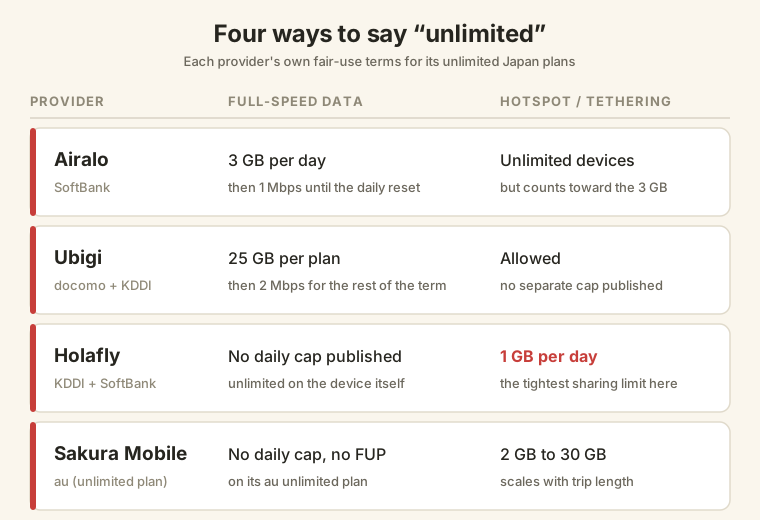
Every provider here sells something called unlimited. None of them means the same thing by it.
Airalo publishes a straightforward fair use policy: 3 GB per day at full speed, then throttling to 1 Mbps for the rest of the day, with the allowance resetting every 24 hours from the moment the eSIM was activated. Tethering is unrestricted in terms of devices, but hotspot traffic counts against the same 3 GB.
Ubigi caps by plan rather than by day: 25 GB at full speed, then 2 Mbps for whatever remains of the term. On a 7-day plan that is generous. On a 30-day plan, a heavy user could be throttled for the last three weeks.
Holafly publishes no daily throttle on the device itself, but limits sharing to 1 GB of hotspot data per day — the tightest tethering rule of the four. If the plan is meant to cover a laptop or a travel companion’s phone, that is the number that matters.
Sakura Mobile splits the difference. Its unlimited plan runs with no daily cap and no fair use policy, but hotspot use is capped on a sliding scale that scales with trip length, from 2 GB on a one-to-three day plan up to 30 GB on plans of 27 days or more.
Which Japanese carrier you land on
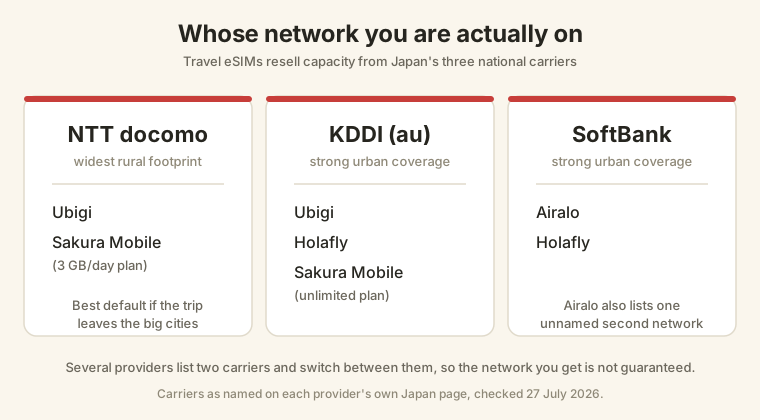
Travel eSIMs do not own towers. They resell capacity from Japan’s three national carriers, and each provider names which ones it uses.
Coverage in Tokyo, Osaka and Kyoto is good on all three networks, and most visitors will not notice a difference. It starts to matter outside the metropolitan areas — mountain roads, smaller islands, rural prefectures — where NTT docomo has historically had the widest footprint. If an itinerary is Tokyo and Kyoto, this is close to irrelevant. If it includes hiking in the Japan Alps or a drive around Hokkaido, it is worth checking.
None of these gives you a Japanese phone number
All four are data-only. There is no Japanese number, no SMS, and no voice line. For most visitors that is fine — messaging apps and internet calling cover it, and Japan runs heavily on LINE rather than SMS.
It becomes a problem in a narrow set of cases: some Japanese restaurant reservation systems, some ticketing sites, and a few delivery redelivery services want a domestic number, occasionally with SMS verification. If a trip depends on booking a specific restaurant through a Japanese-language system, that is the gap to plan around — usually by having the hotel call.
How much data a trip actually needs

The honest answer is that most travelers overbuy. The heavy consumers on a Japan trip are map navigation, transit routing, and translation, all of which are modest. Translation is the one likely to be used standing in a shop: a lot of Japanese product labeling is not printed in English, and the steel and handle terms on a chef knife are a typical example. Video is what moves the needle, and hotel WiFi is generally reliable in Japan.
Public WiFi is a weaker fallback than travelers expect. It exists in stations, convenience stores and larger cafés, but a good share of it requires registering an email address or working through a Japanese sign-in page, and it rarely covers the walk between places. That is the practical argument for buying enough data rather than the minimum.
Two things do quietly need a connection: Suica and other IC cards held in Apple or Google Wallet, which need data to top up on the move, and QR-based payment apps. Neither uses much, but both fail at inconvenient moments if the plan has run dry. Convenience stores are the obvious place to use either, and that same rotating limited-edition shelf is what the convenience-store-style Japanese snack boxes sold abroad are curated from.

The comparison
| Airalo | Ubigi | Holafly | Sakura Mobile | |
|---|---|---|---|---|
| 3 days, unlimited | $11.50 | — | $11.90 | Priced in JPY |
| 7 days, unlimited | $27.00 | $25.00 | $27.50 | Priced in JPY |
| 15 days, unlimited | $48.00 | $39.00 | $50.50 | Priced in JPY |
| 30 days, unlimited | $69.00 | $65.00 | $73.90 | Priced in JPY |
| Cheapest fixed-data | Not listed | 10 GB / 30 days, $16.50 | Unlimited only | 3 GB per day plan |
| Full speed until | 3 GB/day | 25 GB/plan | No cap published | No cap on au plan |
| Then | 1 Mbps | 2 Mbps | — | — |
| Hotspot | Unlimited devices | Allowed | 1 GB per day | 2–30 GB by trip length |
| Network | SoftBank | docomo + KDDI | KDDI + SoftBank | docomo or au |
| Phone number | No | No | No | No |
Prices are the listed rates each provider showed on 27 July 2026 and do not include promotions, which are frequent in this category. Everything here is read off the providers’ own pages rather than measured on a trip, which is the spec-based approach behind every guide here. Ubigi is the cheapest at every duration where it competes, and the only one of the four with a genuinely cheap fixed-data option for light users.
Practical notes

Sakura Mobile prices in yen, not dollars. It is the only Japan-based company of the four, and its plans are billed in JPY — its page quotes rates from ¥1,650 including tax for the travel eSIM, with the total set by the exact dates selected. Any dollar figure is a conversion, so the real cost moves with the exchange rate and whatever your card issuer charges. For US buyers that is a genuine variable, not a rounding detail. Current rates are on Sakura Mobile’s site.
Buy before you fly, activate on arrival. All four sell the eSIM online and let you install the profile in advance. Ubigi describes activation as starting on arrival at the destination rather than at purchase. Check the activation trigger on the specific plan — some start counting from install, which quietly costs a day.
Install it before you leave home. This is the trap that catches first-time eSIM buyers: installing the profile requires an internet connection, and if you wait until you have landed you need airport WiFi to get online in order to get online. Narita, Haneda and Kansai all have free WiFi, so it is recoverable, but the sign-in flow at the end of a long flight is not where anyone wants to be. Install at home, then switch the line on after landing.
Check the expiry, not just the data. These plans expire on a clock that starts at activation, and unused data does not roll over or refund. A 15-day plan bought for a 12-day trip is three days of nothing. Buying the duration that matches the itinerary, and topping up if it runs short, usually beats buying a size up.
Check device compatibility first. eSIM support is standard on recent iPhones and flagship Android phones, but not universal, and some phones sold in Japan and a few carrier-locked US models behave differently. Every provider has a compatibility checker; use it before paying.
Keep the home line for verification codes. Installing a travel eSIM does not remove the primary SIM. Leaving the home line active with data roaming switched off keeps bank and login SMS codes arriving without generating roaming charges.
Coverage claims and reality diverge underground. Tokyo’s subway network has been progressively covered, but connectivity in tunnels and on some deeper lines is still uneven regardless of provider. Downloading offline maps for the areas you will walk is cheap insurance on any plan.

FAQ
Which eSIM is cheapest for a week in Japan? On listed prices as of 27 July 2026, Ubigi at $25.00 for 7 days of unlimited data is the cheapest of the four, ahead of Airalo at $27.00 and Holafly at $27.50. For a light user, Ubigi’s 10 GB for 30 days at $16.50 is cheaper still, and 10 GB is more than many travelers use in a week of maps and messaging.
Is unlimited data in Japan really unlimited? Not in the way the word suggests. Airalo throttles to 1 Mbps after 3 GB in a day, and Ubigi drops to 2 Mbps after 25 GB on the plan. Holafly and Sakura Mobile publish no equivalent daily throttle on the device, but both restrict hotspot sharing — Holafly to 1 GB per day, Sakura Mobile on a sliding scale by trip length. Throttled speeds still handle maps and messaging; they do not handle video comfortably.
Do I need a Japanese phone number as a tourist? Usually not. All four options here are data-only and most travelers get through a trip on messaging apps alone. The exceptions are Japanese reservation and ticketing systems that require a domestic number for SMS verification. If a trip hinges on one of those, ask the hotel to book on your behalf rather than paying for a voice-capable plan.
Summary

For most trips, the decision comes down to two questions. If the goal is the lowest price for a normal amount of use, Ubigi is the cheapest at every duration compared here, runs on docomo and KDDI, and has a real fixed-data option for light users. If the plan has to cover a laptop or a travel companion’s devices, check the hotspot rule before the headline price — Holafly’s 1 GB per day is the constraint that most often surprises people, and Airalo’s unlimited-device tethering is the most permissive, as long as the shared traffic stays inside 3 GB a day.
Sakura Mobile is the option worth a second look for longer stays and for trips going well outside the big cities: it is Japan-based, offers a docomo line, and its unlimited au plan is the only one here with no stated fair use policy at all. The tradeoff is yen pricing, so compare the converted total rather than the sticker.
Whichever you pick, the useful habit is to read the fair use line before the price line. Every provider in this category is selling the same words; only the terms underneath them tell you what you are buying. Terms here also change without much notice, so if a figure above no longer matches the provider’s page, our contact page takes corrections.
Planning the rest of the trip? Our Japanese snack box comparison covers the subscriptions that ship Japan home after you get back.
If a knife is on the shopping list — Kappabashi in Tokyo and Sakai in Osaka are the usual stops — our buyer’s guide to Japanese chef knives explains the steel and handle terminology you will see on shop labels, much of which is not translated. Both it and the snack comparison sit under Japanese kitchen and food, where comparisons in that category collect.