Year-end tax adjustment in Japan: 2026 forms and family abroad

Verdict
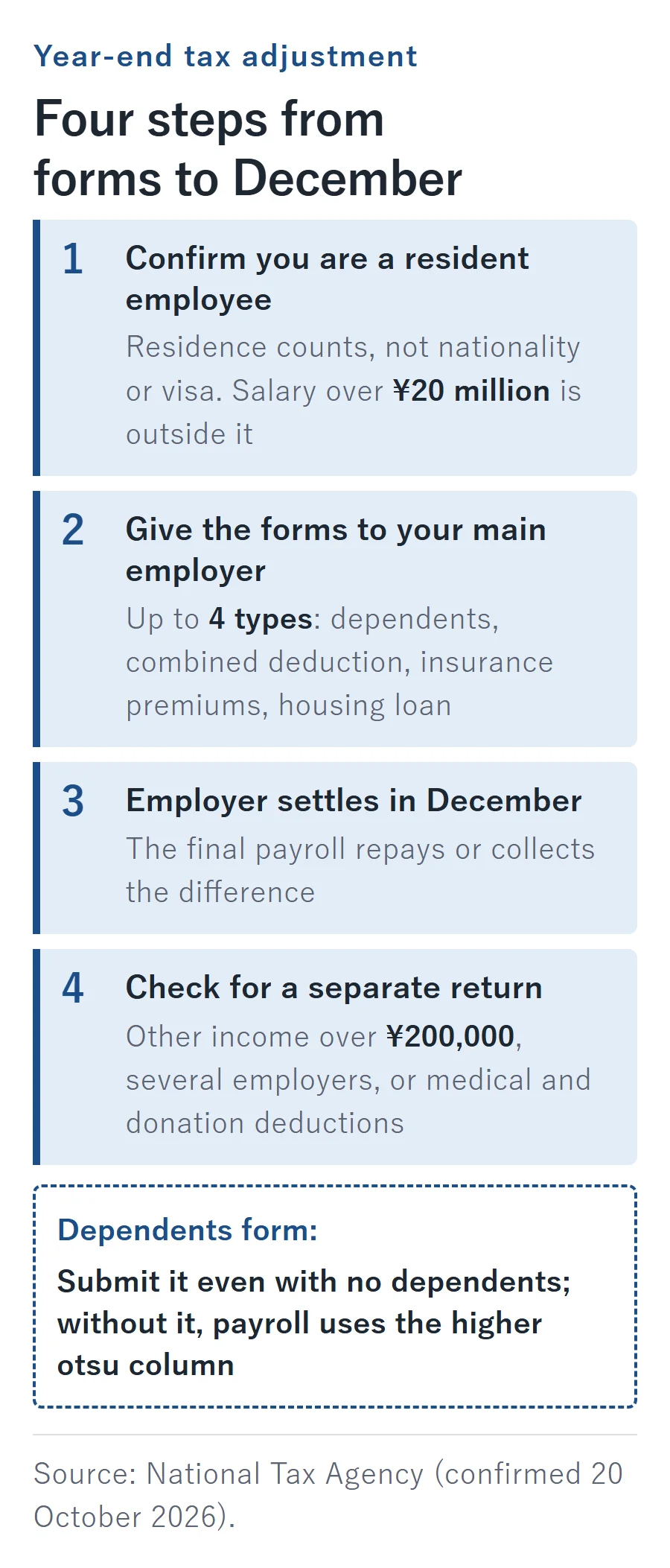
Resident employees covered by year-end tax adjustment (nenmatsu chosei) should submit the applicable forms—up to four types—to their main employer by payroll’s deadlines, regardless of nationality or visa category. The employer settles the year’s income tax through the final payroll, usually in December; for the 2026 tax year, revised deductions enter that December calculation. Prepare relationship and remittance evidence for relatives abroad, and separately establish whether a tax return is required: these are the distinctions in the official guidance as of 20 October 2026.
Source: NTA – employee guidance for 2026, Japanese; NTA – 2026 changes, Japanese; NTA – overseas-relative documentation; NTA – No.12018, separate returns (confirmed 20 October 2026).
What is year-end tax adjustment?
Year-end adjustment is your employer’s reconciliation of tax already withheld from wages against the income tax calculated for the whole year. It can produce either a repayment or an additional collection.
The monthly deductions use withholding tables; the annual calculation brings together the year’s pay and the applicable deductions. For most employees, that employer calculation completes their income-tax settlement without a separate return. Income Tax Act Article 190 provides the year-end adjustment framework.
Source: NTA – employee guidance for 2026, Japanese; Income Tax Act – Article 190 (confirmed 20 October 2026).
The NTA’s English guide describes its role as:
a substitute for filing a final return.
Source: NTA – Withholding Tax Guide, annual adjustment explanation (confirmed 20 October 2026).
Read that as an explanation of the employer’s role, not a promise that every employee’s tax affairs end there. Your practical task is to supply the declarations and evidence payroll needs, then examine income or deductions outside that process. Start with coverage, not an estimate of what December will repay.
Does it apply to me as a foreign resident?
Income-tax residence, not citizenship or visa category, is the starting point. The NTA’s resident definition covers someone with a Japanese domicile or continuous residence here for at least one year.
Source: NTA – Withholding Tax Guide, resident and non-resident definitions (confirmed 20 October 2026).
The domicile route matters: the definition is not simply a waiting period measured from arrival. The NTA also describes a presumption of Japanese domicile for work that ordinarily requires living here continuously for a year or longer. Do not decide your status from the visa label alone.
Source: NTA – Withholding Tax Guide, domicile presumption (confirmed 20 October 2026).
For non-resident salary, the NTA describes flat 20.42% withholding, normally completing income-tax collection through that withholding. Its salary leaflet states:
Non-residents are not subject to the year-end adjustment.
Source: NTA – salary withholding outline (confirmed 20 October 2026).
For residents, identify the employer holding your dependents declaration. That declaration goes to only one employer, making that workplace the main payroll for this purpose; a second employer does not perform year-end adjustment on its wages. Annual salary of more than ¥20 million is outside the adjustment under Income Tax Act Article 190 and the NTA’s Japanese guidance.
Source: NTA – dependents declaration and submission notes; NTA – employee guidance, Japanese; Income Tax Act – Article 190 (confirmed 20 October 2026).
Which forms will my employer ask me to fill out?
Match the paperwork to its purpose: dependents and personal circumstances, the combined deduction declaration, insurance premiums, and housing-loan relief. Your employer supplies paper forms or a payroll system; use its submission instructions and collection deadlines.
The English labels below are shortened for navigation. The Japanese titles distinguish the forms, including the long combined declaration.
| English name (shortened) | Japanese name | When | What for |
|---|---|---|---|
| Dependents and personal circumstances | 給与所得者の扶養控除等(異動)申告書 | By the day preceding the year's initial salary payment | Dependents, disability, widow, single-parent and working-student declarations; payroll withholding category |
| Basic, spouse, specified-relative and income-adjustment declaration | 給与所得者の基礎控除申告書 兼 給与所得者の配偶者控除等申告書 兼 給与所得者の特定親族特別控除申告書 兼 所得金額調整控除申告書 | Before the final salary payment, for year-end adjustment | Basic deduction and the other deductions named on the combined form |
| Insurance-premium deduction declaration | 給与所得者の保険料控除申告書 | In time for year-end adjustment | Life and earthquake insurance; self-paid social insurance and eligible mutual-aid contributions |
| Housing-loan tax-credit declaration | 給与所得者の(特定増改築等)住宅借入金等特別控除申告書 | In time for year-end adjustment | Housing-loan credit from the second claim year; the initial claim needs a tax return |
Source: NTA – employee forms and deadlines, Japanese; NTA – dependents declaration; NTA – combined declaration; NTA – insurance-premium declaration; Income Tax Act – Articles 194 and 195-3 (confirmed 20 October 2026).
For matching an English PDF to that table, the NTA uses these titles. Ellipses mark shortened titles, not separate forms.
The dependents declaration:
Application for (change in) Exemption for Dependents of Employment Income Earner
Source: NTA – English dependents form (confirmed 20 October 2026).
The combined declaration begins:
Application for Basic Exemption of Employment Income Earner …
Source: NTA – English combined form (confirmed 20 October 2026).
The insurance declaration:
Application for Deduction for Insurance Premiums for Employment Income Earner
Source: NTA – English insurance-premium form (confirmed 20 October 2026).
The housing-loan declaration begins:
Application for Special Credit for Loans, etc. Related to a Dwelling …
Source: NTA – Withholding Tax Guide, housing-loan declaration title (confirmed 20 October 2026).
The NTA publishes provisional translations in six languages. Treat those as reading aids alongside the format your employer specifies, not permission to substitute a different submission format.
Source: NTA – foreign-language withholding forms (confirmed 20 October 2026).
Separate premiums already deducted through payroll from amounts you paid yourself. Payroll-deducted social insurance is included in the adjustment; self-paid National Pension contributions belong on the insurance-premium declaration with supporting certificates. Insurance-company certificates generally accompany life- and earthquake-insurance claims. For the underlying coverage systems, use the guide to Japan’s National Pension and health insurance.
Source: NTA – employee guidance on insurance deductions, Japanese (confirmed 20 October 2026).
The dependents form also contains a My Number field. The NTA allows omission under certain conditions, so follow payroll’s instructions for that field; the separate guide to bank-account opening and My Number-related identity documents covers its banking context.
Source: NTA – dependents form, individual-number instructions (confirmed 20 October 2026).
Why must I submit the dependents form with no dependents?
An empty dependents list does not remove the submission requirement. The NTA’s Japanese guidance says employees without a qualifying spouse or dependent still submit this declaration under Income Tax Act Article 194.
Without it, payroll uses the higher otsu withholding column, and the employee is not covered by year-end adjustment. The form is therefore not merely a request for family-related relief: it also establishes the withholding treatment used by the main employer.
Source: NTA – dependents declaration requirement, Japanese; NTA – adjustment coverage; Income Tax Act – Article 194 (confirmed 20 October 2026).
Keep that task separate from the combined declaration. The basic deduction requires its own application through the combined form; it is not added automatically just because payroll knows your salary. Completing the dependents form does not replace supplying the basic-deduction information.
Source: NTA – basic-deduction application requirement, Japanese (confirmed 20 October 2026).
What changed for the 2026 tax year?
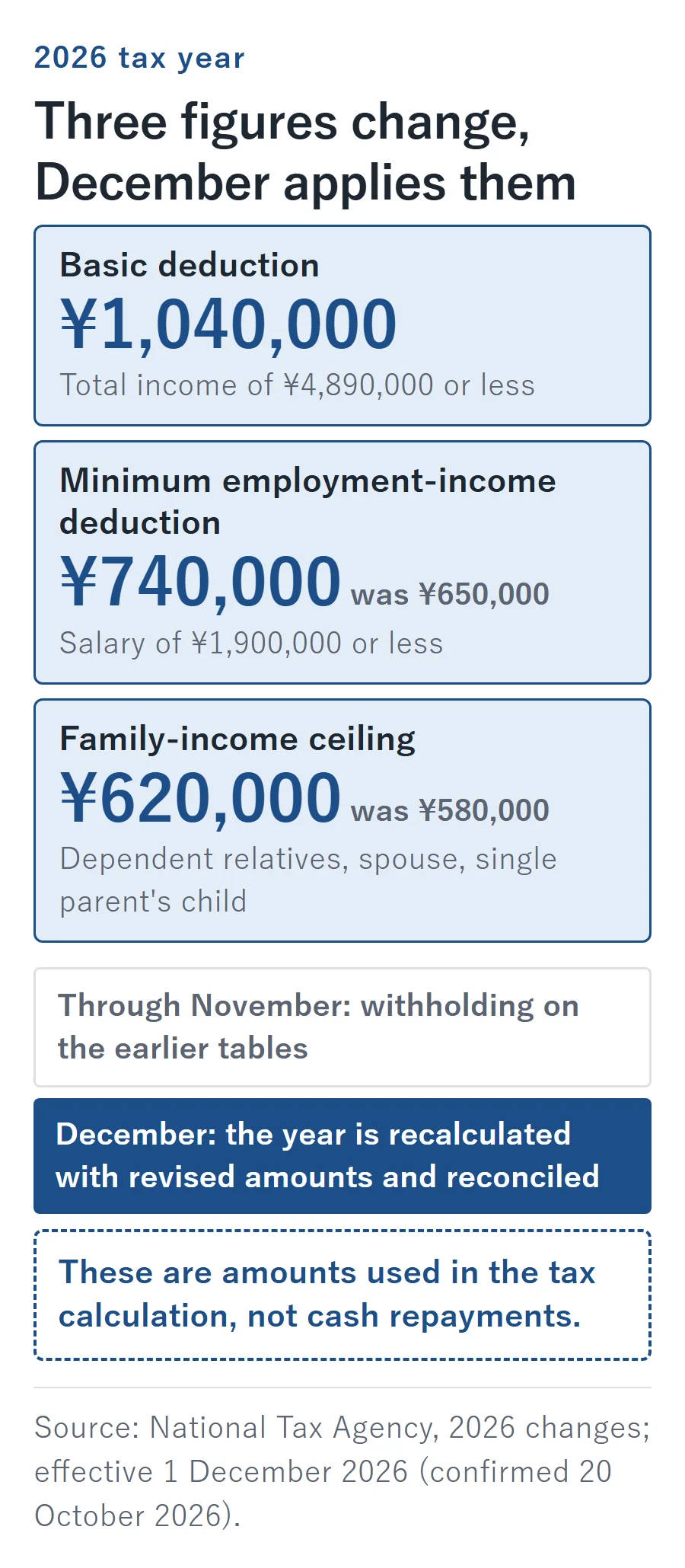
The revised basic deduction reaches ¥1,040,000 for residents whose total income is no more than ¥4,890,000, and the minimum employment-income deduction rises to ¥740,000. These are amounts used in the tax calculation, not cash repayments.
Source: NTA – 2026 basic-deduction amounts, Japanese; NTA – 2026 changes, Japanese (confirmed 20 October 2026).
Use the NTA’s Japanese-language guidance for the 2026 tax year. As of October 2026, its English guide and the text of its English dependents form still carry earlier deduction figures; the Japanese employee page and revision leaflet provide the updated amounts below.
Source: NTA – Japanese employee guidance; NTA – English guide; NTA – English dependents form (confirmed 20 October 2026).
Read total income, rather than gross salary, when locating a basic-deduction band. The resident amounts for 2026 begin as follows:
| Total income for 2026 | Basic deduction |
|---|---|
| ¥4,890,000 or less | ¥1,040,000 |
| Above ¥4,890,000 and no more than ¥6,550,000 | ¥670,000 |
| Above ¥6,550,000 and no more than ¥23,500,000 | ¥620,000 |
Source: NTA – 2026 basic-deduction table, Japanese (confirmed 20 October 2026).
The higher-income bands continue here. This deduction schedule does not override the separate salary limit for employer adjustment.
| Total income for 2026 | Basic deduction |
|---|---|
| Above ¥23,500,000 and no more than ¥24,000,000 | ¥480,000 |
| Above ¥24,000,000 and no more than ¥24,500,000 | ¥320,000 |
| Above ¥24,500,000 and no more than ¥25,000,000 | ¥160,000 |
| Above ¥25,000,000 | None |
Source: NTA – 2026 basic-deduction table, Japanese (confirmed 20 October 2026).
Two other changes affect how the forms are read:
- Employment income: the minimum deduction increases from ¥650,000 to ¥740,000; the ¥740,000 amount applies to salary receipts of ¥1,900,000 or less for 2026. Do not read it as a deduction amount shared by every salary level.
- Family income: the total-income ceiling for dependent relatives, spouses sharing the taxpayer’s livelihood, and a single parent’s child becomes ¥620,000, previously ¥580,000. Meeting that income ceiling alone does not establish eligibility. The NTA calls for an amended dependents declaration where the revision brings a relative within the applicable requirements.
Source: NTA – changes to employment-income deductions and family-income requirements, Japanese; NTA – amended declarations, Japanese (confirmed 20 October 2026).
Use the combined declaration to distinguish spouse-related relief from the special deduction for specified relatives. Sharing a form does not make their income tests interchangeable. For the 2026 tax year, the NTA’s Japanese employee page separates these routes:
- Spouse deduction: the employee’s total income must be no more than ¥10 million, and the spouse’s no more than ¥620,000. The published deduction maximum is ¥380,000, or ¥480,000 for a spouse aged 70 or older.
- Special spouse deduction: the employee’s total-income ceiling remains ¥10 million, while the spouse’s total income must exceed ¥620,000 without exceeding ¥1,330,000. The published maximum is ¥380,000.
Source: NTA – spouse-related income conditions and deduction limits for 2026, Japanese (confirmed 20 October 2026).
The specified-relative category instead concerns a relative sharing the taxpayer’s livelihood, aged at least 19 but younger than 23, with total income above ¥620,000 and no more than ¥1,230,000 for 2026. Spouses and dedicated family workers in blue-return businesses are among the exclusions from that definition. The special deduction began in 2025; its 2026 maximum is ¥630,000 per qualifying relative, with the amount changing according to the relative’s income, not a flat allowance for everyone listed.
Source: NTA – specified-relative definition and deduction for 2026, Japanese (confirmed 20 October 2026).
Record whose income each field requests. The employee’s ceiling and the relative’s ceiling apply to different people; they are not alternative limits for the same person. For a relative abroad, these form fields also do not replace the relationship and support evidence described below.
The reforms generally take effect on 1 December 2026. Withholding through November remains on the earlier tables; December’s adjustment recalculates the year’s liability using the revised amounts and reconciles it with tax already deducted. A November payslip therefore does not show the completed annual calculation.
Source: NTA – effective date and payroll timing, Japanese (confirmed 20 October 2026).
Can I claim family members who live outside Japan?
Overseas relatives require both eligibility review and evidence of the relationship and financial support. A transfer receipt alone does not establish a dependent deduction.
For the ordinary dependent deduction, the NTA’s overseas-relative rules applying since 2023 distinguish these age groups:
- Ages 16–29, or 70 and older: relationship evidence and remittance evidence are required.
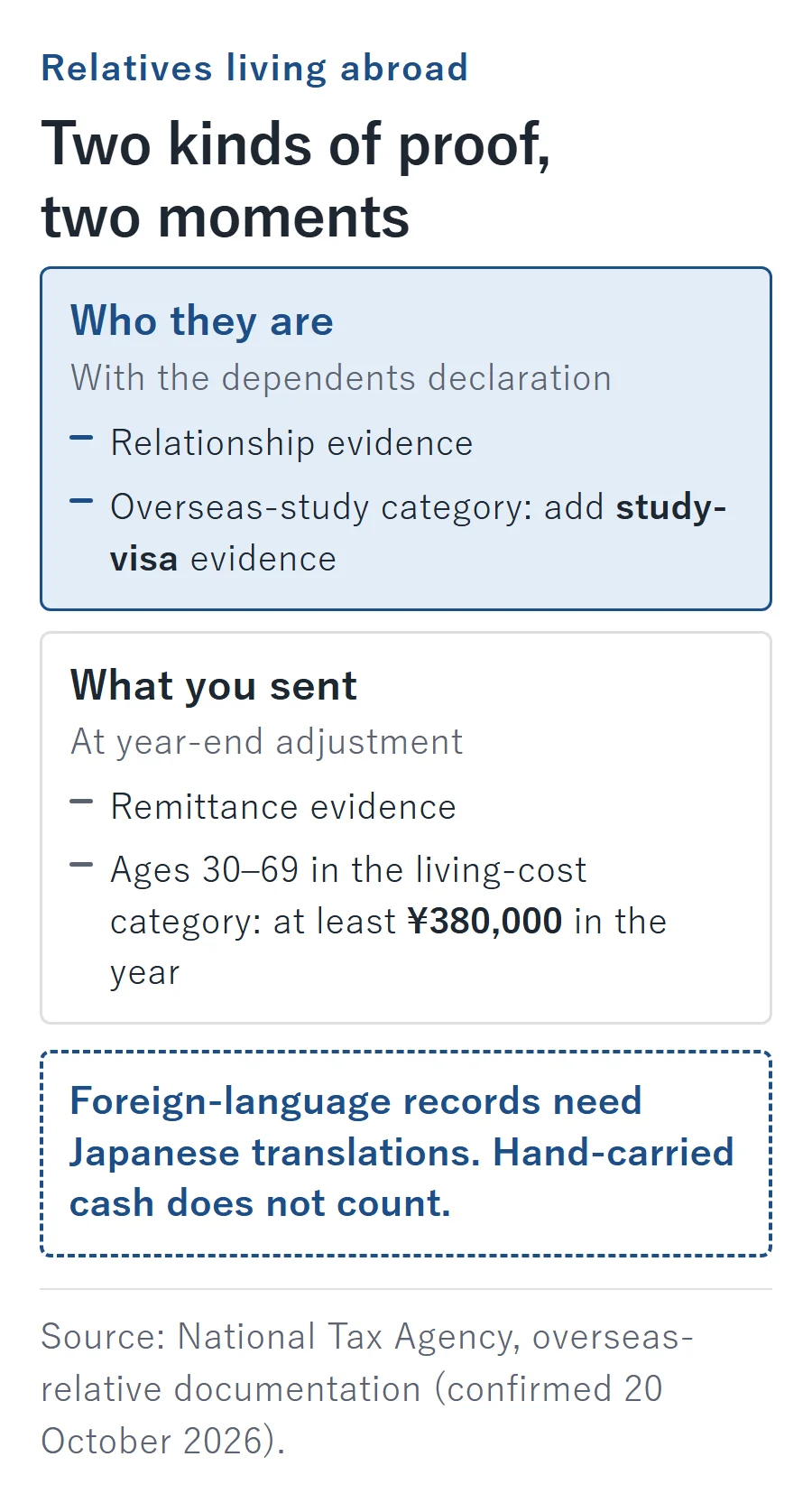
- Ages 30–69: the relative must additionally fall within an eligible category: an overseas-study move that left them without a Japanese domicile or place of residence; disability; or receipt of at least ¥380,000 paid by the taxpayer during that year for living costs or education costs. Someone in this age band outside those categories is excluded from the dependent deduction.
Source: NTA – No.12016, overseas-relative categories; NTA – overseas-relative documentation leaflet (confirmed 20 October 2026).
For 2026, the age assessment uses 31 December 2026; the income assessment uses an estimate for the whole year based on circumstances when adjustment is performed. Keep age, income and evidence together rather than treating the remittance amount as an independent route to approval.
Source: NTA – age and estimated-income assessment, Japanese (confirmed 20 October 2026).
Spouse-related, disability and specified-relative claims involving relatives abroad also require relationship and remittance documentation. Their eligibility should not be inferred from the ordinary dependent age bands. Ask your payroll department or the tax office whether a specific relative qualifies.
Source: NTA – documentation for overseas-relative claims (confirmed 20 October 2026).
What documents prove support for relatives abroad?
Prepare separate evidence of who the relative is and what support they received. Foreign-language documents require translations into Japanese; keep each relative’s evidence together rather than assembling an undifferentiated household bundle.
Source: NTA – relationship, remittance and translation requirements (confirmed 20 October 2026).
For the relationship, the NTA describes alternative document routes:
- A qualifying Japanese public-office record together with a copy of the relative’s passport.
- Records from a foreign national or local government establishing the relationship and recording the relative’s name, birth date and address. Birth, marriage and family-register records are examples; combine documents if the necessary details are not all on the same record.
Source: NTA – relationship evidence and document combinations (confirmed 20 October 2026).
For support, bank or funds-transfer-provider records can establish payments for living costs or education costs during the relevant year. The NTA also recognizes qualifying family-card statements issued by a credit-card company. The guide to sending money from Japan through banks and transfer services covers the transfer side; retain the evidence for the tax-document task separately.
Hand-carried cash is not a substitute for remittance documentation. The NTA specifically rejects the situation where an acquaintance delivers cash and no remittance record exists. Also match the recipient to the claim: money sent entirely to a spouse supplies evidence for that spouse, not for children as additional recipients.
Source: NTA – remittance evidence, cash and individual recipients; NTA – No.12016, funds-transfer-provider evidence (confirmed 20 October 2026).
Organize submission by stage:
- With the dependents declaration: supply relationship evidence; the qualifying overseas-study category also needs study-visa evidence.
- At adjustment: supply remittance evidence, including evidence of the required annual ¥380,000 or more where that category applies.
- Alongside foreign-language records: supply their translations into Japanese, covering both the relationship and support documents.
Source: NTA – submission stages for overseas-relative documents (confirmed 20 October 2026).
Do I still need to file a tax return after year-end adjustment?
Yes, some employees need a separate return, and some deductions sit outside payroll adjustment. Review those questions even after your employer has completed its calculation.
The NTA’s filing guidance lists situations including:
- Annual salary of more than ¥20 million. This also lies outside employer adjustment under Income Tax Act Article 190.
- Salary from one employer plus other income exceeding ¥200,000, excluding employment and retirement income from that other-income test.
- Multiple employers, where wages outside the main employer’s adjustment plus other income exceed ¥200,000.
- Salary paid by an employer without a withholding obligation. Foreign-employer pay belongs in this review when that condition applies; do not assume a Japanese employer has settled it.
Source: NTA – No.12018, wage-earner filing situations; Income Tax Act – Article 190 (confirmed 20 October 2026).
Separately, medical-expense deductions and donation deductions are claimed through a return, not through the year-end payroll forms. The initial housing-loan-credit claim also requires a return. These are different reasons to use the return process: additional income creates a filing question, while a deduction outside payroll creates a separate claim task.
Source: NTA – Withholding Tax Guide, deductions claimed through returns; NTA – initial housing-loan-credit claim, Japanese (confirmed 20 October 2026).
What should I do with my withholding record?
Keep the gensen choshuhyo, or 源泉徴収票, issued by your employer after adjustment. The NTA’s English name is:
Employment Income Withholding Record
Source: NTA – Withholding Tax Guide, withholding-record title (confirmed 20 October 2026).
Income Tax Act Article 226 governs this record. The NTA guide describes an employee copy and a tax-office copy, with 31 January of the following year as the employer’s tax-office submission deadline. That is not a deadline for you to submit the earlier year-end declarations.
Source: NTA – withholding-record issuance and submission; Income Tax Act – Article 226 (confirmed 20 October 2026).
File it with your payroll correspondence and supporting evidence. Keep the result of the employer’s calculation distinct from your separate decision about a tax return.
What if I leave Japan or join an employer mid-year?
An overseas transfer that makes an employee non-resident brings the adjustment forward to that point. The NTA assesses dependents and related circumstances at departure in that situation; it is not a rule to apply to every flight abroad.
Source: NTA – Withholding Tax Guide, mid-year adjustment; NTA – departure-time assessment, Japanese (confirmed 20 October 2026).
Use the guide to re-entry permission for temporary trips outside Japan for travel-and-return procedures, keeping that task separate from income-tax residence. For a permanent departure, keep pension, health-insurance and departure paperwork on a separate checklist.
An employer generally does not perform year-end adjustment for someone who leaves that job during the year, subject to exceptions such as death. For someone joining during the year, the dependents declaration is due by the day preceding their initial salary payment after joining. Bring the employment change to payroll rather than assuming the December timetable answers both situations.
Source: NTA – Withholding Tax Guide, leaving employment and initial declaration deadlines (confirmed 20 October 2026).
FAQ
Is there an English version of the forms?
Yes: the NTA provides provisional English translations, alongside Chinese, Portuguese, Spanish, Vietnamese and Filipino versions. Use the NTA’s foreign-language forms index to locate them, then follow your employer’s designated submission format. Availability of a translated PDF does not establish which format payroll accepts.
Source: NTA – translated withholding forms (confirmed 20 October 2026).
Do relationship documents have to be originals?
The NTA leaflet requires originals to be submitted or presented, apart from the passport copy. Prepare the translations into Japanese with those records rather than replacing the originals with translations alone.
Source: NTA – relationship-document presentation requirements (confirmed 20 October 2026).
Must I supply the same relationship evidence again with the combined form?
The NTA says relationship evidence already supplied with the dependents declaration need not be supplied again with the combined declaration. That avoids duplicating the relationship evidence; it does not remove the separate support-document requirement.
Source: NTA – previously supplied relationship evidence (confirmed 20 October 2026).
What if I did not submit the dependents declaration before my initial salary payment?
The NTA’s salary leaflet says submission before year-end adjustment can still bring an otherwise covered employee into that procedure. Give the missing declaration to payroll before it carries out the adjustment rather than treating the missed initial deadline as the end of the process.
Source: NTA – salary withholding outline, late dependents declarations (confirmed 20 October 2026).
What to remember
Submit the applicable declarations through your main employer, keeping the dependents form separate from the basic-deduction application.
Use the Japanese guidance for the relevant tax year and organize overseas-family evidence by relative, document type and submission stage.
Keep your withholding record, review the separate-return question, and take unresolved eligibility questions to payroll or the tax office.