Japan bicycle rules 2026: blue tickets, helmets and insurance

Verdict
If you cycle in Japan, follow the riding rules: since 1 April 2026, riders aged 16 or over can receive a blue ticket for dangerous violations—a notice offering a fixed payment instead of criminal proceedings. As of October 2026, everyday enforcement still generally starts with a warning, and helmets remain a duty of effort without a fine for non-wearing. Wear one, complete the legally required bicycle registration, and check whether your prefecture’s ordinance requires liability cover; Tokyo has required it since 1 April 2020.
Source: NPA – bicycle notification system; NPA – bicycle rulebook; Bicycle Act – Article 12(3); Tokyo Metropolitan Police – bicycle liability insurance (confirmed 13 October 2026).
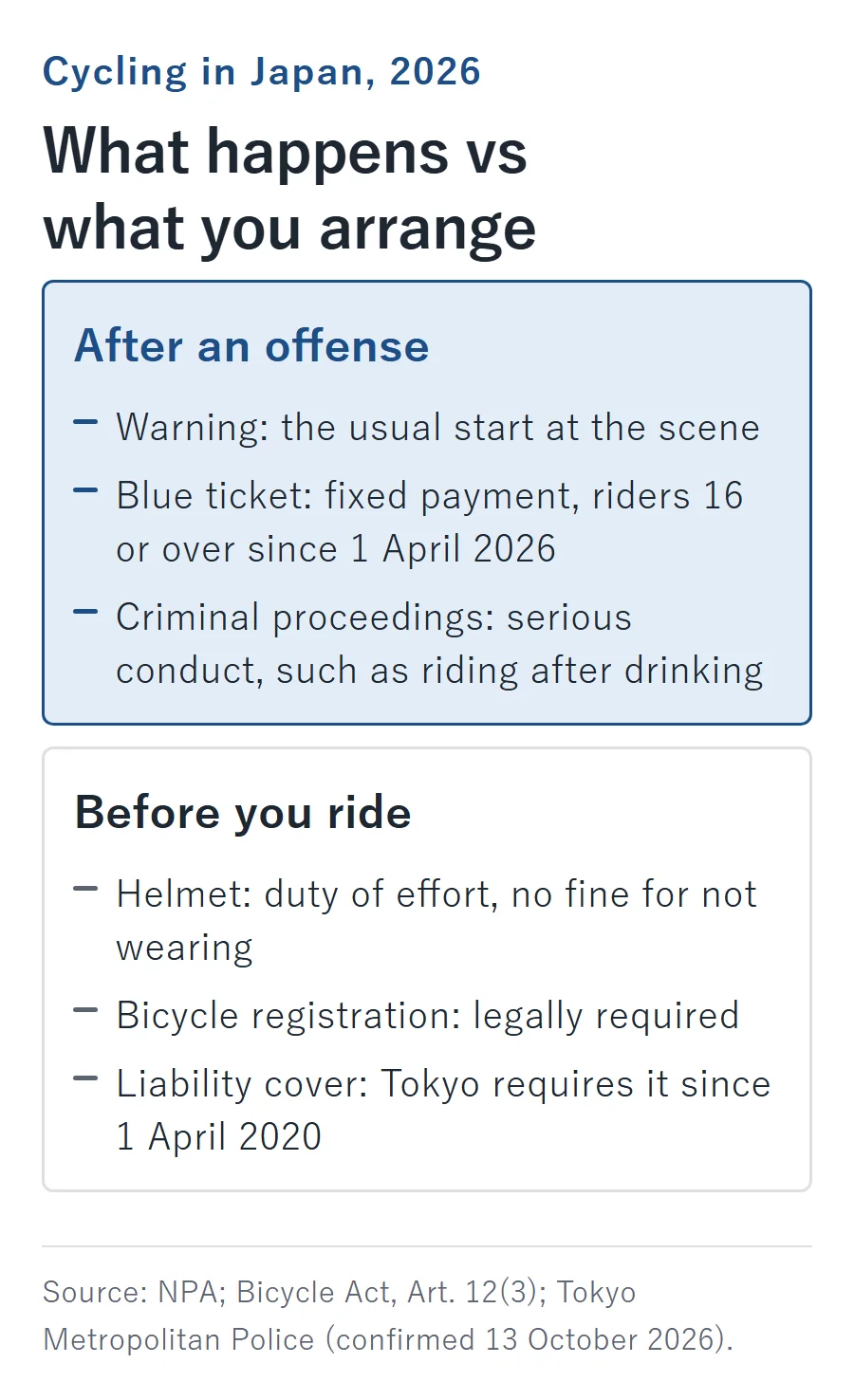
The useful distinction is between how to ride, what happens after an offense, and what to arrange before owning a bicycle. If a bike is part of setting up a new apartment in Japan, put registration and insurance on the setup checklist rather than treating the purchase as the final step.
What changed in April 2026—and what didn’t?
The main change was the procedure after a cycling offense, not a wholesale replacement of Japan’s riding rules. The Traffic Offence Notification System became available for cyclists aged 16 or over on 1 April 2026; younger riders remain outside that system and are generally handled through guidance and warnings.
Source: NPA – bicycle notification system; Tokyo Metropolitan Police – English notification-system questions (confirmed 13 October 2026).
That distinction changes how to read a headline about new bicycle laws. A payment schedule is not permission to ride dangerously, and introducing tickets does not mean every observed mistake now produces one. Learn the riding requirements separately from the enforcement process.
There is also an earlier phone-related change to keep distinct: penalties for holding a phone to call or concentrate on its screen while cycling were strengthened from 1 November 2024. The later introduction of blue tickets is a procedural change, not the starting date of that restriction.
Source: NPA – strengthened bicycle phone-use penalties (confirmed 13 October 2026).
As of October 2026, the initial nationwide figures used here are the NPA’s first-month provisional totals, published on 14 May 2026: 2,147 blue tickets and 135,855 warning slips. These describe the launch month, not the months since. Failing to stop, handheld-phone use and signal violations were the largest ticket categories in that report.
Source: NPA – first month of bicycle blue-ticket operation (confirmed 13 October 2026).
Will you get a warning, a blue ticket or a red ticket?
A warning remains the normal starting point; dangerous or persistent violations can move into enforcement. The Tokyo Metropolitan Police’s English leaflet puts the baseline succinctly:
“police officers generally give a warning at the scene.”
Source: Tokyo Metropolitan Police – English leaflet on enforcement and penalties (confirmed 13 October 2026).
Separate the routes rather than assuming an officer must warn you before any ticket:
- Warning: guidance addresses the behavior without issuing a blue ticket.
- Blue ticket: conduct creates an accident risk, endangers others, or continues after an officer’s warning. The NPA also identifies handheld-phone use and entering a closed railway crossing as enforcement targets.
- Red ticket: serious conduct, including alcohol-related riding and aggressive obstruction, follows criminal procedures rather than the fixed-payment route.
Source: NPA – enforcement approach; NPA – Japanese-language bicycle questions; Tokyo Metropolitan Police – English enforcement flow (confirmed 13 October 2026).
Sidewalk riding needs two separate answers. The NPA’s Japanese-language guidance says merely riding there is, in principle, handled with a warning. Dangerous sidewalk riding or continuing a prohibited route after a warning can lead to a blue ticket for a road-position violation, with a ¥6,000 penalty as of October 2026. That enforcement distinction does not remove the conditions for using a sidewalk.
Source: NPA – Japanese-language bicycle questions; NPA – bicycle rulebook, road position (confirmed 13 October 2026).
How do you pay a blue-ticket penalty, and by when?
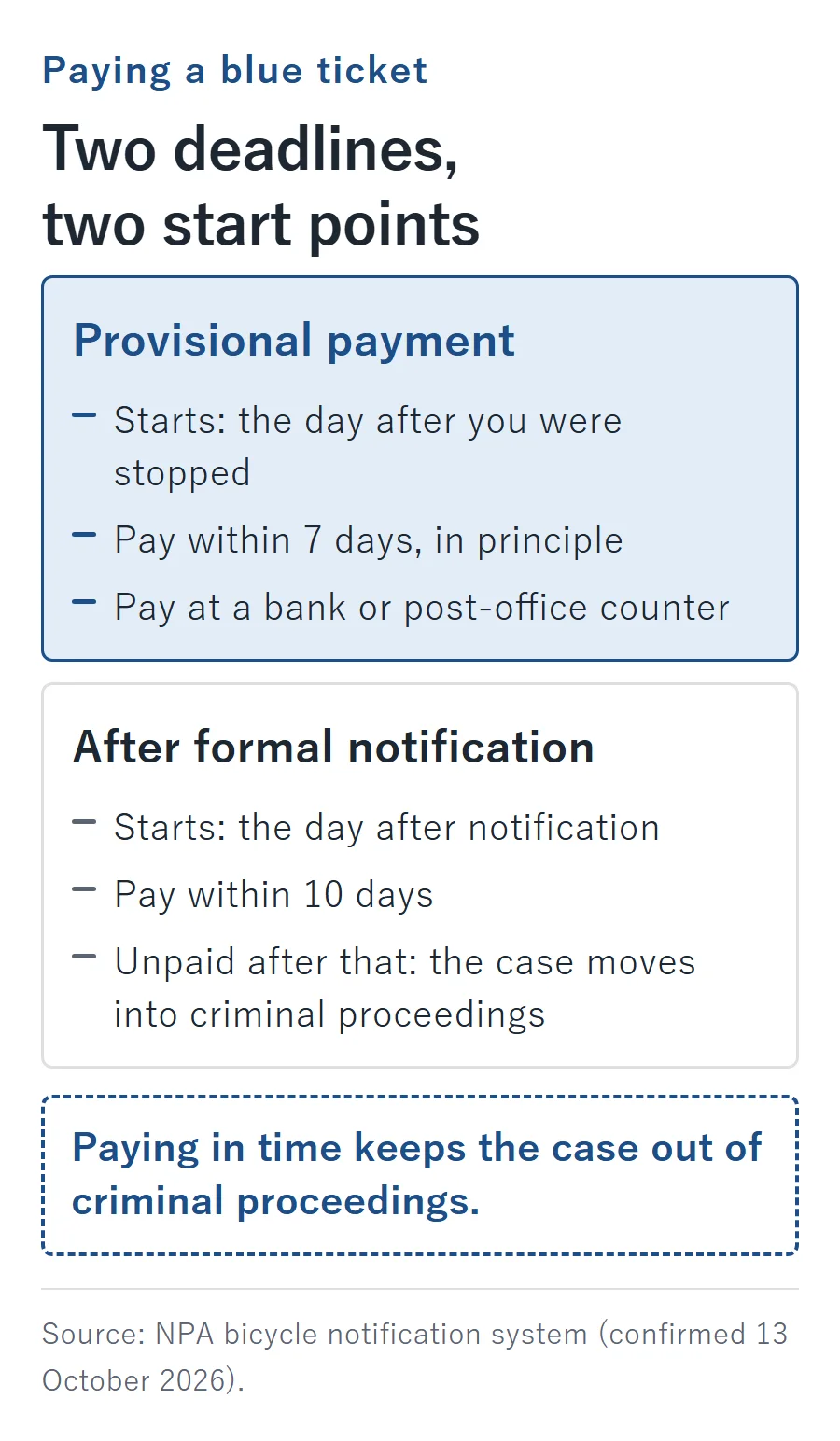
If you accept the offense, take the payment slip to a bank or post-office counter and pay in principle within seven days, counting from the day after you were stopped. Paying through this procedure prevents the case from moving into criminal proceedings and does not create a criminal record.
Source: NPA – bicycle notification system and payment procedure (confirmed 13 October 2026).
Keep the initial payment stage and the later notification stage separate:
- Identify the papers. The officer gives you the blue ticket and a payment slip. Read the offense and the instructions together, rather than treating the slip as an unrelated bill.
- Use the initial payment window if you accept the offense. This is called provisional payment. The NPA describes the result as no prosecution and no attendance for interrogation or trial.
- If you did not pay provisionally, follow the notification instructions. Attend the traffic-offense notification center on the date shown. Notification can instead be sent by post for someone far away, with mailing costs added.
- Use the later deadline correctly. Payment within ten days, counting from the day after formal notification, also keeps the case out of criminal proceedings. Leaving the penalty unpaid after that moves it into the criminal process.
Source: NPA – payment and formal notification; Government Public Relations Online – bicycle blue-ticket procedure (confirmed 13 October 2026).
The NPA’s general English payment guide—not a bicycle-only leaflet—specifies Japanese-yen cash, no installments, and counter service on weekdays during hours when transfers can be processed. Plan the counter visit around that service window. Do not confuse the time allowed for the initial payment with the separate deadline following formal notification.
Source: NPA – general English traffic-notification payment guide (confirmed 13 October 2026).
What are the fines for common bicycle offenses?
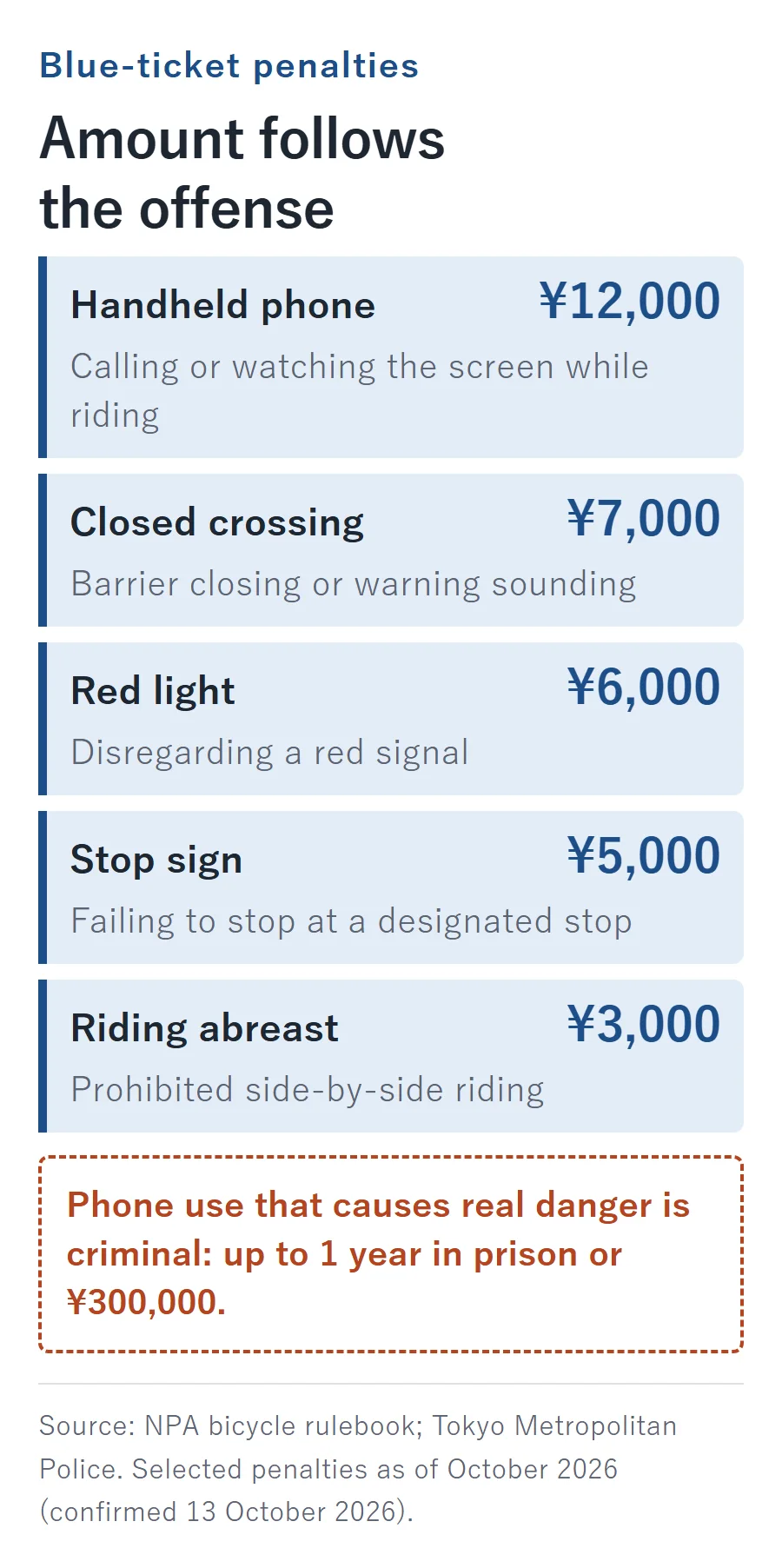
The amount follows the offense, not a general price for unsafe cycling. These are selected blue-ticket penalties as of October 2026, not a complete schedule or a promise that every instance will be ticketed.
| Offense | Conduct covered | Penalty |
|---|---|---|
| Handheld phone | Calling or concentrating on the screen while holding the phone and riding | ¥12,000 |
| Red light | Disregarding a red signal | ¥6,000 |
| Wrong side | Riding against the required direction of traffic | ¥6,000 |
| Closed railway crossing | Entering while the barrier is closing or the warning is sounding | ¥7,000 |
| Stop sign | Failing to stop at a designated stop | ¥5,000 |
| Umbrella | Riding while holding an open umbrella | ¥5,000 |
| Earphones | Riding unable to hear necessary surrounding sounds | ¥5,000 |
| No light | Riding at night without switching on the light | ¥5,000 |
| Riding abreast | Prohibited side-by-side riding | ¥3,000 |
| Two-up riding | Carrying another person outside the permitted passenger arrangements | ¥3,000 |
Source: NPA – September 2025 bicycle rulebook, individual offense explanations; Tokyo Metropolitan Police – English examples of penalties (confirmed 13 October 2026).
The condition in the middle column matters. Earphones are not prohibited simply because they are worn, and a permitted child-seat arrangement is different from prohibited passenger carrying. Under rules described in the NPA handbook, a guardian aged 16 or over can carry a child below elementary-school age in an appropriate child seat; permitted arrangements also include certain tandem and passenger-seat-equipped tricycles.
Source: NPA – bicycle rulebook, passenger and earphone rules (confirmed 13 October 2026).
Which offenses go straight to criminal proceedings?
Alcohol-related riding, aggressive obstruction and phone use that actually creates traffic danger are not resolved through a blue-ticket payment. Do not read the handheld-phone row above as the maximum consequence of using a phone while moving.
For phone use that causes actual traffic danger, the NPA rulebook lists up to one year in prison or a criminal fine of up to ¥300,000, as of October 2026. That is a different category from holding a phone without that resulting danger.
Source: NPA – bicycle rulebook, criminal offenses; Government Public Relations Online – serious bicycle offenses (confirmed 13 October 2026).
For alcohol, use a simpler decision than trying to calculate an allowance: do not ride after drinking. Road Traffic Act Article 65(1) prohibits it regardless of alcohol concentration; the thresholds attached to specific criminal penalties are not permission to consume less and ride.
Source: Road Traffic Act – Article 65(1); NPA – bicycle rulebook, alcohol (confirmed 13 October 2026).
The NPA rulebook separates the following criminal penalties, as of October 2026:
- Alcohol impairment: where alcohol creates a risk of being unable to ride normally, the maximum is five years in prison or a ¥1,000,000 criminal fine.
- Specified alcohol levels: a blood concentration of at least 0.3 mg/mL or a breath concentration of at least 0.15 mg/L carries up to three years in prison or a ¥500,000 criminal fine.
- Aggressive obstruction: the general penalty is up to three years in prison or a ¥500,000 criminal fine.
These are criminal maximums, not alternative entries to add to the blue-ticket payment table.
Source: NPA – bicycle rulebook, alcohol impairment, alcohol levels and obstruction (confirmed 13 October 2026).
Bicycle offenses add no points to a driver’s license, but especially dangerous conduct such as drink riding can result in license suspension for up to six months; residents arranging a Japanese license can use the separate foreign-license conversion guide.
Source: Tokyo Metropolitan Police – English notification-system questions; NPA – bicycle rulebook, license suspension (confirmed 13 October 2026).
Which riding rules catch residents out?
Use the roadway and keep left as the general rule. Decide whether a sidewalk exception applies before choosing that route, rather than following whichever path other riders are taking.
The ordinary-bicycle category has specific criteria; it does not simply mean a bike used for everyday trips. The NPA handbook includes a maximum length of 190 cm and width of 60 cm among those criteria, so dimensions alone are not its complete definition.
Source: NPA – bicycle rulebook, ordinary-bicycle criteria (confirmed 13 October 2026).
For qualifying ordinary bicycles, the NPA describes these sidewalk exceptions:
- A sign or marking permits bicycle use.
- The rider is under 13, 70 or older, or has a disability that affects their riding.
- Roadworks, a continuous line of parked vehicles, or dangerous roadway conditions make riding on the left difficult or unsafe; heavy traffic and a narrow roadway are examples.
On a sidewalk, proceed slowly enough to stop immediately, use the part nearer the roadway rather than the inner half, and stop when necessary to avoid obstructing pedestrians.
Source: NPA – bicycle safety and sidewalk conditions; NPA – Japanese-language bicycle questions (confirmed 13 October 2026).
Signals depend on your path and the sign attached. Follow vehicle signals on the roadway and pedestrian signals when using a crosswalk. If the pedestrian signal is marked for both pedestrians and bicycles, follow that signal even while riding on the roadway. At a designated stop, stop rather than treating a clear-looking junction as permission to continue.
Source: NPA – bicycle rulebook, signals and stopping; Tokyo Metropolitan Police – stop-sign violation (confirmed 13 October 2026).
For phones, distinguish a holder from permission to concentrate on navigation. The NPA’s Japanese guidance prohibits sustained attention to a mounted display: actual traffic danger brings the criminal route, while without that danger it describes no enforcement. Stop somewhere safe before studying the route instead of testing that boundary while moving.
For earphones, the relevant issue is hearing necessary sounds and voices. The rulebook accepts single-ear, open-ear and bone-conduction arrangements when those sounds remain audible. An umbrella holder is not a blanket exemption either: obstructed vision, impaired control or excessive load dimensions can breach the rules; the NPA distinguishes that from enforcement, which can follow resulting danger.
Source: NPA – Japanese-language bicycle questions on phone and umbrella holders; NPA – bicycle rulebook, earphones (confirmed 13 October 2026).
A separate passing rule effective 1 April 2026 requires drivers to use a safe speed when clearance is insufficient while passing a cyclist, and requires the cyclist to move left as far as possible.
Source: NPA – Japanese-language questions on passing bicycles (confirmed 13 October 2026).
Are helmets a duty of effort rather than a fine?
Yes: Road Traffic Act Article 63-11 sets a duty to make an effort to wear a helmet, not a blue-ticket penalty for going without one. The all-age duty began on 1 April 2023 and remains the position as of October 2026.
Source: Road Traffic Act – Article 63-11; NPA – helmet guidance; NPA – bicycle rulebook, no helmet penalty (confirmed 13 October 2026).
The duty extends beyond your own head. Riders should make an effort to have their passengers wear helmets, and guardians should do the same for children who cycle. Put the helmet beside the bicycle’s everyday equipment rather than treating it as something needed only when enforcement is visible.
Source: Road Traffic Act – Article 63-11, paragraphs 2 and 3 (confirmed 13 October 2026).
The handbook’s pooled 2020–2024 data concern cyclists who sustained head injuries: the fatality rate among those without helmets was about 1.4 times the rate among helmet wearers. This compares deaths within the head-injured group, not everyone’s probability of being involved in a crash. It gives a reason to separate the safety decision from the penalty question: absence of a ticket is not an argument against head protection.
Source: NPA – bicycle rulebook, head-injury fatality data for 2020–2024 (confirmed 13 October 2026).
How do you check your prefecture’s liability-insurance rule?
Start with the prefectural ordinance and the personal-liability section of your existing insurance. Tokyo has required bicycle liability cover since 1 April 2020, covering liability for another person’s injury or death; guardians arrange it for a minor who rides.
Source: Tokyo Metropolitan Police – insurance duties, page updated 3 April 2026 (confirmed 13 October 2026).
As of October 2026, the nationwide snapshot used here is MLIT’s count dated 1 April 2024: 34 prefectures with mandatory-cover ordinances and 10 with a duty of effort, counted by ordinance promulgation date. Those are the dated figures, not a fresh count of prefectures for 2026.
Source: MLIT – promotion of bicycle liability insurance (confirmed 13 October 2026).
Before buying another policy, inspect what you already hold. The Tokyo guidance identifies personal-liability cover attached to automobile, fire or injury policies, card benefits and group schemes as places to look. Identify the liability provision and its coverage amount, not merely a reference to accidents or injury benefits. For renters, start with the insurance paperwork discussed in renting an apartment in Japan.
Tokyo also imposes an insurance duty on businesses that rent out bicycles and businesses using bicycles for work. Its guidance excludes work-related accidents from personal-liability insurance. Keep that distinction separate from an ordinary household-policy search; the business’s duty is not a reason to assume your own arrangements are complete.
Source: Tokyo Metropolitan Police – existing-policy checklist and business-use warning (confirmed 13 October 2026).
Another route in Tokyo’s guidance is insurance attached to a TS mark after bicycle inspection and maintenance. For that route, confirm the mark relates to an inspection within the past year, then read its limited coverage conditions. Do not substitute the presence of a sticker for identifying the attached insurance and its scope.
Source: Tokyo Metropolitan Police – TS-mark insurance conditions (confirmed 13 October 2026).
How does bicycle registration, or bōhan tōroku, work?
Japan’s Bicycle Act, Article 12(3), requires crime-prevention registration for the bicycle you use. Bōhan tōroku is that registration, separate from both insurance and the rules governing how you ride.
Source: Bicycle Act – Article 12(3) (confirmed 13 October 2026).
Tokyo’s procedure goes through bicycle retailers entrusted by its designated registration association. Those shops handle new registrations, changes, transfers and cancellations. When accepting a used bicycle, include the registration transfer in the handover plan rather than assuming possession settles the administrative side.
As of October 2026, the Tokyo police guidance gives a validity period of ten years starting with the year after registration. Continued use after that period requires a new registration; do not translate that into ten years counted from the purchase day.
Source: Tokyo Metropolitan Police – bicycle crime-prevention registration (confirmed 13 October 2026).
Keep the customer copy of the registration card. Tokyo police say it is not reissued and is needed for tasks including address changes, theft reports and scrapping. Its guidance directs owners of unregistered bicycles to arrange registration promptly in the prefecture where the bicycle is used.
Source: Tokyo Metropolitan Police – registration card and unregistered bicycles (confirmed 13 October 2026).
When retiring the bike rather than transferring it, treat the registration task and physical disposal as separate jobs. The guide to municipal garbage and bulky-waste rules explains how to approach the disposal side without importing another city’s procedure into your own move.
When do repeat offenses trigger a cyclist safety course?
For riders aged 14 or over, being dealt with for at least two qualifying dangerous acts within three years can lead to an order to attend a cyclist safety course. That age threshold is separate from eligibility for blue tickets.
Source: Government Public Relations Online – repeat dangerous acts; Tokyo Metropolitan Police – English questions, course eligibility (confirmed 13 October 2026).
The public safety commission specifies an attendance period of no more than three months. The course lasts three hours and requires a fee; the NPA rulebook states that failing to attend within three months of an order can lead to a criminal fine of up to ¥50,000, as of October 2026.
Source: NPA – bicycle rulebook, cyclist safety course; Government Public Relations Online – course orders (confirmed 13 October 2026).
Do not confuse the trigger with collecting warning slips. The NPA says receiving repeated guidance and warnings does not itself bring an additional disposition.
Source: NPA – Japanese-language questions on repeated warnings (confirmed 13 October 2026).
FAQ
Did the 2026 change create a new bicycle helmet fine?
No: as of October 2026, the NPA rulebook does not attach a traffic penalty to cycling without a helmet. The all-age duty of effort dates from 1 April 2023 under Road Traffic Act Article 63-11, rather than from the blue-ticket launch.
Source: NPA – helmet guidance; NPA – bicycle rulebook; Road Traffic Act – Article 63-11 (confirmed 13 October 2026).
Do the rules apply to foreign residents and tourists?
Yes: the official blue-ticket eligibility is based on being a cyclist aged 16 or over, without a nationality distinction. The sources do not create a separate exemption for visitors, so a holiday is not a reason to disregard the riding rules.
Source: NPA – bicycle notification system; Tokyo Metropolitan Police – English questions, age eligibility (confirmed 13 October 2026).
Do bicycle fines add points to a Japanese driver’s license?
No: cycling offenses do not add license points. The Tokyo police distinguish points from suspension, which remains possible for serious, dangerous conduct such as drink riding; no points does not mean no consequences for driving.
Source: Tokyo Metropolitan Police – English questions, effect on a driver’s license (confirmed 13 October 2026).
What to remember
Keep left, obey signals and stops, and distinguish a warning from ticketed or criminal enforcement. If you accept a blue-ticket offense, follow the payment slip and the correct deadline’s starting event. Wear a helmet, keep registration current, and check whether liability cover is required where you ride.