Japan re-entry permit: special permission, fees and deadlines

Verdict
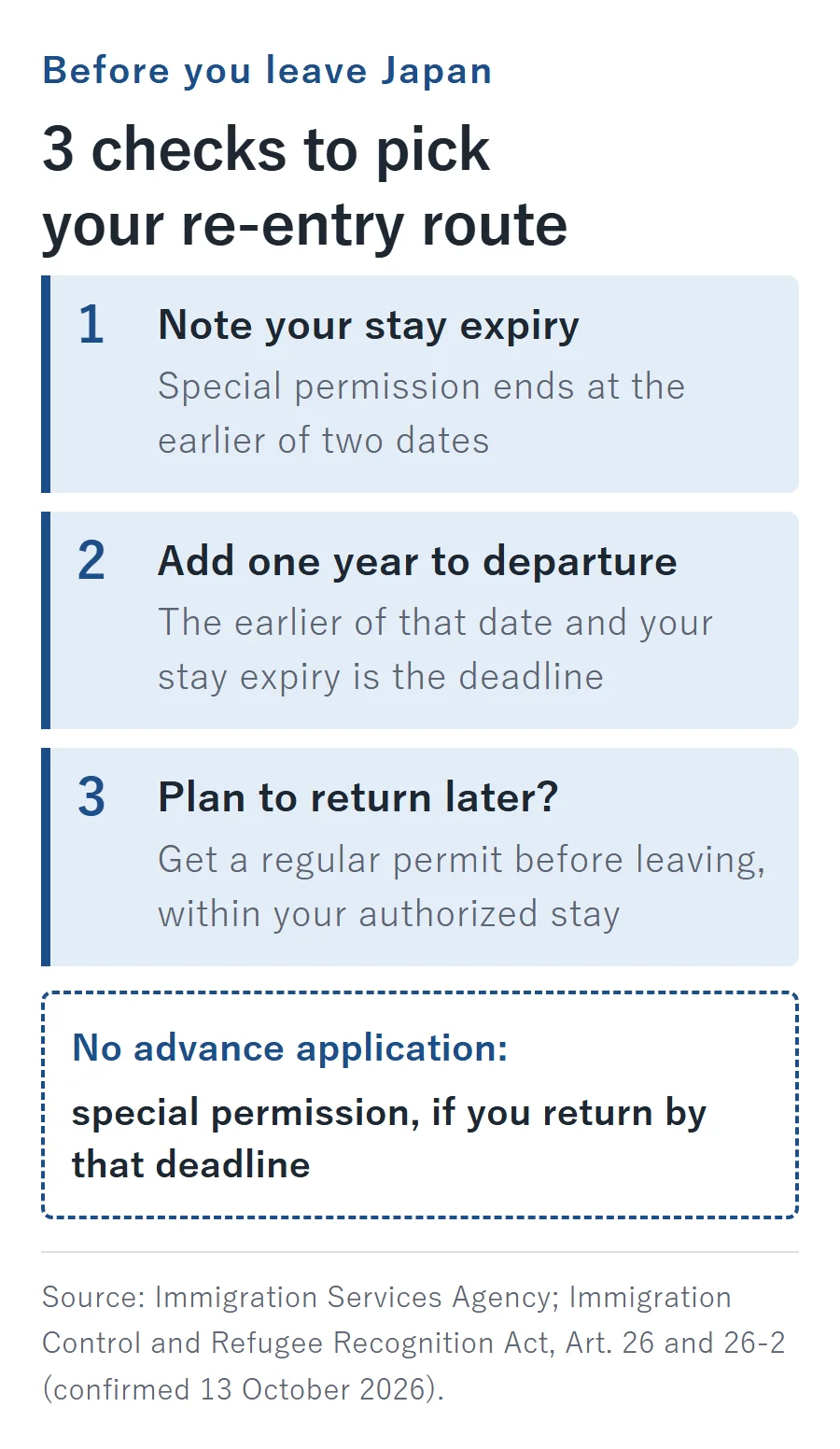
Eligible residents holding a valid passport and residence card need no advance application for special re-entry permission under Art. 26-2 if they return by the earlier of one year after departure and their period-of-stay expiry. This permission cannot be extended abroad. For a longer absence, obtain a re-entry permit before leaving, within your authorized stay; as of October 2026, counter fees are ¥4,000 for a single return or ¥7,000 for multiple returns.
Source: Immigration Services Agency – special re-entry permission, Japanese; re-entry permit application, Japanese; Immigration Control and Refugee Recognition Act – Art. 26 and Art. 26-2 (confirmed 13 October 2026).
Who should use these re-entry procedures?
These procedures concern foreign residents leaving Japan temporarily with the intention of resuming life here, not tourists arranging another holiday. For mid- to long-term residents, eligibility for special re-entry permission requires both a valid passport and a residence card.
The Immigration Services Agency’s Japanese-language guidance excludes people granted a stay of three months or less, and people with Temporary Visitor status. Its Q&A Q62 also says regular re-entry permits are generally not granted to Temporary Visitors; this is not a way to turn a tourist departure into continuing residence.
Source: Immigration Services Agency – special re-entry eligibility, Japanese; immigration Q&A, Q62, Japanese (confirmed 13 October 2026).
A limited set of other exclusions is listed on the agency’s eligibility page; affected residents need the regular-permit route instead. Identify your eligibility before comparing trip lengths.
If you are leaving without plans to return, the procedures are different: use the guide to pensions, health insurance and departure paperwork when leaving Japan.
How do the two re-entry options compare?
Choose by the expected absence and the end of your authorized stay, not simply by whether the trip is for work or family. Re-entry permission is the mechanism allowing a resident to leave temporarily and return using their existing residence status.
The ordinary residence-card routes below differ in advance paperwork, validity and overseas extension. Special permanent residents have separate durations, covered below; fees shown are as of October 2026.
| Option | Who it fits | Validity | Fee | Extendable abroad? |
|---|---|---|---|---|
| Special re-entry permission | Eligible residence-card holders returning within its deadline; no advance application | Earlier of one year after departure and authorized-stay expiry | The agency lists no fee | No |
| Regular re-entry permit | Residence-card holders planning a longer absence; apply before departure | Up to five years, within the current authorized stay | Counter: ¥4,000 single; ¥7,000 multiple; revenue stamps | Discretionary: up to one year, never beyond six years from taking effect |
Source: Immigration Services Agency – special re-entry permission, Japanese; re-entry permit application, Japanese; Immigration Control and Refugee Recognition Act – Art. 26 and Art. 26-2 (confirmed 13 October 2026).
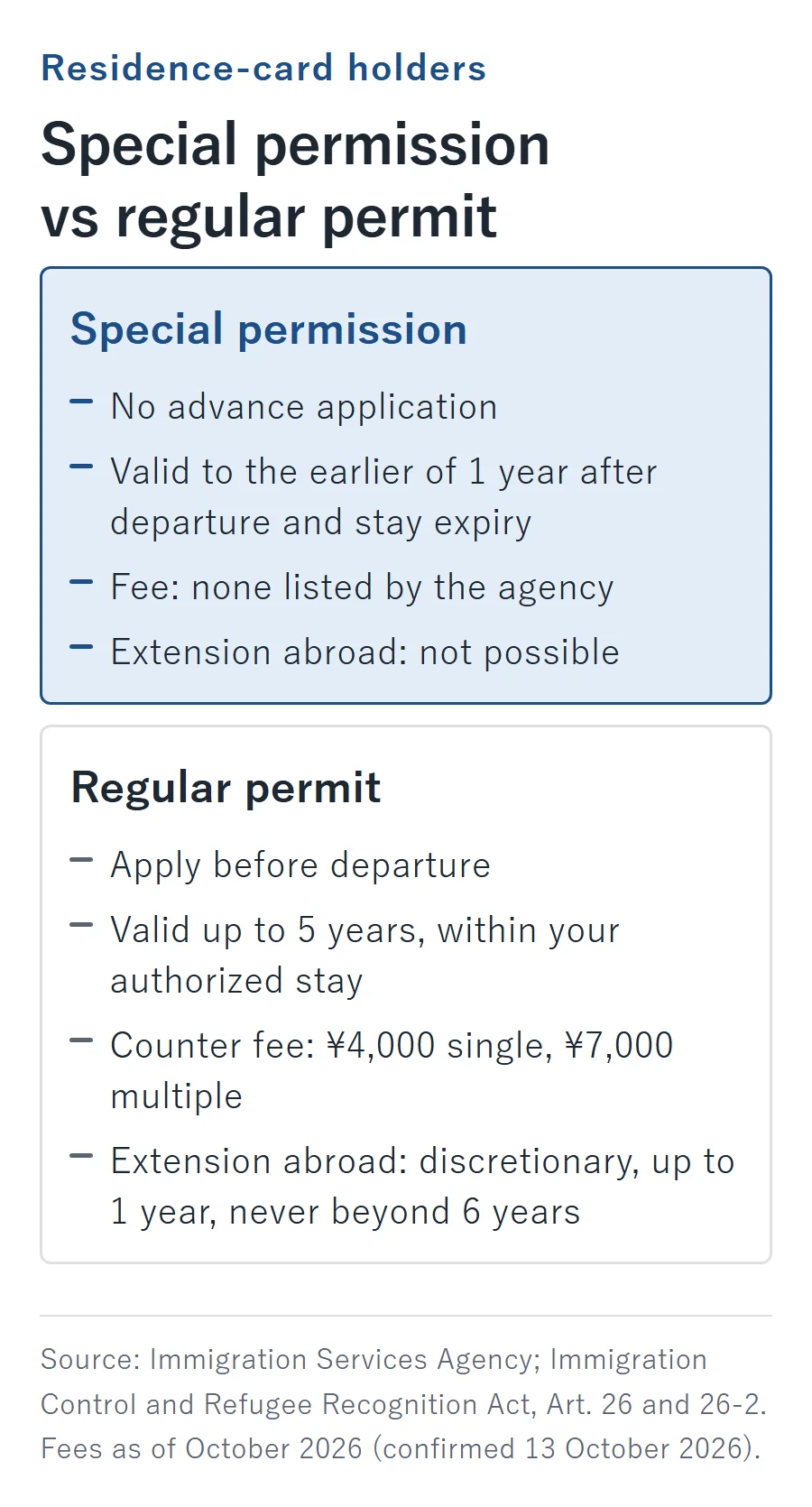
The agency uses special re-entry permission; searches also call it a special re-entry permit. The airport procedure and the advance permit application are alternative routes, not successive stages of the same application.
Does special re-entry permission give you a full year away?
Not if your authorized stay ends sooner. Under the Immigration Control and Refugee Recognition Act, Art. 26-2(2), the deadline is whichever arrives first: one year after departure or your authorized-stay expiry.
Source: Immigration Control and Refugee Recognition Act – Art. 26-2(2); Immigration Services Agency – special re-entry permission, Japanese (confirmed 13 October 2026).
For example, consider this hypothetical trip, with no renewal or status-change application pending:
- Departure: 10 December 2026.
- Current authorized stay ends: 15 March 2027.
- The departure-based anniversary: 10 December 2027.
- The applicable return deadline: 15 March 2027, because the authorized stay ends first.
Source: Immigration Control and Refugee Recognition Act – Art. 26-2(2), rule applied to the fictional dates above (confirmed 13 October 2026).
A return ticket dated before the anniversary does not solve an earlier residence expiry. Write the actual deadline alongside your travel plans, rather than recording only the length of the holiday.
A regular permit does not extend your authorized stay either: its validity remains inside that period. If your intended return is later than your residence expiry, resolve the residence-period issue before departure instead of treating the paid permit as a workaround. Pending renewal and status-change applications have a separate rule, explained below.
Source: Immigration Services Agency – re-entry permit validity, Japanese; Immigration Control and Refugee Recognition Act – Art. 26 (confirmed 13 October 2026).
For the separate question of bank identity checks, the guide to residence cards and the My Number-integrated card in Japanese banking covers that use of the document.
What do you do with the re-entrant ED card at departure?
Present the completed ED card for re-entry, the residence card and the passport, making your intention to return clear. For the special-permission route, the agency’s Japanese-language instructions also require telling the officer that you want to depart using that procedure.
Source: Immigration Services Agency – departure instructions, Japanese; Guidebook on Living and Working, seventh edition, English (confirmed 13 October 2026).
Keep the document task and the spoken explanation together:
- Have the documents ready: the completed re-entrant ED card, valid passport and residence card.
- Record the planned absence: the form includes the intended length of time outside Japan.
- Choose the return-intention answer: mark the answer expressing your plan to return.
- Tell the officer which route you are using: for special re-entry permission, say so rather than relying on the mark alone.
Source: Immigration Services Agency – special re-entry departure instructions, Japanese; English leaflet on the ED-card revision (confirmed 13 October 2026).
The form change effective 1 April 2016 removed the choice between the regular and special permission systems from the departure card. The agency’s English leaflet explains that the relevant choice became:
whether or not you intend to re-enter Japan.
Source: Immigration Services Agency – English explanation of the ED-card change effective 1 April 2016 (confirmed 13 October 2026).
Focus on that meaning rather than hunting for an older form’s permit-type selection. The quotation explains the change; it is not a transcription of the currently printed card.
Regular-permit holders also complete the re-entrant ED card when departing. On return, present your passport and residence card; use the Visit Japan Web guide for returning residents’ customs preparation for the separate customs task.
Source: Immigration Services Agency – Guidebook on Living and Working, re-entry procedures, English (confirmed 13 October 2026).
When should you obtain a regular re-entry permit?
Arrange a regular permit before departure if your planned absence exceeds the special-permission window; first resolve any authorized-stay expiry that would cut the trip short. Apply to the Regional Immigration Services Office responsible for your home address, not after you have left Japan.
Under the Immigration Control and Refugee Recognition Act, Art. 26, the agency sets validity within the current authorized stay, with a maximum of five years, or six years for special permanent residents. The maximum is not an automatic length awarded to every applicant.
Source: Immigration Services Agency – re-entry permit application and validity, Japanese; Immigration Control and Refugee Recognition Act – Art. 26 (confirmed 13 October 2026).
How should you plan a long or open-ended absence?
Separate the time you hope to spend abroad from the time your documents actually allow. Before choosing the paid route, make a short record of the authorized stay’s end date, your intended return date, and whether the plan involves one return or repeated travel.
Use that record to distinguish these situations:
- A long trip that still fits within your authorized stay: the advance-permit application addresses the longer absence; selecting single or multiple use is a separate decision about repeated returns.
- A return planned after your authorized stay expires: applying for a regular permit does not remove the residence-expiry problem. Address that issue first, rather than assuming the maximum permit duration overrides it.
- An uncertain return date: compare the later possible return with the applicable limit, not just the date you currently hope to travel. If the absence could exceed the special-permission limit but stays within your authorized period, arrange the regular permit before leaving.
After a permit is granted, plan against its actual end date, not the maximum described online. Keep that distinction when booking or changing travel: the application form records intentions, while the granted permission determines the period available for re-entry.
Source: Immigration Services Agency – re-entry permit validity and application requirements, Japanese; bilingual application form; Immigration Control and Refugee Recognition Act – Art. 26 (confirmed 13 October 2026).
Which fee and permit type should you select?
Choose single use for a single return, or multiple use for repeated returns during the permit’s validity. As of October 2026, the agency lists ¥4,000 for single use and ¥7,000 for multiple use at the counter, payable in revenue stamps when permission is granted.
Source: Immigration Services Agency – permit types and counter fees, Japanese; immigration Q&A, Q59, Japanese (confirmed 13 October 2026).
The choice concerns reuse, not permission to remain overseas past the end date. Decide whether your plans involve a single departure-and-return journey or repeated travel before selecting the permit type on the application.
As of October 2026, the listed online fees are ¥3,500 for single use and ¥6,500 for multiple use only when the re-entry application is filed online together with an application to change status, extend your authorized stay or acquire status. They are not stand-alone online prices available for any departure.
Source: Immigration Services Agency – online re-entry applications and fees, Japanese (confirmed 13 October 2026).
What should you prepare for the office?
Prepare the application form and present your residence card, or Special Permanent Resident Certificate, and passport; without a passport, the agency requests a written explanation. The bilingual form asks for the purpose and destination of travel, intended departure and return dates and ports, and the single-use or multiple-use choice.
Source: Immigration Services Agency – application documents, Japanese; bilingual re-entry permit application form (confirmed 13 October 2026).
The agency lists same-day standard processing. Published reception hours are weekdays 09:00–12:00 and 13:00–16:00, with procedure-specific days or hours possible at the office; these are application-counter hours, not airport arrangements.
Source: Immigration Services Agency – reception hours and standard processing, Japanese (confirmed 13 October 2026).
Use the processing standard to understand the service, not to infer a required number of days before flying. The application still belongs before departure.
Residence-renewal and status-change fees were revised on 1 October 2026, so anyone arranging renewal before traveling should read the agency’s separate fee notice.
Source: Immigration Services Agency – residence-procedure fee revision effective 1 October 2026, Japanese (confirmed 13 October 2026).
Can you extend the permission if you are stuck abroad?
Special re-entry permission has no overseas extension route. Art. 26-2(3) excludes that extension mechanism, and Q57 on the agency’s Japanese-language Q&A page states the restriction directly.
Source: Immigration Control and Refugee Recognition Act – Art. 26-2(3); Immigration Services Agency – immigration Q&A, Q57, Japanese (confirmed 13 October 2026).
For an ordinary regular permit, an application through a Japanese embassy or consulate offers a different route. Under Art. 26(5)–(6), an extension is discretionary: the authority must recognize sufficient reason why the traveler cannot return before the permit expires.
An approved extension can add no more than one year, and the resulting end date cannot exceed six years after the permit originally took effect. Both limits apply together, not as alternative allowances.
Source: Immigration Control and Refugee Recognition Act – Art. 26(5)–(6) (confirmed 13 October 2026).
The practical decision is therefore made before leaving: which permission will you travel under? Once overseas, an extension provision attached to a regular permit does not become available merely because a traveler using special permission needs extra time. Keep the permission type and its deadline together when reconsidering travel plans.
Can you leave while a renewal or status change is pending?
Yes. As of October 2026, Q61 of the Immigration Services Agency’s Japanese-language Q&A permits departure using either route while a period-of-stay extension or status-change application is being examined.
For departure under special re-entry permission, return by the earlier of two months after the original authorized stay expires and one year after departure. The starting point for the additional months is the old residence expiry, not the application date or the day you left.
Source: Immigration Services Agency – immigration Q&A, Q61, Japanese (confirmed 13 October 2026).
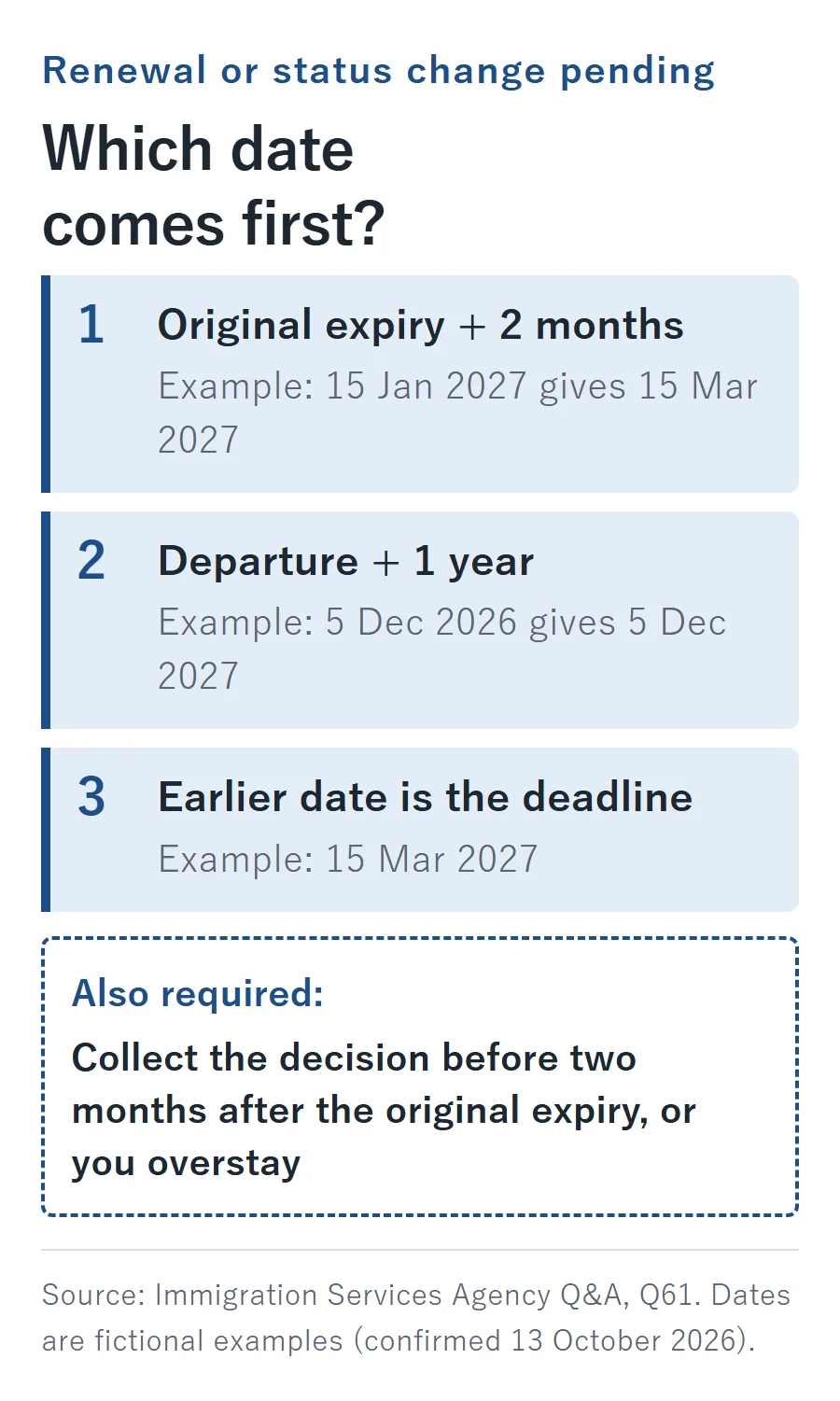
There is another task after returning: receive the decision at the office handling your application before two months have elapsed after the original expiry. The agency warns that remaining in Japan beyond that point constitutes overstaying even if the application is still pending.
Source: Immigration Services Agency – immigration Q&A, Q61, result collection and overstay warning, Japanese (confirmed 13 October 2026).
How would those deadlines look on a calendar?
Use the original residence expiry as the starting date for the pending-application calculation, then keep the decision-collection requirement visible beside the return deadline. For example, assume a resident leaves under special re-entry permission while a renewal application is pending:
- Departure: 5 December 2026.
- Original authorized-stay expiry: 15 January 2027.
- Two months after that expiry: 15 March 2027.
- One year after departure: 5 December 2027.
- Earlier return deadline: 15 March 2027.
Source: Immigration Services Agency – immigration Q&A, Q61, rule applied to the fictional dates above, Japanese (confirmed 13 October 2026).
These are fictional dates illustrating Q61, not an additional period granted to everyone leaving Japan. In this example, the residence-based deadline comes before the departure-based anniversary, so the earlier date governs the return.
Decision collection is still a separate obligation: the resident must receive the result before the point two months after the original expiry, rather than treating arrival on the return deadline as completion of the process. Build the itinerary around completing both actions, without assuming the office visit happens automatically when you enter Japan.
Source: Immigration Services Agency – immigration Q&A, Q61, decision-collection requirement, Japanese (confirmed 13 October 2026).
A useful calendar entry records the source of each date: departure, original residence expiry, and the result-collection limit. This prevents a planning error: using the outward flight date as the starting point for every deadline.
For someone leaving with a regular permit, Q61 instead specifies returning before that permit’s validity ends. The agency also advises remaining reachable because it can contact you about the examination while you are away.
Source: Immigration Services Agency – immigration Q&A, Q61, Japanese (confirmed 13 October 2026).
If retaining a Japanese number is part of staying reachable, the resident guide to Japanese voice SIMs and phone numbers covers the line and identity-check side of that plan.
If your pending application is for permanent residence, confirm your return and decision-collection arrangements with the Regional Immigration Services Office or the Foreign Residents Information Center before you leave.
What happens if you do not return before the deadline?
You can no longer re-enter on your current status if you miss the validity deadline. The agency’s English guidebook also requires the residence card to be handed back within 14 days when someone has departed under either permission and failed to return before it expires.
Source: Immigration Services Agency – Guidebook on Living and Working, residence-card return, English; Immigration Control and Refugee Recognition Act – Art. 26 and Art. 26-2 (confirmed 13 October 2026).
Treat the missed deadline and the card-return requirement as separate matters. Physically holding the card does not replace valid re-entry permission, and the guidebook’s instruction to surrender it is not an extension procedure. For planning purposes, the return deadline belongs on the calendar before you depart, not among tasks to investigate after an extended trip.
What if your passport or residence card is lost or renewed?
The agency provides a procedure to certify the re-entry permission’s expiry when documents are lost abroad or an old passport was taken back when a replacement was issued. A representative in Japan, such as a cohabiting relative or someone holding your authorization, can request that certification through the immigration office. The agency accepts authorization sent to the representative by fax or a similar method.
Source: Immigration Services Agency – certification of the re-entry permission deadline, Japanese (confirmed 13 October 2026).
Describe the problem precisely: missing passport, missing residence card, or replacement passport with the old one no longer available. The certificate concerns evidence of the permission’s end date; it should not be confused with asking to extend the permission itself.
If an old passport contains a valid re-entry endorsement and you want it transferred into the replacement passport, Q14 describes a transfer-request procedure at the immigration office responsible for your address. That is a different administrative task from obtaining the deadline certificate after losing documents abroad.
Source: Immigration Services Agency – immigration Q&A, Q14, Japanese (confirmed 13 October 2026).
For someone unable to obtain a passport, the agency can issue a re-entry permit document, but the destination decides whether to accept it as a travel document.
Source: Immigration Services Agency – immigration Q&A, Q63, Japanese (confirmed 13 October 2026).
FAQ
Is special re-entry permission free?
There is no advance application, and the Immigration Services Agency lists no fee for special re-entry permission. Its published explanation does not explicitly describe the procedure as free.
Source: Immigration Services Agency – special re-entry permission, Japanese (confirmed 13 October 2026).
Do special permanent residents get longer?
Yes: for a special permanent resident holding a valid passport and Special Permanent Resident Certificate, special re-entry permission lasts two years after departure. Identify the category and its certificate together, rather than applying the ordinary residence-card row of the comparison table.
Source: Immigration Services Agency – special permanent residents and special re-entry permission, Japanese (confirmed 13 October 2026).
Can you use special re-entry permission more than once?
Yes: Q58 on the agency’s Japanese-language Q&A page sets no numerical limit on its use. For each departure under the ordinary resident route, eligibility still matters, and return is due by the earlier of one year after that departure and authorized-stay expiry.
Source: Immigration Services Agency – immigration Q&A, Q58, Japanese; special re-entry validity, Japanese (confirmed 13 October 2026).
Can someone apply for a regular permit on your behalf?
In principle, apply personally. The agency also lists approved intermediaries, lawyers or administrative scriveners who have made the required notification, and legal representatives; relatives or cohabitants can qualify when the applicant is under 16 or cannot attend because of illness or a comparable reason. Being busy with work, commuting or school does not qualify as a reason for inability to attend.
Source: Immigration Services Agency – who can submit a re-entry permit application, Japanese (confirmed 13 October 2026).
What to remember
Compare the departure-based limit with your authorized stay’s expiry; special re-entry permission cannot be extended abroad.
Arrange a regular permit before departure if that is the route you need; it does not extend your authorized stay.
Complete the departure card, state your intention to return, and handle a pending application’s return and decision-collection deadlines separately.