Bringing medication to Japan: limits, paperwork and permits

Verdict
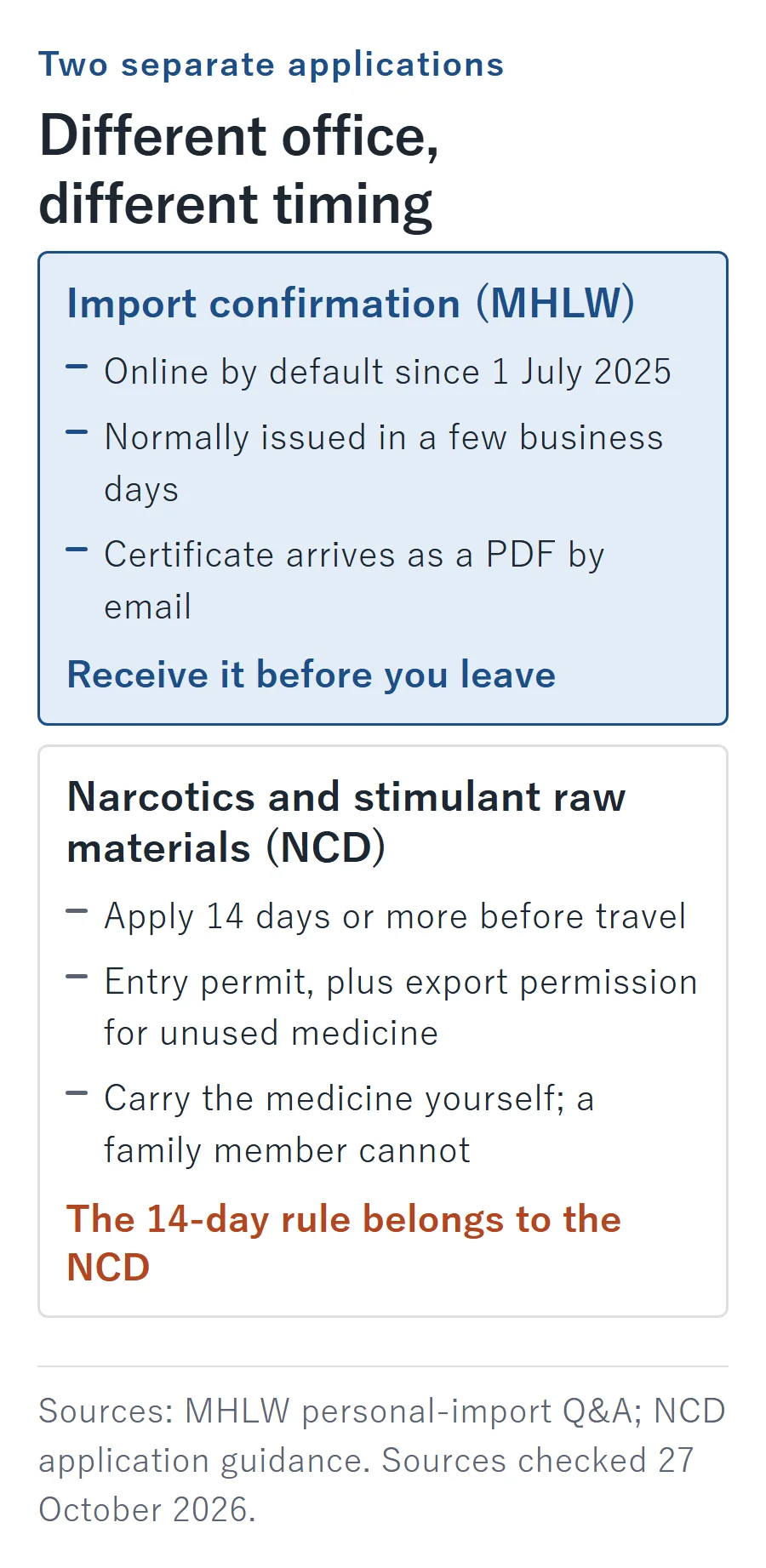
As of October 2026, identify the ingredient before counting the medicine: subject to separate substance restrictions, the import-confirmation exemptions for your own treatment cover up to one month’s prescription medicine, poisons or deadly poisons; 24 pieces per item for external medicines excluding those categories; two months of other drugs or quasi-drugs; and one month of injectables only in pre-filled syringes or self-injection kits. Above those limits, obtain an import confirmation (formerly yakkan shoumei) before departure: online applications became the default on 1 July 2025, and complete applications are normally issued in a few business days. Separately, narcotics and stimulant raw materials require advance Narcotics Control Department permission, with applications 14 days or more before travel; its official answers distinguish Adderall, which cannot be brought even with a prescription, from Vyvanse, which needs advance permission.
Source: MHLW – bringing medicines into Japan; MHLW – personal-import Q&A; MHLW – online application system, Japanese; Narcotics Control Department – application guidance (confirmed 27 October 2026).
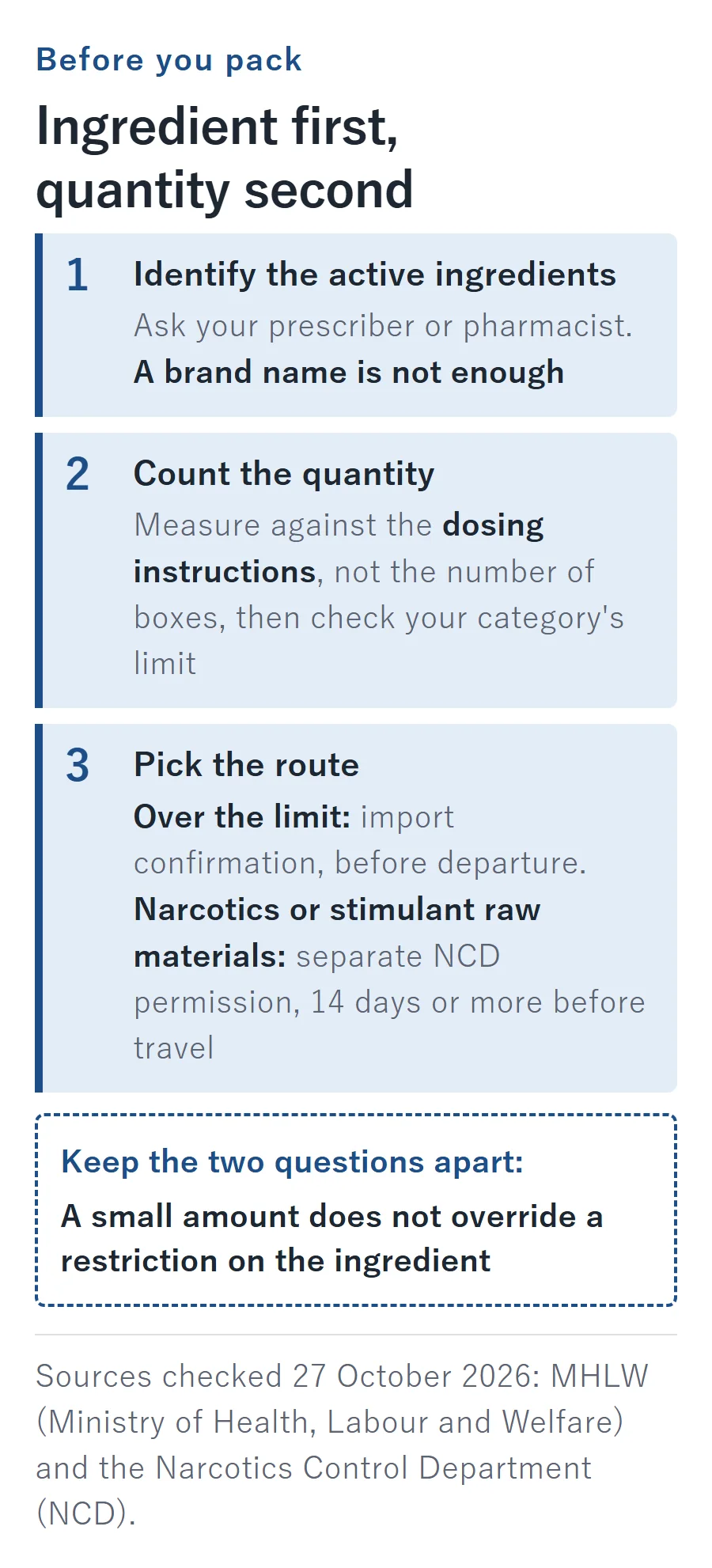
Keep the substance question and the quantity question separate. A small amount does not override a restriction on the ingredient, while a larger amount of an ordinary medicine raises a different paperwork question. Start with the active ingredients supplied by your prescriber or pharmacist, rather than searching only for a familiar brand.
Can I bring my prescription medicine to Japan without paperwork?
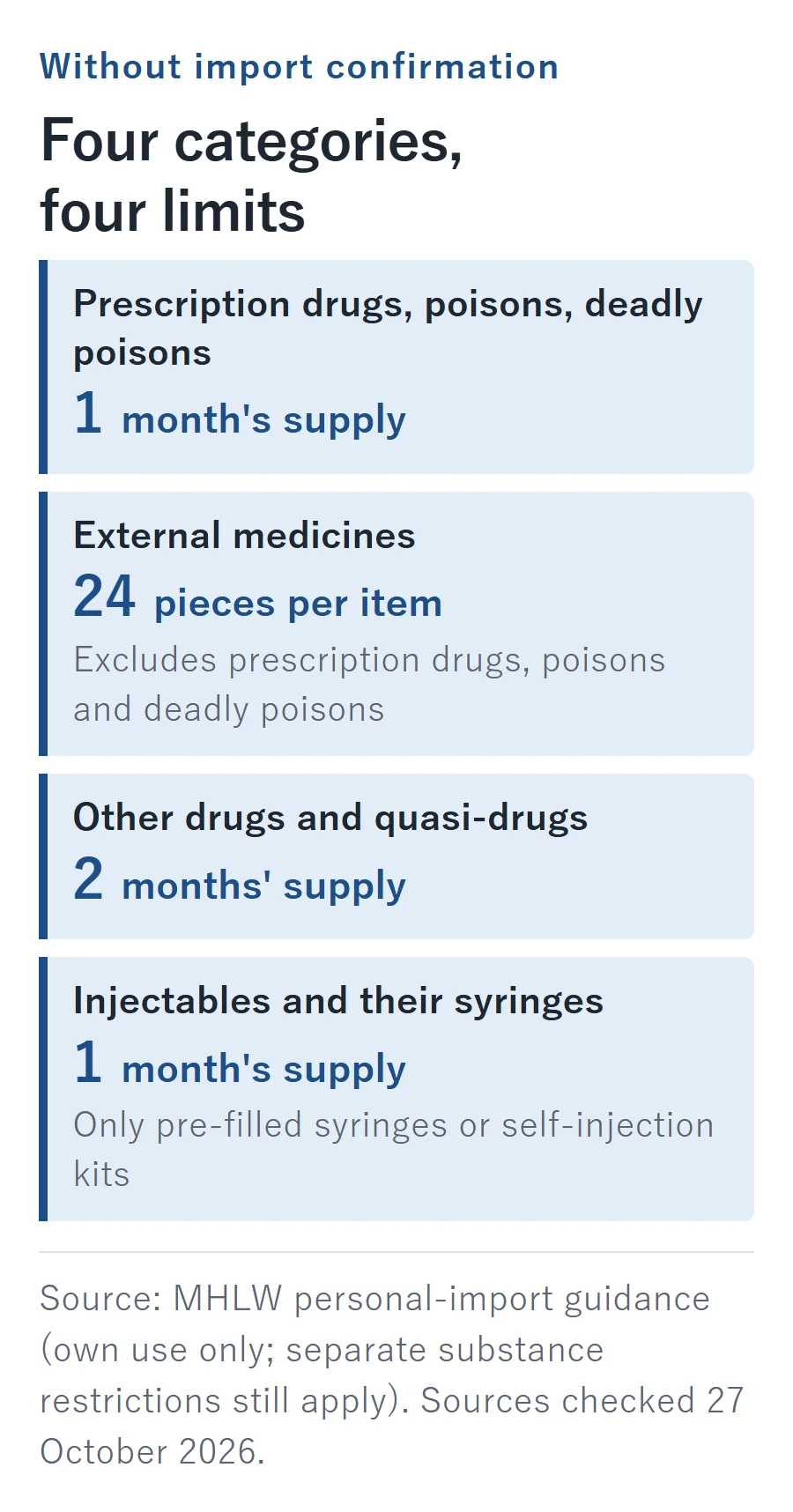
Yes, within the standard quantity limits and subject to the separate ingredient rules. The table describes exemptions from import confirmation for medicines you will use yourself, not permission for every product sold on prescription abroad.
As of October 2026, the Ministry of Health, Labour and Welfare (MHLW) gives these categories:
| Category | Limit without import confirmation | Conditions |
|---|---|---|
| Prescription drugs, poisons and deadly poisons | Up to one month's supply | For your own use; separate substance restrictions still apply |
| Drugs for external use | Up to 24 pieces per item | Excludes prescription drugs, poisons and deadly poisons |
| Other drugs and quasi-drugs | Up to two months' supply | For your own use; not a substitute for checking ingredient restrictions |
| Injectable drug and its syringe | Up to one month's supply | Only pre-filled syringes or self-injection kits; separate substance rules still apply |
Source: MHLW – personal-use quantities; PMD Act Enforcement Regulation – Article 218-2-4, Japanese (confirmed 27 October 2026).
Japan Customs qualifies the personal-use exemption with this wording:
provided that the volume of import is within a permitted scope.
Source: Japan Customs – medicine import requirements, answer 1805 (confirmed 27 October 2026).
For nonprescription purchases, establish the Japanese category rather than treating the US store shelf as the answer. The other-medicines allowance is not a blanket allowance for everything bought without a prescription overseas.
According to MHLW’s Japanese-language page, products sold abroad as foods or supplements can count as medicines in Japan because of their ingredients or claimed medical effects. Include those products in your ingredient review instead of leaving them off the packing list.
Source: MHLW – personal imports and product classification, Japanese (confirmed 27 October 2026).
For the separate issue of buying medicine during your trip, read the guide to Japan’s tax-free shopping and refund rules.
How do I count a one-month supply?
Count the contents against the medicine’s dosing instructions, not the number of boxes. The daily amount and the supply period belong together; packaging alone does not establish how long a supply lasts.
MHLW’s Japanese-language example uses two tablets per dose, taken three times daily. For a medicine in the two-month category, its calculation is (2 tablets × 3 doses) × 30 days × 2 months = 360 tablets; with 20 tablets in a box, that equals 18 boxes.
Source: MHLW – quantity calculation example, Japanese (confirmed 27 October 2026).
That example explains the counting method, not an allowance for every tablet medicine. Select the category before using its duration, and keep any separate controlled-substance restriction outside this calculation.
A useful preparation note records the ingredient, dosing instructions, total contents and intended supply period together. It gives your prescriber and the relevant office a specific quantity to discuss, rather than an ambiguous request about bringing a bottle. Do not change the prescribed dosing instructions to make the supply fit a limit.
What is the import confirmation, and is it still called yakkan shoumei?
An import confirmation is the MHLW personal-import procedure whose resulting certificate documents the required confirmation for Customs. According to MHLW’s Japanese-language page, the current certificate replaced its predecessor on 1 September 2020.
Source: MHLW – replacement of the former certificate, Japanese; MHLW – current English guidance (confirmed 27 October 2026).
The English document title is Certificate for Import Confirmation. Use the current ministry guidance to reach the application route, rather than building an application around an older form found through the former name.
The legal framework separates the requirement from its exemptions: the PMD Act establishes import confirmation in Article 56-2, while its Enforcement Regulation sets out exemptions in Article 218-2-4. Read the quantity table as a route out of that confirmation procedure, not an approval of every ingredient within those quantities.
Source: PMD Act – Article 56-2, Japanese; PMD Act Enforcement Regulation – Article 218-2-4, Japanese (confirmed 27 October 2026).
Keep this certificate distinct from an NCD permit. Applying for an excess quantity through the ordinary route does not settle a separate substance restriction. Your preparation should identify which requirement applies before you gather documents, not after you receive a certificate for a different purpose.
Source: MHLW – personal-import Q&A; NCD – separate controlled-medicine procedures (confirmed 27 October 2026).
How do I apply online, and how long does it take?
Apply before departure through the MHLW online system and receive the certificate before leaving. As of October 2026, online submission is the default, effective 1 July 2025, according to MHLW’s Japanese-language system notice.
Source: MHLW – online application system and commencement date, Japanese; MHLW – English traveler guidance (confirmed 27 October 2026).
Prepare the application around the medicine and the journey:
- Medical evidence: a valid prescription or a document from the doctor covering every medicine or medical device, identifying the patient, medicine and doctor.
- Travel evidence: an airline document, such as an itinerary or ticket copy, identifying your name, arrival date, arrival airport or port, and flight number.
- Submission: reach the current system through the ministry’s official page and submit the relevant documents.
- Receipt: when the application is accepted without problems, the certificate arrives as a PDF at the registered email address.
Source: MHLW – personal-import Q&A, A2, A4 and A5 (confirmed 27 October 2026).
Compare the attachments before submission: a medicine list without the patient’s identity or a booking without the arrival details does not supply the information described above. The medical document and travel document serve different purposes; prepare both rather than expecting one to stand in for the other.
For processing time, MHLW’s English Q&A says:
It will be normally issued in a few business days
Source: MHLW – personal-import Q&A, A7 (confirmed 27 October 2026).
That estimate assumes a complete application and excludes Saturdays, Sundays and Japanese national holidays. It is a normal processing estimate, not an arrival date promised for your certificate. The 14-day advance application guidance belongs to the separate NCD permit, not this estimate.
Source: MHLW – personal-import Q&A, A7; NCD – application timing (confirmed 27 October 2026).
For import-confirmation questions, use the Regional Bureau responsible for the arrival point: Kanto-Shin’etsu covers airports including Narita and Haneda; Kinki covers airports including Kansai, Chubu, Fukuoka and Naha. The MHLW English contact guidance directs you to the appropriate office.
According to the Japanese-language system page, both bureaus’ published telephone availability excludes the year-end and New Year closure. For holiday travel, plan to apply early in December rather than relying on late-month handling; no specific closure dates are assumed here.
Source: MHLW – regional contacts; MHLW – office availability, Japanese (confirmed 27 October 2026).
Which medicines need a separate permit from the Narcotics Control Department?
Medicines classified as narcotics or stimulant raw materials require advance NCD permission, separate from import confirmation. The NCD instructs applicants to submit 14 days or more before travel; Tokyo NCD expressly refuses last-minute applications, including requests made by phone or email.
Source: NCD – application categories and timing (confirmed 27 October 2026).
Products containing pseudoephedrine may count as stimulant raw materials depending on content. Have the prescriber establish the ingredient and take the classification question to the NCD; do not decide from a cold-medicine brand or a percentage calculation.
Source: NCD – stimulant raw materials guidance (confirmed 27 October 2026).
Build the permit request around these documents:
- Application forms: the inward-travel form and, if carrying unused medicine out afterward, the outward-travel form as well.
- Prescriber’s certificate: your name and current address, the specific medical reason, the medicines and dosages, the doctor’s signature, and an issue date within the preceding three months.
- Package photographs: pictures of your own medicine’s packaging, supplied as JPEG, PDF or Word attachments; HEIC is not accepted.
Source: NCD – required documents (confirmed 27 October 2026).
The clinical reason must explain why you take the medicine; saying only that it is for travel or personal use is insufficient. Ask the prescriber for that explanation while gathering the medicine details, rather than treating the certificate as a generic travel letter.
The NCD route accepts submission by email, fax or post. Use the NCD’s official office directory, not the ordinary import-confirmation system, for this application. Visitors apply to the office covering their arrival airport, even when departing through a different airport; residents follow the home-address rule below.
Source: NCD – certificate content, submission methods and office selection (confirmed 27 October 2026).
For emailed applications, send files as attachments rather than cloud links. When attachments exceed 10 MB, split them across emails and send a receipt-confirmation email as directed by the NCD.
Source: NCD – email attachment instructions (confirmed 27 October 2026).
The return journey belongs in the same preparation. Apply for export permission if taking unused medicine out of Japan; if no export permit is needed, state that in the application email. Carry the medicine yourself and present the applicable permit to Customs: a family member cannot carry it on your behalf.
Before contacting the office, put the amount you will bring in and the remainder you expect to take out beside the ingredient list. Identify whether you are visiting Japan or returning to your home there. That gives the office a specific product, quantity and journey to address, rather than a brand name without the details needed to choose the application route.
Source: NCD – export permission and personal carriage (confirmed 27 October 2026).
Can I bring Adderall or Vyvanse to Japan?
The NCD’s named-product answers are different: Adderall cannot be brought for treatment, while Vyvanse requires advance permission. A prescription alone does not replace the agency’s decision for either product.
For Adderall, the official answer is:
No
Source: NCD – Adderall question and answer (confirmed 27 October 2026).
The explanation identifies amphetamine, Adderall’s active ingredient, as the reason: the NCD says it cannot be imported for treatment even when prescribed abroad. Discuss an alternative treatment plan with your prescriber before travel rather than treating a smaller supply as a solution.
For Vyvanse, the official answer is:
Yes
Source: NCD – Adderall and Vyvanse questions and answers (confirmed 27 October 2026).
That answer comes with the advance-permission requirement. The NCD classifies lisdexamfetamine, Vyvanse’s active ingredient, as a stimulant raw material and provides the permit route for bringing it into and taking it out of Japan. Do not extend either named-product answer to other ADHD medicines; establish their ingredients and relevant category separately.
Source: NCD – Vyvanse explanation and classification guidance (confirmed 27 October 2026).
What about sleeping pills, anxiety medication and other psychotropics?
Use the NCD’s psychotropics table, then assess the supply period and whether the medicine is injectable. For a non-injectable psychotropic at or below the table’s quantity, NCD guidance requires neither its permission nor a doctor’s certificate; this does not remove a separate import-confirmation requirement.
Source: NCD – psychotropics instructions; NCD – List of Psychotropics (confirmed 27 October 2026).
The NCD names methylphenidate as an example of this category. Read the official psychotropics table for the relevant substance instead of using a single pill count for all sleeping, anxiety or ADHD medicines.
The action changes when any of these conditions applies:
- Above the table quantity: carry a doctor’s certificate identifying the condition, why treatment is needed, and the medicine and prescribed amount.
- Injectable form: carry that doctor’s certificate; according to MHLW’s Japanese-language page, import confirmation is also required in advance.
- More than a month’s supply: according to MHLW’s Japanese-language page, obtain import confirmation before travel; the NCD also directs you to the Regional Bureau for this situation.
Source: NCD – psychotropics documentation; MHLW – psychotropics requirements, Japanese (confirmed 27 October 2026).
If the table amount is exceeded, the supply exceeds a month, or the product is injectable, follow both sets of guidance before departure: resolve import confirmation with the Regional Bureau and the controlled-medicine requirements through the NCD guidance. Neither a doctor’s letter nor an NCD table entry should be treated as completing every requirement.
Do special ingredient checks also affect supplements?
Yes. MHLW publishes an additional ingredient list concerning products marketed abroad for enhanced mental performance and similar effects. According to its Japanese-language annex, products containing those ingredients require advance confirmation regardless of amount, with a specific traveler exception.
That exception covers people arriving from overseas who carry amounts within the standard personal-import limits for their own treatment during their stay in Japan. Keep all those conditions together: the list is not a blanket ban on treatment carried by visitors, and residents ordering products from abroad cannot use that carried-by-traveler exception.
Source: MHLW – ingredients requiring confirmation and traveler exception, Japanese; MHLW – English personal-import guidance (confirmed 27 October 2026).
Can I have medicine mailed to me in Japan?
Do not arrange international mail or courier delivery of psychotropics, narcotics or stimulant raw materials: MHLW’s Q&A prohibits sending these categories, so a family member cannot mail replacements if you run short. Other medicines remain subject to the personal-import quantities and ingredient-specific requirements; amounts above the ordinary limits require import confirmation. For a shipment held by Customs, MHLW describes an online application supported by the invoice, the air waybill (or the Customs postcard) and the prescription; the named importer must match the patient on that prescription. Resolve what the product contains before arranging a shipment, rather than treating a parcel as an alternative to the traveler rules.
Source: MHLW – personal-import Q&A, mailed medicines and matching names; NCD – prohibition on sending controlled medicines (confirmed 27 October 2026).
I live in Japan — do the same rules apply when I come back from a trip home?
Yes: the personal-import rules also cover medicine brought back from overseas. According to MHLW’s Japanese-language page, bringing something home is included in personal importation, so use the same quantity categories and ingredient review for the return journey.
Source: MHLW – personal imports including medicines brought back from overseas, Japanese (confirmed 27 October 2026).
For narcotics or stimulant raw materials, a Japan resident applies to the NCD office responsible for their home address. Organize the medicine permits alongside, but separately from, the re-entry permission needed for a temporary trip abroad.
Source: NCD – application office for Japan residents (confirmed 27 October 2026).
For the insurance side of receiving care as a resident, use the guide to Japanese health insurance and pension enrollment.
FAQ
Do I need to declare my medicine at customs?
MHLW’s instruction is to present the import-confirmation certificate when Customs requests it. Do not alter the certificate: changing it makes it invalid. For the separate declaration process, use the Visit Japan Web arrival and customs guide rather than treating a medicine certificate as a completed declaration.
Source: MHLW – personal-import Q&A, A6; Japan Customs – medicine import requirements (confirmed 27 October 2026).
What if I cannot finish the online application?
MHLW’s Q&A directs system-operation problems to the help desk first. If that does not resolve the issue, it describes emailing the forms and documents to the Regional Bureau responsible for the arrival point. That fallback is different from making email the default application method.
Source: MHLW – personal-import Q&A, A10 (confirmed 27 October 2026).
Does the medicine allowance cover syringes imported separately?
MHLW’s Q&A requires import confirmation for a syringe imported on its own as a medical device, even for a single syringe. The exemption for an eligible injectable medicine together with its syringe is not a general allowance for separate equipment.
Source: MHLW – personal-import Q&A, A3 (confirmed 27 October 2026).
Does an NCD application for Haneda or Narita need extra supporting documents?
The airport notice requests address evidence, such as a driver’s license or utility bill, unless the doctor’s certificate already includes your current address. For a stay longer than 90 days, it also requests supporting documents such as a visa, employment contract or acceptance letter. These supplement the application, medical certificate and package photographs.
Source: NCD – additional instructions for Haneda and Narita arrivals (confirmed 27 October 2026).
What to remember
Ask your prescriber for the ingredients, then resolve their Japanese categories with the Regional Bureau and NCD before counting the supply.
Obtain the required confirmation and permits before travel, including export permission when taking unused controlled medicine out.
Carry the medicine with the relevant documents; do not plan on mailed replacements for psychotropics, narcotics or stimulant raw materials.