Donabe clay pot guide: seasoning, rice, and induction

Verdict
For a first donabe, shortlist Nagatani-en’s Kamado-san for rice, or Mushi Nabe for steaming plus classic-pot use with its steamer plate removed. Induction users must settle compatibility before choosing a model: Nagatani-en limits its IH donabe compatibility statement to cooktops marketed in Japan. Do not buy that IH range for rice—the maker recommends against it.
Source: Nagatani-en — Iga-yaki and product introductions, Nagatani-en — FAQ (confirmed 17 September 2026).
What is a donabe?
A donabe is traditional Japanese earthen cookware designed to sit over heat. Nagatani-en, the Iga-ware maker behind the models below, explains the name:
“‘DO’ means clay, and ‘NABE’ means pot.”
Source: Nagatani-en — Iga-yaki and Nagatani-en (confirmed 17 September 2026).
The useful shopping distinction is not traditional versus modern. It is what you want the pot to do. Rice, steaming, and cooking without liquid lead to different choices within the same maker’s range. Nagatani-en describes its approach explicitly:
“Each piece of Nagatani-en’s donabe … has its speciality and is designed for a specific cooking method, such as rice cooking, steaming, smoking, etc.”
Source: Nagatani-en — product introductions (confirmed 17 September 2026).
Start with the meal you intend to repeat, not a collection of matching cookware. If rice is the reason for buying, prioritize a rice model. If steaming is the attraction but you also want classic-pot use, the removable plate in Mushi Nabe gives you a concrete reason to consider it. Appearance alone does not settle either choice.
For a kitchen purchase rather than a display piece, upkeep belongs in that decision too. Set aside a place to dry the pot and read the seasoning instructions before ordering. The same shopping discipline is useful on the preparation side: our Japanese chef knife buyer’s guide to steel, handles, and maintenance helps separate the knife you like looking at from the care routine you are willing to follow.
How do you season a donabe before first use?
Follow Nagatani-en’s medome procedure for its Iga donabe, with the maker’s stated exceptions: donabe skillets and ceramic grillware do not require it. Medome is the rice-porridge seasoning process used to fill the porous clay with rice starch before cooking.
Source: Nagatani-en — FAQ, before first use (confirmed 17 September 2026).
This is not an oil-seasoning routine. Nagatani-en explains the reason for using rice:
“As the clay is highly porous and susceptible to leaking without proper care, the rice starch formed when cooking porridge will fill the pores of the clay and prevent the absorption of water.”
Source: Nagatani-en — FAQ, seasoning (confirmed 17 September 2026).
Keep mild detergent away from the pot until medome is finished. The maker’s reason is that detergent can soak into the unsealed clay. Its procedure also requires the rinsed pot to air-dry completely before heating; heating it while still wet can cause cracking.
Source: Nagatani-en — FAQ, before first use (confirmed 17 September 2026).
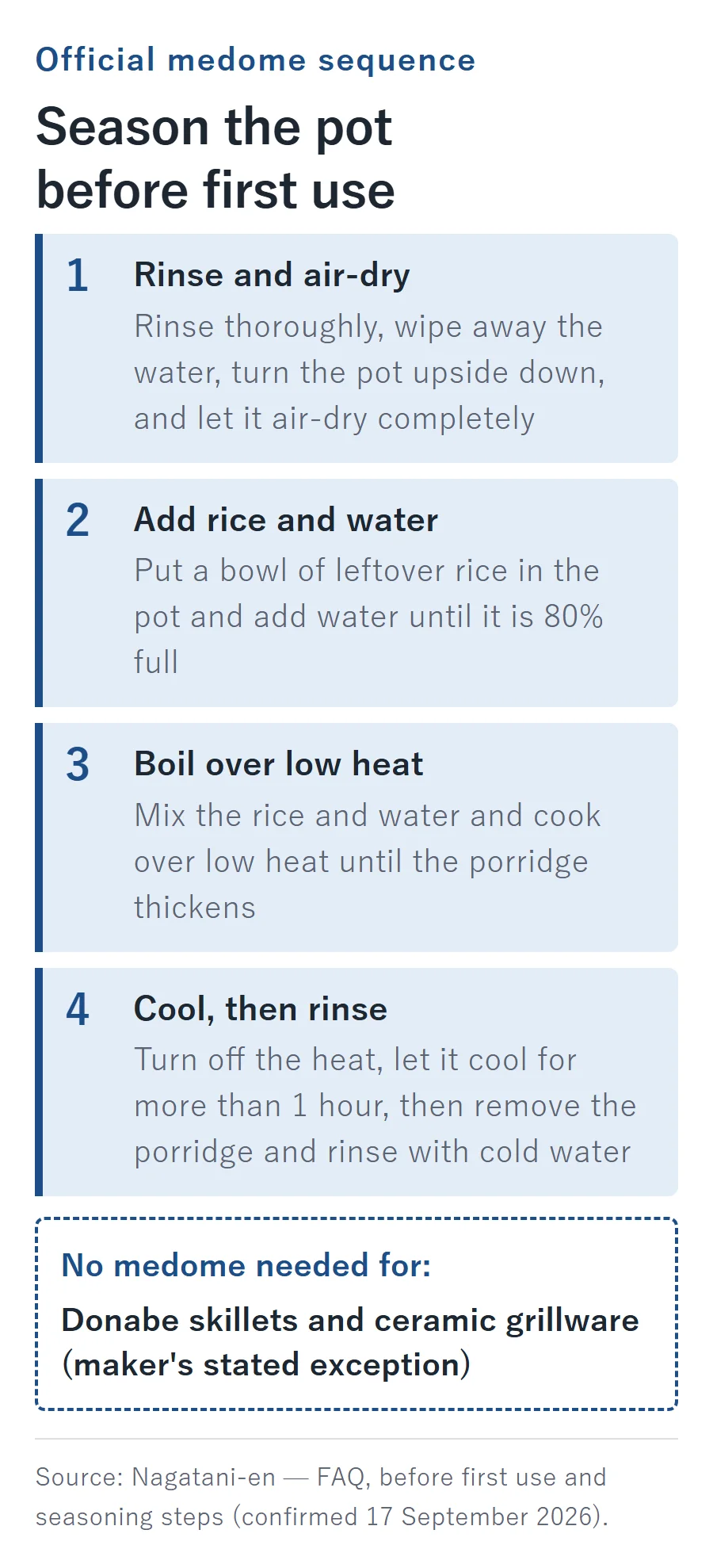
Use the official sequence:
- Rinse the donabe thoroughly. Wipe away the water, turn the pot upside down, and let it air-dry completely.
- Put a bowl of leftover rice in the pot and add water until the pot is 80% full.
- Mix the rice and water, bring it to a boil over low heat, and cook until the porridge thickens.
- Turn off the heat and let the pot cool for more than 1 hour. Remove the porridge and rinse the pot with cold water.
Source: Nagatani-en — FAQ, official medome steps (confirmed 17 September 2026).
Keep the drying stage separate from the cooking stage. A dry pot body is the starting condition; it is not permission to heat the pot empty. Likewise, the cooling instruction belongs before the final cold-water rinse, not after it. Keeping that order intact matters more than trying to turn seasoning into a quick extra step while preparing dinner.
Nagatani-en also says to repeat medome if the pot has gone unused for over two or three months. That is a return-to-use instruction, not a requirement to season after every meal.
Source: Nagatani-en — FAQ, repeating medome (confirmed 17 September 2026).
Can you use a donabe on induction?
Nagatani-en states that its standard pots cannot be used on an induction system. Its separate IH range does not establish compatibility with a US cooktop: as of September 2026, the maker limits that range’s suitability statement to cooktops marketed in Japan.
Source: Nagatani-en — FAQ, induction compatibility (confirmed 17 September 2026).
The market restriction is explicit in Nagatani-en’s English FAQ:
“This product is designed and suitable for induction cooktop marketed in Japan only.”
Source: Nagatani-en — FAQ, IH donabe (confirmed 17 September 2026).
The same answer also contains a further exclusion:
“Our IH donabe is not compatible with electromagnetic induction cooktop and low-frequency induction heater. Please refer to the user’s manual of your heating system in advance.”
Source: Nagatani-en — FAQ, IH donabe (confirmed 17 September 2026).
Those are the maker’s terms. Do not translate them into an assumed approval for a particular US heating technology. For an induction-only kitchen, identify the exact cooktop and exact pot, then obtain a manufacturer-supported compatibility answer before buying. A retailer’s use of the letters IH is not a substitute for that answer.
There is a separate restriction even within the IH range: Nagatani-en prohibits dry heating and requires water, cold or hot, inside the pot before heating. Cooktop compatibility and permitted cooking methods are separate decisions. A pot accepted for a heating system still has its own rules about what goes inside it.
Source: Nagatani-en — FAQ, dry heating an IH donabe (confirmed 17 September 2026).
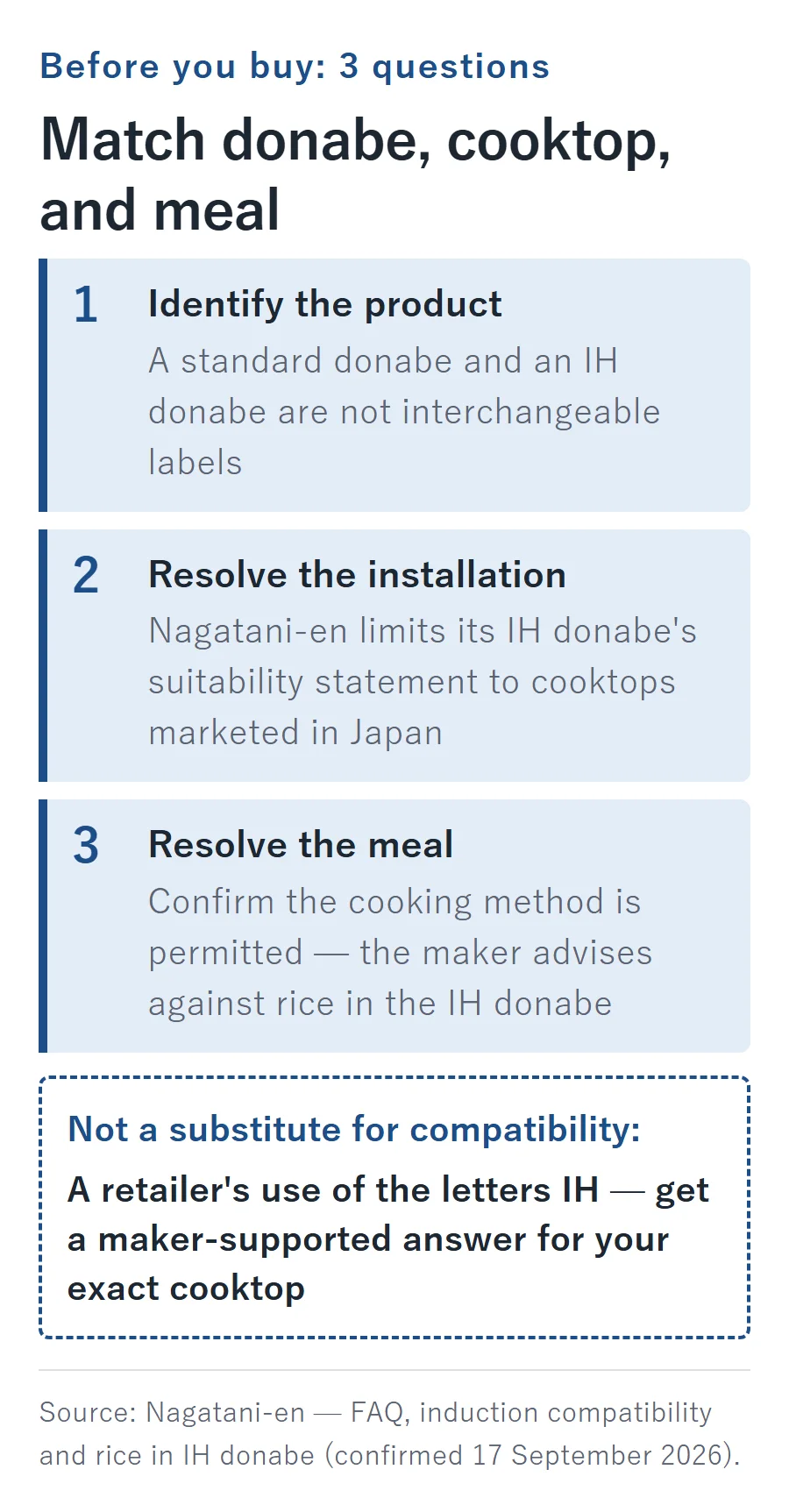
Treat the buying decision as a sequence:
- Identify the product: a standard donabe and an IH donabe are not interchangeable labels.
- Resolve the installation: match the exact model to the exact heating system using the maker’s limits, including the Japan-market restriction.
- Resolve the meal: confirm that the intended cooking method is permitted; the rice warning below is relevant even after the heating question is settled.
Do not reverse that sequence by choosing a beautiful pot first and solving the cooktop problem later. Nor does the restriction mean every induction-compatible clay pot from every manufacturer has the same limitations. These instructions concern Nagatani-en’s documented products; another maker needs its own evidence.
What should you know before cooking rice in a donabe?
Choose a rice-focused model and use the method in that model’s maker booklet. Do not use Nagatani-en’s IH donabe as the rice option: its FAQ directly advises against that use.
“We do not recommend to use IH donabe for cooking rice. It may cause breakage as the water gets dried up towards the end of cooking.”
Source: Nagatani-en — FAQ, rice in IH donabe (confirmed 17 September 2026).
That explains why adding water at the beginning does not answer the rice question. The maker’s warning concerns what happens toward the end of cooking. Do not treat the initial presence of water as an exception to the restriction.
For a rice-first shortlist, Nagatani-en identifies Kamado-san as the relevant model and describes a specific distinction from conventional donabe:
“‘Kamado-san’ is so designed that does not require readjustment of heat.”
Source: Nagatani-en — Kamado-san introduction (confirmed 17 September 2026).
That design statement is a reason to investigate Kamado-san, not a complete recipe. Follow its booklet for the cooking method instead of combining a generic rice ratio with timing taken from a different pot. The heat-readjustment statement is not a replacement for the full cooking instructions.
Keep the choice between cookware and an electrical rice cooker separate. Our guide to Japan-market rice cookers and US voltage covers the appliance route. Moving to clay cookware does not remove the need to match your cooking equipment to the heat source you actually have.
What care mistakes can damage a donabe?
For Nagatani-en’s pots, start with a completely dry pot body before heating, respect each model’s liquid requirements, and hand-wash rather than use a dishwasher. Care instructions for a dry-heat-safe model do not automatically apply to a standard moist-heat pot or the IH range.
Source: Nagatani-en — FAQ, daily care and use (confirmed 17 September 2026).
Can you heat it empty or cook with oil?
Only a model explicitly identified as dry-heat-safe permits cooking without liquid. Nagatani-en says the clay composition distinguishes its dry-heat-safe donabe from its standard moist-heat donabe; a similar shape is not evidence of the same permission.
The maker permits a little oil for cooking in dry-heat-safe donabe, but prohibits deep frying in donabe because of the fire hazard. Permission to cook without liquid is not permission to fill the vessel with frying oil.
Source: Nagatani-en — FAQ, dry heating and oil (confirmed 17 September 2026).
How should you wash and dry it?
After seasoning, Nagatani-en’s routine is hand-washing with lukewarm water, using a sponge and mild detergent for stuck food, and rinsing the detergent off promptly. Wipe the pot thoroughly, place it upside down, and air-dry it completely. The FAQ explicitly says not to use a dishwasher.
Source: Nagatani-en — FAQ, washing (confirmed 17 September 2026).
For burnt spots, the maker specifies a wooden spatula. That is a cleaning instruction, not a reason to change the model’s permitted cooking method or deliberately heat it dry to remove residue.
Source: Nagatani-en — FAQ, burnt spots (confirmed 17 September 2026).
Where should you store it and set it down?
Choose a well-ventilated, low-humidity storage place. Nagatani-en warns that the space under a kitchen sink is humid and prone to mold; for longer storage, it instructs owners to wrap the pot and the lid in newspaper as two separate pieces, rest the lid on the pot the other way up, and skip cardboard boxes.
Source: Nagatani-en — FAQ, storage (confirmed 17 September 2026).
For serving, put the pot on a stand that tolerates high heat. The maker warns against placing a steaming-hot donabe on flammable or non-heat-resistant material because it can melt, stick to the pot, or burn the tabletop. Make the serving surface part of the plan before cooking, rather than improvising once the food is ready.
Source: Nagatani-en — FAQ, trivets (confirmed 17 September 2026).
Are fine glaze lines the same as cracks?
No. Nagatani-en describes fine glaze lines called kan-nyu as a result of different expansion and contraction rates between the clay and glaze during firing, and says they do not prevent use. Its separate guidance on cracks says small cracks can be repaired through medome, while bigger cracks are not necessarily repairable.
Source: Nagatani-en — FAQ, glaze lines and cracks (confirmed 17 September 2026).
Keep those categories separate: the reassurance about glaze lines is not blanket reassurance about a damaged vessel. Equally, the possibility of treating a small crack does not establish that any size of crack can be fixed with rice porridge.
Which donabe should you put on your first-purchase shortlist?
Start with Kamado-san for rice or Mushi Nabe for steaming plus classic-pot use, after resolving the heat-source question. The remaining models below serve different priorities; the table groups them by documented function, not quality or rank.
| Maker | Model | Documented use | Distinguishing feature |
|---|---|---|---|
| Nagatani-en | Kamado-san | Rice cooking | Designed not to require heat readjustment. |
| Nagatani-en | Mushi Nabe | Steaming; classic-pot cooking | With the steamer plate taken out it works as a general-purpose pot. |
| Nagatani-en | Miso Shiru Nabe | Stir-frying and roasting | The maker expressly permits cooking without liquid inside. |
| Nagatani-en | Fukkura-san | Oven cooking | The maker expressly identifies this model as oven-safe. |
| Nagatani-en | Iga Donabe | Classic-style cookware | Traditional appearance designed for use in modern life. |
Source: Nagatani-en — product introductions (confirmed 17 September 2026).
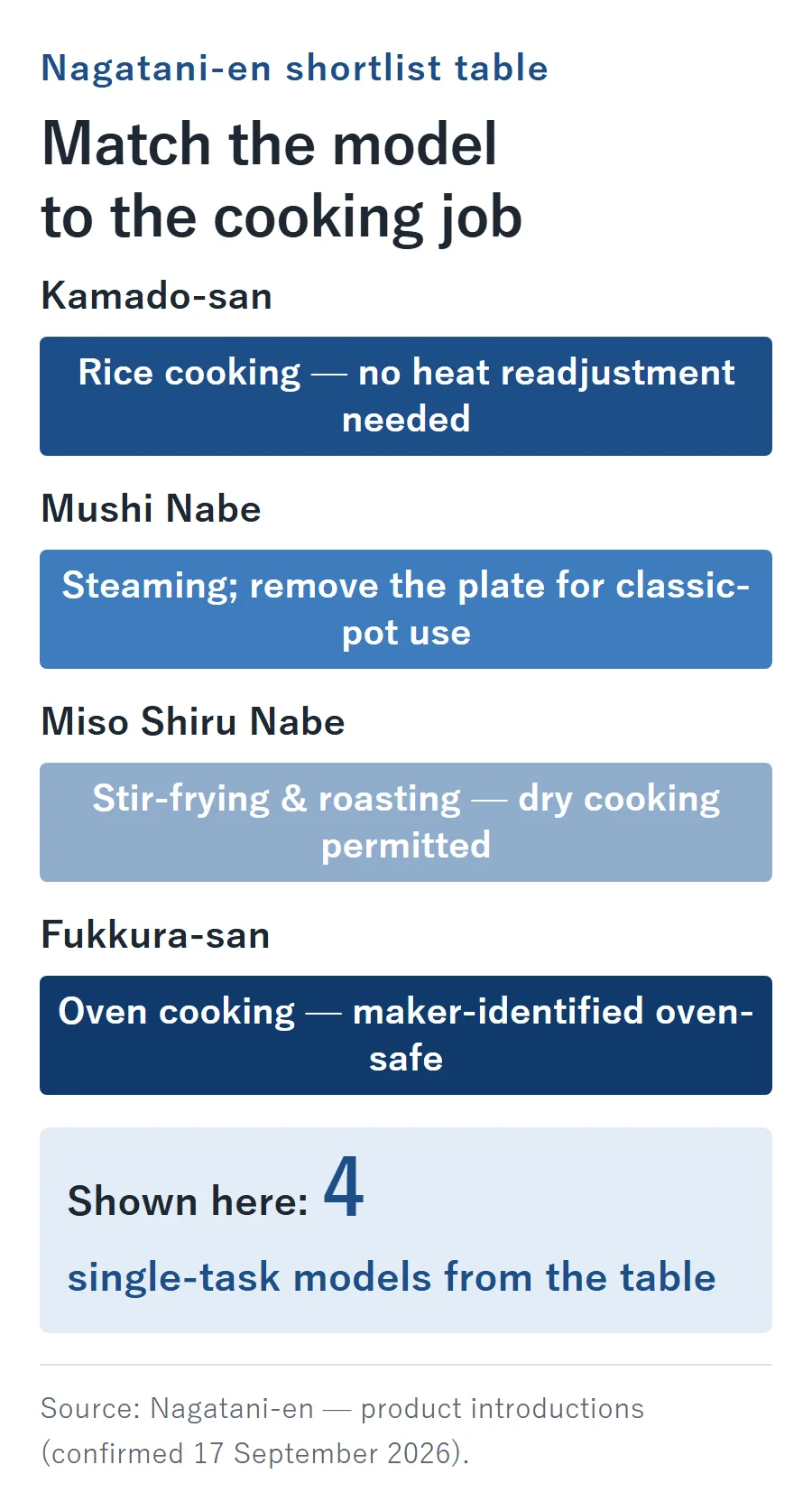
Keep each feature attached to its model. Fukkura-san’s oven statement is not evidence that every model in the table is oven-safe. Miso Shiru Nabe’s dry-cooking permission is not permission to dry-heat the IH range. These distinctions are more useful when shopping than treating the product names as interchangeable versions of the same pot.
Nagatani-en also presents Ibushi Gin for smoking, with a water reservoir between the body and lid that seals the lid. Consider that specialist only if smoking is the cooking task you want; it is not the default recommendation for a rice-and-steaming decision.
Source: Nagatani-en — Ibushi Gin introduction (confirmed 17 September 2026).
Build the purchase around a meal you already want to cook. Keep the pot decision focused on heating and cooking, and the preparation-tool decision focused on the ingredients you cut. Our santoku, gyuto, and nakiri shape guide covers that separate choice without requiring a matching set of Japanese kitchen equipment.
FAQ
Can you eat the porridge used for seasoning?
Yes. Nagatani-en says the porridge can be eaten after seasoning; that permission refers to the porridge from its medome procedure.
Source: Nagatani-en — FAQ, medome (confirmed 17 September 2026).
Can you put the donabe in a microwave?
Nagatani-en says its donabe can be used in a microwave oven. Remove any metal grate before doing so.
Source: Nagatani-en — FAQ, microwave use (confirmed 17 September 2026).
Can you leave leftovers in the pot?
Nagatani-en instructs owners to transfer leftovers promptly to another container. Its stated concern is that storing leftovers in the donabe can cause clogging.
Source: Nagatani-en — FAQ, leftover food (confirmed 17 September 2026).
Does blackish discoloration mean the pot is unsafe?
Nagatani-en says the blackish discoloration addressed in its care FAQ does not make the pot unsafe to use. That statement concerns discoloration, not the separate question of structural cracks.
Source: Nagatani-en — FAQ, discoloration (confirmed 17 September 2026).
Who is Nagatani-en’s official US agent?
As of September 2026, Nagatani-en lists TOIRO in West Hollywood, California, as its official US agent. Nagatani-en also says it does not, in principle, ship to addresses outside Japan and directs buyers to a retailer near them.
Source: Nagatani-en — FAQ, international purchases and US agent (confirmed 17 September 2026).
What to remember
Choose the cooking job first: Kamado-san for a rice shortlist, Mushi Nabe for steaming and classic-pot use with its plate removed.
Resolve induction compatibility before buying; Nagatani-en’s Japan-market IH statement is not US approval, and the maker recommends against rice in its IH donabe.
Follow the model’s medome, liquid-use, washing, and drying instructions instead of borrowing permissions from a different pot.