How to see a doctor in Japan: clinics, costs, English help

Verdict
If life is at risk, call 119; for non-emergency care, start at a local clinic, as the government advises. As of November 2026, you can attend a larger hospital without a referral, but covered hospitals add a tax-inclusive minimum of ¥7,000 for an initial medical visit without one, separate from your co-payment; emergency patients must not be charged this fee. Show a My Number health insurance card or eligibility certificate, expect a 30% share for most insured adults, with age-related differences, and look for English-language care through JNTO, the government list or Tokyo’s phone service, then call the facility before going.
Source: FDMA – Making the Most of the Ambulance Service; MHLW – special-charge leaflet, Japanese; MHLW – English insurance-card guide; Health Insurance Act – Article 74, Japanese (confirmed 3 November 2026).
Source: JNTO – medical search and visitor guidance; MHLW/Japan Tourism Agency – provider list, Japanese; Tokyo Metropolitan Government – foreign-language medical information, Japanese (confirmed 3 November 2026).
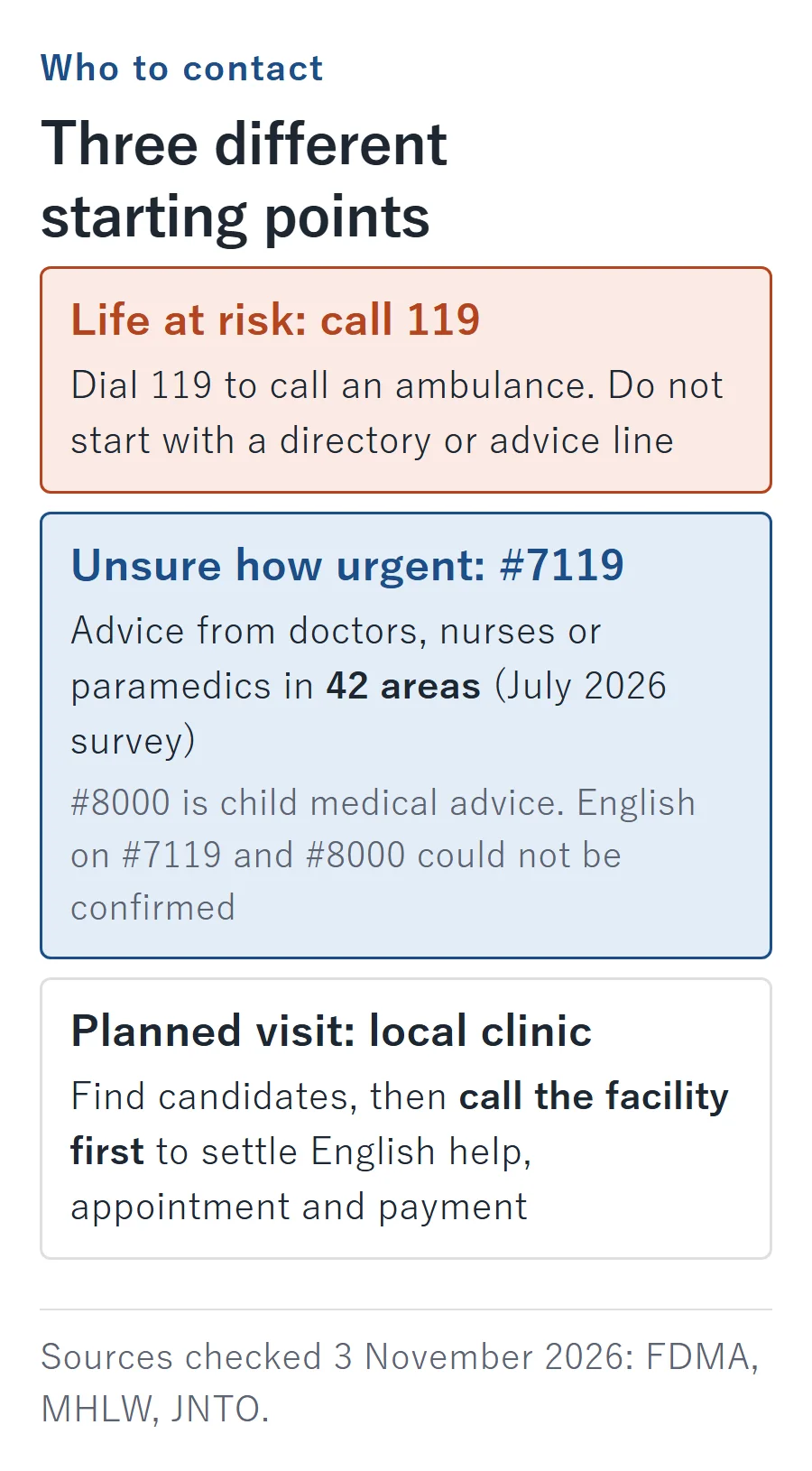
Organize a planned visit around separate questions: where to seek care, what insurance evidence to present, and how to communicate. A directory listing does not settle the appointment or payment arrangements. Use the search to find a candidate, then resolve those practical details with its reception desk.
Should I go to a clinic or a hospital in Japan?
Start with a nearby clinic for non-emergency care. The Ministry of Health, Labour and Welfare (MHLW) advises using a local provider first, with a referral onward when needed; JNTO’s English guidance also directs people toward a clinic or a general hospital within its normal hours.
Source: MHLW – local care and referrals, Japanese; JNTO – choosing a place for care (confirmed 3 November 2026).
For a GP-style visit, you can approach a clinic directly without first obtaining a referral. Ask whether it handles appointments or accepts people without one, and establish its opening hours. There is no single appointment rule to apply to every clinic.
The legal distinction concerns inpatient capacity. Article 1-5 of Japan’s Medical Care Act defines a hospital as having at least 20 inpatient beds, and a clinic as having no beds or no more than 19. A place called a clinic or iin usually falls into the latter group, but the sign alone does not establish its legal classification.
Source: Medical Care Act – Article 1-5, Japanese; JNTO – contacting providers (confirmed 3 November 2026).
If department names are unfamiliar, JNTO provides a chart connecting symptoms and departments. Use the JNTO department guide as a reference when asking the provider where to book, not as a diagnosis. For someone uncertain about the appropriate department, JNTO uses this label:
General Diagnosis and Treatment
Source: JNTO – department guidance (confirmed 3 November 2026).
Can I go to a big hospital without a referral letter?
Yes, but a covered hospital generally adds a special charge for an initial visit without a referral. A shokaijo is a referral letter issued when your doctor decides to refer you to another provider; the special charge is separate from the ordinary patient co-payment.
According to MHLW’s Japanese-language guidance, the scheme covers advanced-treatment hospitals; it also covers regional medical-support hospitals and referral-focused hospitals, with at least 200 general beds required for each of those latter categories. Hospital size alone is therefore not the complete test.
Source: MHLW – covered hospital categories and referral access, Japanese; MHLW – referral-focused hospitals, Japanese (confirmed 3 November 2026).
For medical care, the following tax-inclusive minimums remain unchanged in the 2026 revision, as of November 2026:
| Visit | Minimum special charge | Condition |
|---|---|---|
| Initial medical visit | ¥7,000 or more | Attending a covered hospital without a referral from another provider |
| Later medical visit | ¥3,000 or more | Continuing at that hospital after it has offered to refer you elsewhere |
Source: MHLW – special-charge leaflet, revision effective 1 October 2022, Japanese; MHLW – 2026 revision, outpatient-care section, Japanese (confirmed 3 November 2026).
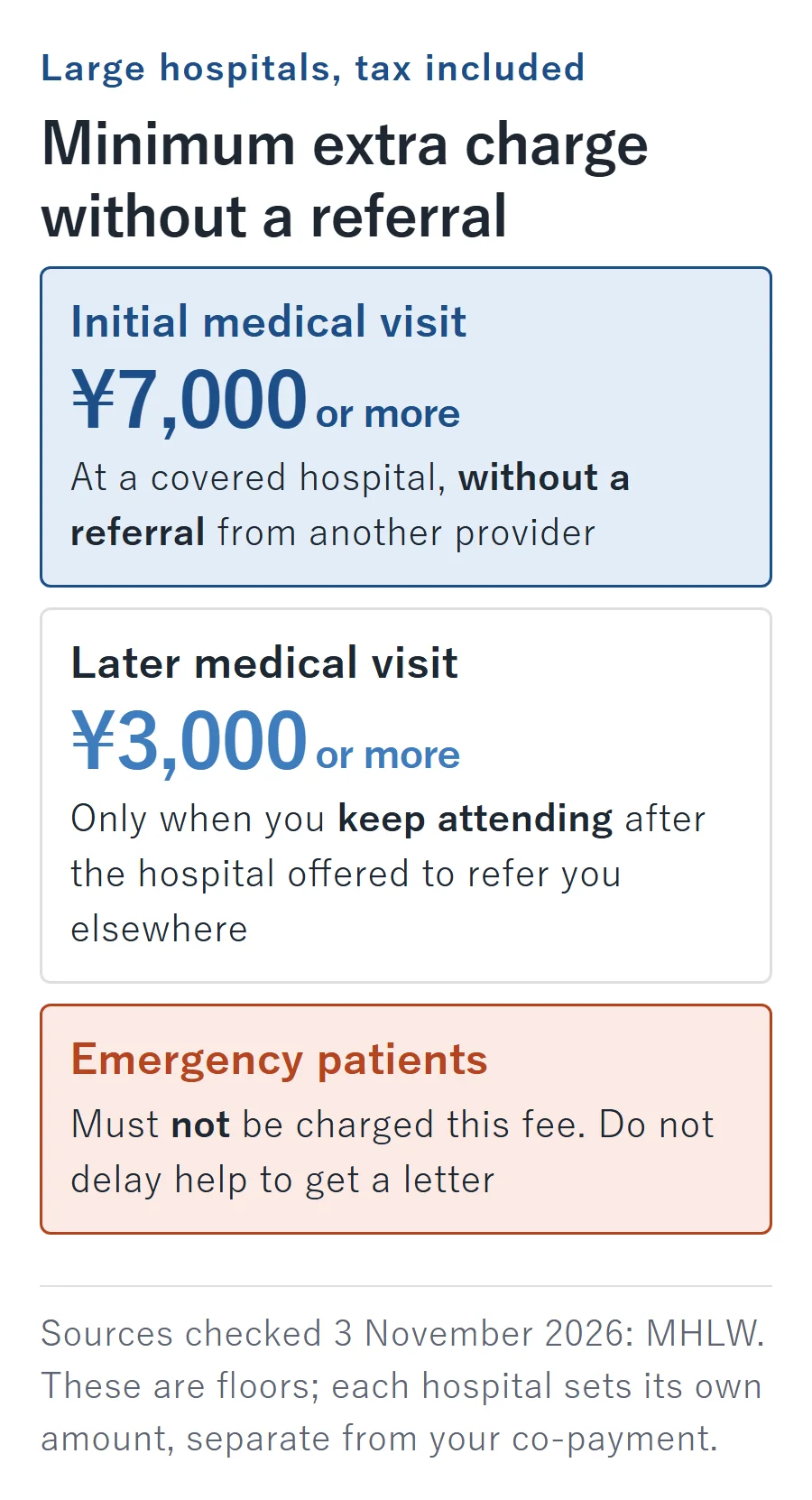
These are floors, not a hospital’s final quote: hospitals set their amounts at or above them. The later-visit condition is important—it is not a blanket extra fee for every follow-up appointment. Ask the hospital about its charge for attending without a referral before a planned visit.
MHLW says emergency patients must not be charged this special fee. Do not postpone emergency help to obtain a letter. That specific exception is different from assuming an after-hours visit automatically removes the charge: MHLW also describes discretionary exceptions, not a universal after-hours waiver.
Source: MHLW – special-charge leaflet, Q6, Japanese (confirmed 3 November 2026).
When your doctor recommends another hospital, discuss the letter with the clinic. Ask about the letter’s own charge separately rather than treating the hospital’s no-referral fee as its price.
What do I bring to the reception desk?
Pack a My Number health insurance card or Health Insurance Eligibility Certificate, details of medicines you currently take, and a way to pay. The certificate is the alternative for people without a card registered for insurance use.
As of November 2026, the old insurance card is not the document to rely on: conventional cards remained usable only through 1 December 2025 at the latest. The My Number card guide for foreign residents covers insurance-use registration, reader failures and electronic-certificate expiry.
Source: MHLW – English insurance-card guide; MHLW – English card-use leaflet; JNTO – preparing for a visit (confirmed 3 November 2026).
Keep your current medicine names and dosing schedule ready to show. JNTO links to communication sheets for reception and describing symptoms; open those resources rather than relying on improvised medical vocabulary. MHLW’s English card guide is another useful document to show at reception if the card process is confusing.
JNTO warns that a clinic can require cash, so carry yen or ask about payment before leaving. The foreign-card ATM guide handles the separate task of obtaining cash. Presenting insurance evidence and being able to settle the patient payment are different preparations.
Source: JNTO – communication resources and payment guidance; MHLW – English reception guide (confirmed 3 November 2026).
How much will I pay?
Most insured adults pay 30% of covered care, not a fixed national price per appointment. Use the patient share, any applicable special charge and the high-cost benefit as separate questions.
The Japanese-language Health Insurance Act, Article 74, and National Health Insurance Act, Article 42, set the shares below. The preschool entry is specifically the National Health Insurance provision confirmed for this guide.
| Insured group | Patient share and its condition |
|---|---|
| Children before school age | 20% under National Health Insurance, through the first March 31 on or after the sixth birthday |
| School-age children and adults | 30% from school age through the month in which you turn 70 |
| Older adults below the higher-income threshold | 20% from the month after turning 70 while under 75, when the higher-income threshold is not met |
| Older adults meeting the higher-income threshold | 30% from the month after turning 70 while under 75, when the higher-income threshold is met |
Source: Health Insurance Act – Article 74, Japanese; National Health Insurance Act – Article 42, Japanese (confirmed 3 November 2026).
People aged 75 or over use a separate system, outside this guide’s rate table. For a child’s circumstances, ask your municipality about child medical subsidies; do not read the statutory percentage as a municipality-specific quote.
For the separate questions of joining coverage and paying premiums, use the Japanese health-insurance and pension enrollment guide. At reception, ask for an estimate for the planned care. A percentage explains your share of covered costs; it does not tell you what treatment the doctor will recommend or supply a universal visit price.
Source: JNTO – requesting a treatment estimate (confirmed 3 November 2026).
What if the bill is huge?
Ask your insurer about the high-cost medical expense benefit and how to apply its ceiling at reception. This public-insurance benefit limits patient payments under the applicable category; it is not a single ceiling for every patient.
MHLW’s Japanese-language explanation gives this example: for a patient under 70 with annual income of about ¥3,700,000–¥5,100,000, care totaling ¥1,000,000 leaves a patient payment of about ¥93,000. Keep the age, income band and treatment amount attached to that illustration rather than adopting the result as your own limit.
Source: MHLW – high-cost medical expense benefit, Japanese (confirmed 3 November 2026).
As of November 2026, the system has already changed in August 2026, including an annual ceiling; a further revision is scheduled for August 2027. Use the ministry’s current explanation rather than an old income-band table.
MHLW describes using the My Number health insurance card or obtaining a ceiling-application certificate in advance to limit the counter payment. Take that question to your insurer while organizing the visit: establish the relevant category and which document you will use, instead of assuming the example amount applies automatically.
Source: MHLW – August 2026 changes, August 2027 revision and counter-payment procedure, Japanese (confirmed 3 November 2026).
Separately, filing a tax return for medical-cost deductions cancels the furusato nozei one-stop exception.
How do I find a doctor who speaks English?
Use JNTO’s search, the government’s provider list or Tokyo’s foreign-language telephone service, then call your chosen facility. Treat the directory as a way to find candidates, not confirmation that English assistance will be available for your appointment.
Start with JNTO for an English search interface. Its medical search lets you narrow by area, language and department. The distinction between a listing and an arranged visit is explicit in its advice:
When possible, please contact each medical institution before visiting.
Source: JNTO – search and advance-contact guidance (confirmed 3 November 2026).
For a planned appointment, organize the call around concrete questions: Is English support available when you intend to attend? Does the department receive patients at that time? Is an appointment required? What payment method should you bring? This turns a search result into practical arrangements without treating a language filter as a promise.
JNTO also displays JMIP, a third-party certification for providers receiving foreign patients. Certification and the language available for a particular visit are different questions; JNTO warns that a listed language is not necessarily available for every visit.
Source: JNTO – JMIP and language limitations (confirmed 3 November 2026).
Use the MHLW/Japan Tourism Agency list as another reference. As of November 2026, its Japanese-language publication page identifies 30 June 2026 as publication and 30 September 2026 as the latest listed update. It provides an Excel list of providers selected by prefectures. The publication page says the JNTO information would be updated later, so the search and spreadsheet are not synchronized references.
Source: MHLW/Japan Tourism Agency – provider list and update notice, Japanese; MHLW – explanation of the list, Japanese (confirmed 3 November 2026).
The ministry’s explanation distinguishes Category 1, providers able to handle emergency patients needing admission, from Category 2, which also includes clinics. These labels describe capacity, not a ranking or proof of English availability. Use them to understand the listing, not to choose a destination based on symptoms.
Source: MHLW – provider-list categories, Japanese (confirmed 3 November 2026).
In Tokyo, call 03-5285-8181 for healthcare information in English, with service daily from 9 a.m. to 8 p.m., as of November 2026. Tokyo’s Japanese-language service page supplies the number, languages and hours.
The same page records that the Himawari web search closed on 31 March 2024. Use the telephone service rather than planning around an old bookmark for that website; the web closure and the operating phone line are separate facts.
Source: Tokyo Metropolitan Government – foreign-language telephone service and Himawari closure, Japanese (confirmed 3 November 2026).
Who do I call at night or when I’m not sure it’s an emergency?
If life is at risk, call 119 rather than starting with a directory or advice service. The Fire and Disaster Management Agency’s English guide gives the instruction directly:
Dial 119 to call an ambulance
Source: FDMA – Making the Most of the Ambulance Service (confirmed 3 November 2026).
For the handover when responders arrive, prepare what happened and when, existing conditions, your regular doctor, and the medicines you take. The agency’s booklet also lists medication, cash and shoes among things to prepare while waiting. Keep those practical preparations separate from deciding whether to call: they are not a reason to postpone an emergency call.
Source: FDMA – preparation and information for arriving responders (confirmed 3 November 2026).
For uncertainty about urgency, #7119 connects callers with advice from doctors, nurses or paramedics in participating areas. As of November 2026, the agency’s Japanese-language page reports 42 areas, based on its July 2026 survey. The short code is not available everywhere; some areas provide advice through another number.
Source: FDMA – #7119 coverage and purpose, Japanese (confirmed 3 November 2026).
#8000 is the child medical-advice number. English support on #7119 and #8000 could not be confirmed from the cited official guidance. Arrange Japanese-language help for an advice call when needed, rather than assuming that an English guide establishes the telephone service’s languages.
Tokyo’s #7119 service operates around the clock throughout the year. That Tokyo schedule is not a nationwide schedule for either advice number.
Source: MHLW – child medical advice, Japanese; Tokyo Fire Department – #7119 service, Japanese; FDMA – English emergency guidance (confirmed 3 November 2026).
For the fire agency’s guidance on symptoms requiring urgent action, read its English emergency booklet. As JNTO explains, arrangements for receiving patients outside normal hours are local; do not infer a particular reception desk’s hours from the word hospital alone.
Source: JNTO – after-hours arrangements (confirmed 3 November 2026).
What happens during the visit, and where do I get my medicine?
Expect reception, a questionnaire, the doctor’s consultation, payment and then dispensing if medicine is prescribed. JNTO’s visit guide separates the clinical visit from the pharmacy purchase.
- Reception: present your insurance evidence and raise the language and cost questions prepared before coming.
- Questionnaire: complete the medical-information form, keeping your current medicine information ready to show.
- Consultation: discuss your concerns and medicines with the doctor, then receive the resulting care and any prescription.
- Clinic or hospital payment: settle the provider’s bill rather than assuming it includes an outside pharmacy purchase.
- Dispensing: hand the prescription over when collecting medicine through a pharmacy, paying its charge separately. JNTO also notes that some providers dispense medicine themselves.
Source: JNTO – visit sequence and separate dispensing payment (confirmed 3 November 2026).
The pharmacy step has a deadline. Under Article 20 of the Japanese insured-treatment regulation, prescriptions generally remain valid for four days, counting the issue date. Keep dispensing in the visit plan instead of treating the prescription as paperwork to deal with later.
Source: 保険医療機関及び保険医療養担当規則 – Article 20, Japanese (confirmed 3 November 2026).
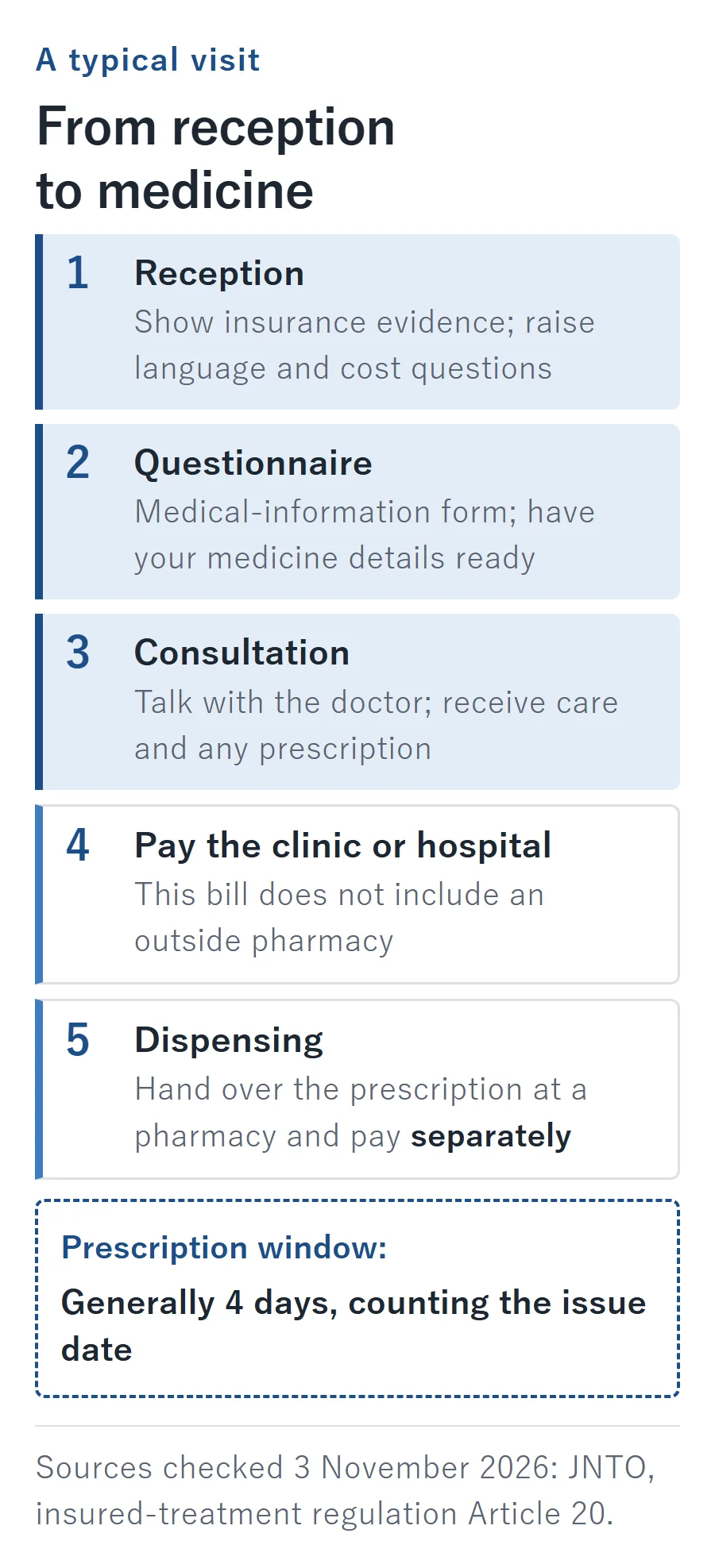
Distinguish the documents by their jobs: insurance evidence is for reception, a referral carries the move between providers, and the prescription belongs to the dispensing step. Keeping those jobs separate helps you ask the relevant desk about the next action without confusing hospital access with collecting medicine.
I’m a tourist without insurance: what should I know?
Be prepared for the possibility of paying the entire treatment bill, and ask reception for an estimate. JNTO warns about full payment when a visitor has no travel cover.
Ask for a general estimate of the treatment cost at reception.
Source: JNTO – visitor insurance and treatment estimates (confirmed 3 November 2026).
Bring your travel-insurance details if you have coverage. Show information about medicines you take, while using the separate guide to bringing medication into Japan for the import question. A consultation in Japan and permission to bring medicine across the border are different tasks.
As of November 2026, JNTO’s Japan Visitor Hotline is 050-3816-2787, answering in English, Chinese and Korean, 24 hours daily throughout the year. It is a visitor-assistance contact, not a substitute for emergency dispatch. JNTO says booking appointments and connecting a three-party interpreted call are generally outside its service.
Source: JNTO – Japan Visitor Hotline and service limits (confirmed 3 November 2026).
Arrange a way to make telephone calls; the guide to Japan eSIMs with a phone number covers that separate connectivity decision.
Do not leave an unpaid bill unresolved. MHLW’s Japanese-language provider guide states that, from 1 April 2026, unpaid visitor bills of ¥10,000 or more meet the reporting threshold. Providers participate voluntarily; the resulting reports reach immigration authorities for entry screening. JNTO warns that unpaid care can affect a later entry decision, not that every report automatically results in refusal.
Source: MHLW – visitor-patient provider guide, reporting threshold effective 1 April 2026, Japanese; MHLW – unpaid-bill information sharing, Japanese; JNTO – unpaid bills and later entry (confirmed 3 November 2026).
FAQ
Is hospital free in Japan?
No: public insurance ordinarily leaves a patient payment. The emergency exception to the no-referral special charge concerns that charge specifically; it does not establish that the whole visit is free.
Source: Health Insurance Act – Article 74, Japanese; MHLW – special-charge leaflet, Q6, Japanese (confirmed 3 November 2026).
Does #7119 speak English?
English availability could not be established from the official materials cited. For another contact route, JNTO’s guide links to prefectural consultation services; use those contacts to ask about language assistance rather than treating the short code as an English-language service.
Source: FDMA – #7119 guidance, Japanese; JNTO – prefectural consultation contacts (confirmed 3 November 2026).
Can I pay by card?
Do not plan a card-only visit. JNTO identifies larger hospitals as places accepting cards, while warning about clinics that require cash; its search also includes a card-payment filter. Use that filter to shortlist a facility, then ask reception about payment for your visit.
Source: JNTO – payment guidance and search filters (confirmed 3 November 2026).
How long is my prescription valid?
The ordinary window is four days, counting the date it was issued. Article 20 allows an exception when special circumstances, such as extended travel, are recognized; refill prescriptions have separate rules.
Source: 保険医療機関及び保険医療養担当規則 – Article 20, Japanese (confirmed 3 November 2026).
What to remember
Put emergency help first; for a planned visit, contact a local clinic and settle language and appointment arrangements.
Bring insurance evidence, medicine information and a payment method, keeping the co-payment and any special charge distinct.
Plan the pharmacy step and ask your insurer about high-cost support when organizing expensive care.