My Number card for foreigners: expiry, renewal, 2026 card

Verdict
As of October 2026, every registered foreign resident receives a 12-digit My Number, but the card requires an optional application: most mid-to-long-term residents’ cards end with their authorized stay, subject to an earlier fifth birthday after creation for those under 18 when the card was created, while permanent residents, Highly Skilled Professional (ii) holders and special permanent residents follow the Japanese-national rule below. After renewing your stay, if you keep separate cards, arrange the card extension yourself at your municipality—Nagano City says it sends no reminder for this—and track the separate electronic certificate, whose expiry is the fifth birthday following issue and whose renewal is free. The optional combined residence/My Number card has been available since 14 June 2026; for healthcare, use a card registered for insurance or a Health Insurance Eligibility Certificate, since conventional insurance cards were usable only through 1 December 2025 at the latest.
Source: Nagano City – English My Number guidance, August 2026; My Number implementing order – Articles 26 and 27, Japanese (confirmed 27 October 2026).
Source: Digital Agency – card and certificate renewal, Japanese; Immigration Services Agency – specified residence cards, Japanese; MHLW – English health-insurance guide (confirmed 27 October 2026).
Can foreign residents get a My Number card?
Yes. Being recorded in the resident register, rather than holding Japanese citizenship, is the starting point: registered foreign residents receive a number and can apply for the card.
The administrative distinction is between assignment and application. Resident registration produces the number notification; it does not complete a card application on your behalf. Decide whether to request the card after separating that choice from the fact that you have been assigned a number.
Source: Nagano City – English My Number guidance; My Number Act – Article 17, Japanese (confirmed 27 October 2026).
What is the difference between your My Number and the card?
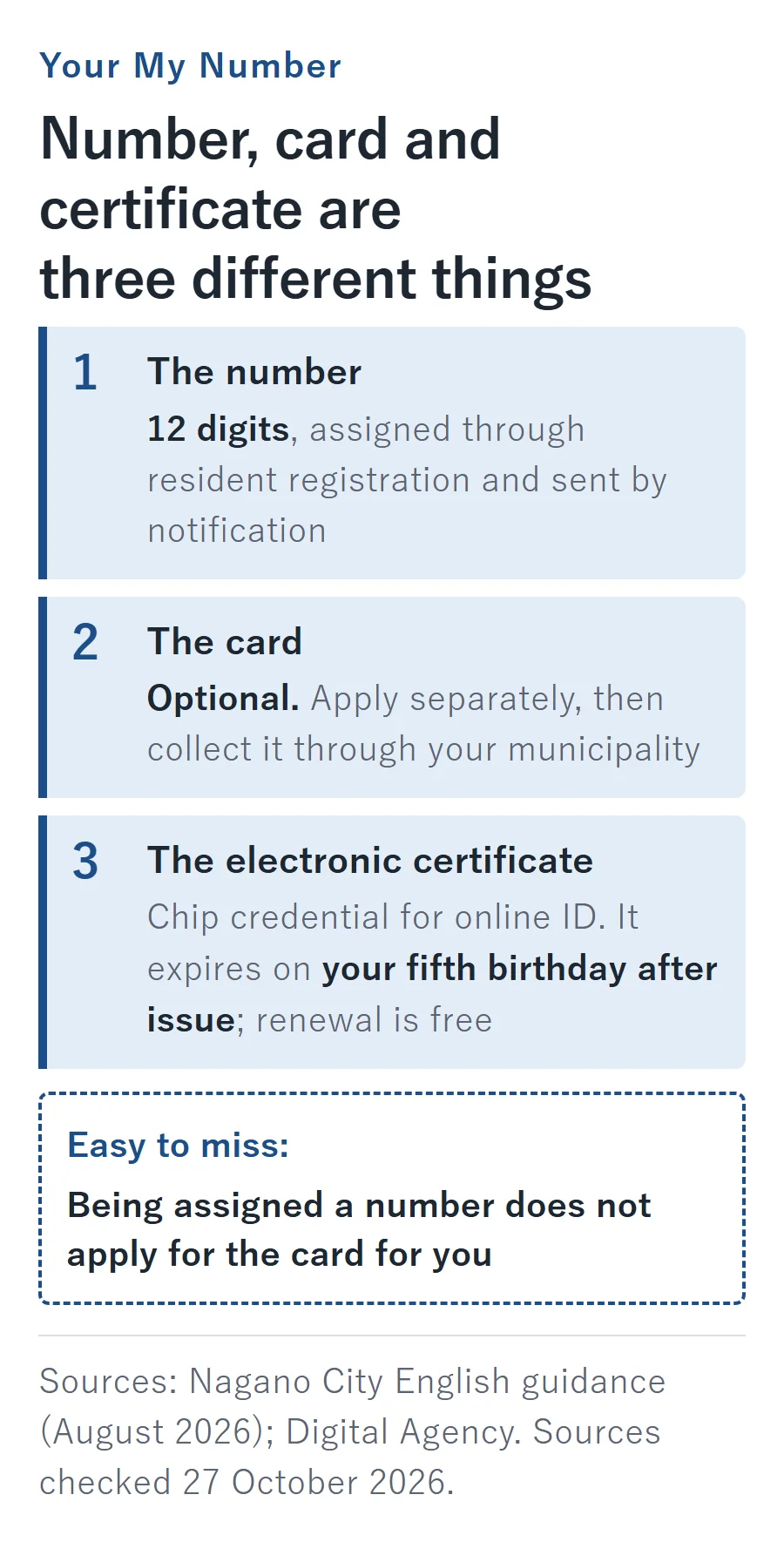
Your My Number is a 12-digit personal identifier; the My Number Card is the physical card obtained through a separate application. Keep the number, the card and its digital features distinct when reading a form or planning an office visit.
- Number: assigned through resident registration and communicated by notification.
- Card: requested separately, then collected through the municipality.
- Electronic certificate: the card-chip credential for online identification, with its own expiry to manage.
Source: Nagano City – number notification and card applications; Digital Agency – electronic certificates, Japanese (confirmed 27 October 2026).
For example, the My Number field on year-end tax-adjustment paperwork concerns the number; completing that paperwork is not a card-renewal procedure. For identity-document requirements when arranging a mobile contract, use the separate guide to resident voice SIMs and Japanese phone numbers.
How do I apply, and how long does it take?
Use the application form enclosed with your number notification, then collect the card through your municipality after the collection notice arrives. Postal mail, smartphone, computer and an ID-photo booth are the application routes listed in the Ministry of Health, Labour and Welfare’s English guide.
The same guide labels the smartphone and computer application screens as Japanese-only. Choosing an online application therefore concerns how you submit the request, not an entirely online process that removes municipal collection.
Source: MHLW – English guide, application methods; Nagano City – application and collection guidance (confirmed 27 October 2026).
Plan around the stages:
- Number notification: Nagano City’s August 2026 guidance puts this mailing roughly three weeks from initial resident registration.
- Card application: submit through a listed route using the enclosed application form.
- Collection notice: Nagano City gives about one month after applying for this notice, followed by collection at the municipal office.
Source: Nagano City – English application timetable (confirmed 27 October 2026).
Those are Nagano City’s guide figures, not nationwide processing deadlines. The intervals also start from different events: registering as a resident and applying for the card. Do not turn them into a universal arrival-to-card timetable.
Collection appointments are a local arrangement: Nagano asks people to book, and the Digital Agency also describes appointment-based pickup. Follow the collection instructions addressed to you.
Source: Nagano City – card pickup; Digital Agency – collection guidance, Japanese (confirmed 27 October 2026).
When does my card expire if I’m not a permanent resident?
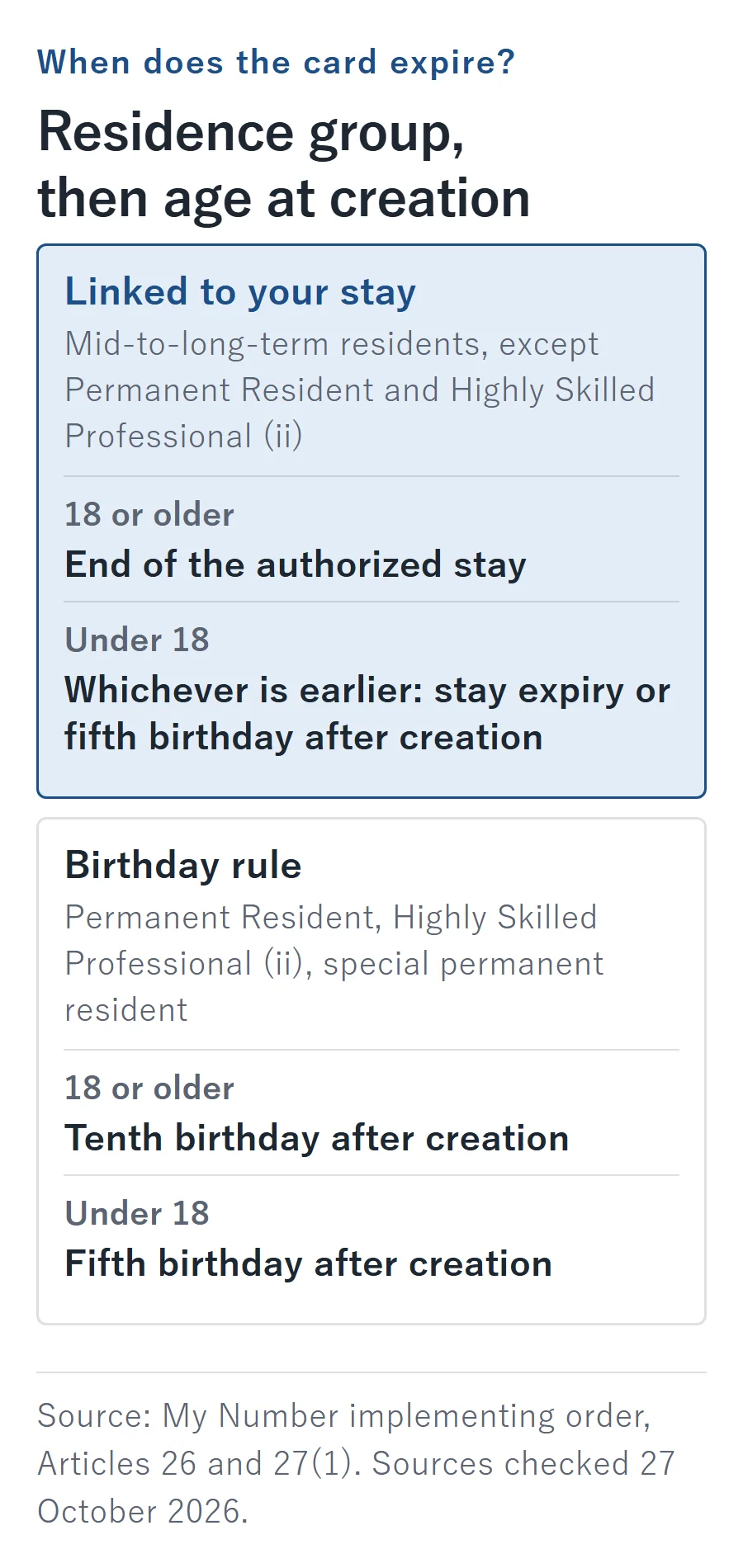
For most mid-to-long-term residents, the controlling date is the authorized-stay expiry recorded on the residence card. Article 27(1) of the My Number implementing order supplies the foreign-resident rule; Article 26 supplies the birthday-based rule for the excluded categories.
Use both residence category and age at card creation, rather than assuming every foreign resident receives a decade of validity:
| Resident group | Age when card was created | Card expiry |
|---|---|---|
| Mid-to-long-term resident, excluding Permanent Resident and Highly Skilled Professional (ii) | 18 or older | End of the authorized stay recorded on the residence card |
| Mid-to-long-term resident, excluding Permanent Resident and Highly Skilled Professional (ii) | Under 18 | Earlier of the authorized-stay expiry and the fifth birthday following card creation |
| Permanent Resident, Highly Skilled Professional (ii), or special permanent resident | 18 or older | Tenth birthday following card creation |
| Permanent Resident, Highly Skilled Professional (ii), or special permanent resident | Under 18 | Fifth birthday following card creation |
Source: My Number implementing order – Articles 26 and 27(1), Japanese (confirmed 27 October 2026).
A birthday-based limit and a residence-linked limit are different rules, not different descriptions of the same date. Record the applicable card deadline separately from the electronic-certificate deadline discussed below.
How should I read these dates together?
Start with the residence-category row, then use the age when the card was created. For an adult in the stay-linked group, the residence expiry supplies the card deadline; for a child in that group, compare it with the birthday-based limit rather than discarding either condition.
Keep a short record with the applicable category, the card deadline and the certificate deadline labeled separately. When immigration grants an extension, return to the municipal-update procedure below instead of assuming that the new residence date has already been written into the other card. This makes the next task clear without treating every expiry as a fresh card application.
Source: My Number implementing order – Articles 26 and 27; Digital Agency – separate certificate validity, Japanese (confirmed 27 October 2026).
What do I do after renewing my visa?
If you keep separate residence and My Number cards, take the municipal extension step yourself after receiving immigration approval and the replacement residence card. The immigration decision does not automatically change the My Number Card’s expiry.
Under Article 27(2) of the My Number implementing order, an eligible foreign resident may request an adjusted validity period from their municipality by presenting the card. After a qualifying extension or status change, the revised period follows the newly authorized stay, without exceeding Article 26’s birthday-based limit; becoming a permanent resident or another excluded category brings that birthday-based limit into play.
Source: My Number implementing order – Article 27(2), Japanese (confirmed 27 October 2026).
Keep the sequence clear:
- Receive permission for the extension or change of residence status.
- Receive the new residence card.
- Have the municipality amend the My Number Card’s validity before the existing card expires.
Source: My Number implementing order – Article 27(2); Nagano City – residence changes and card expiry (confirmed 27 October 2026).
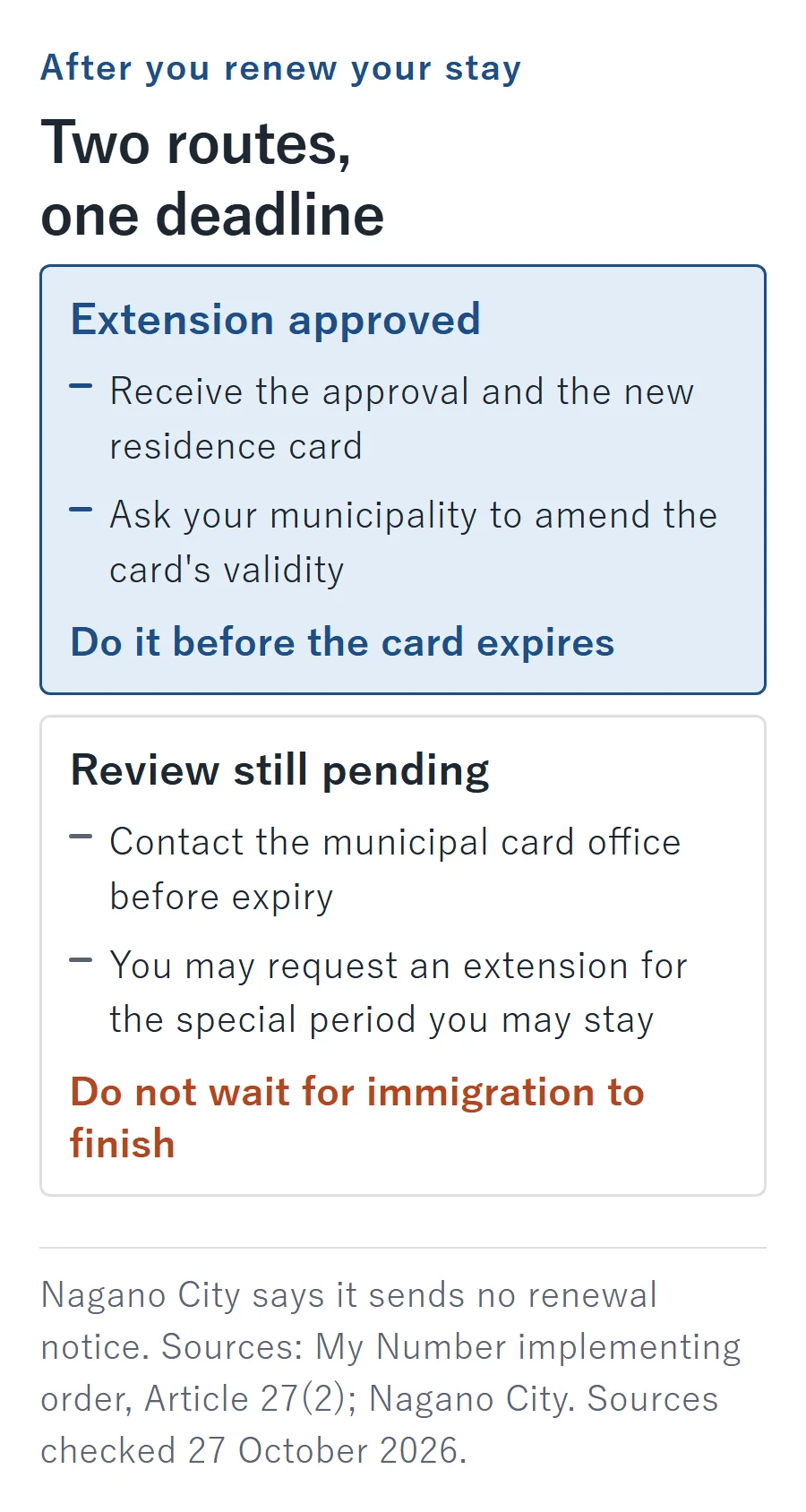
If the immigration review is still pending, Article 27(2), item 2 also permits requesting an extension for the applicable special period during which the person remains authorized to stay. Contact the municipal card office before expiry rather than waiting for immigration to finish. Use that office’s instructions for the local procedure.
Source: My Number implementing order – Article 27(2), item 2; Nagano City – pending applications (confirmed 27 October 2026).
Do not make a reminder letter your trigger. For this residence-linked procedure, Nagano City’s English guidance says:
You will not receive a renewal notification …
Source: Nagano City – English renewal guidance (confirmed 27 October 2026).
Nagano also warns that leaving the procedure undone lets the card expire, with a charge for reissuance. The warning is about replacing a lapsed card, not the cost of renewing an electronic certificate.
Source: Nagano City – expiry and reissuance (confirmed 27 October 2026).
What is the electronic certificate, and why does it expire separately?
The certificate supports online identity checks and has its own deadline: your fifth post-issue birthday, for any age group. A residence-linked card expiry can come sooner, so that certificate timetable does not grant extra validity to the physical card.
Source: Digital Agency – certificate validity, Japanese; Immigration Services Agency – My Number-function expiry, Q5-3, Japanese (confirmed 27 October 2026).
A certificate that has expired stops working for online identification, including Mynaportal, e-Tax and online bank-account opening. Think of this as maintaining digital access, separate from extending your permission to remain in Japan.
As of October 2026, certificate renewal is available at your municipality from three months before expiry, and renewal is free. Put that task on the calendar even if the card itself has a later expiry.
Source: Digital Agency – renewal window, charges and unavailable services, Japanese (confirmed 27 October 2026).
Healthcare has a specific certificate-expiry allowance: use as an insurance card continues for three months counted from the end of the month containing the certificate’s expiry date. Renew during that window; do not count it as three months from whatever day you notice the problem.
Source: Digital Agency – healthcare after certificate expiry, Japanese (confirmed 27 October 2026).
Keep this allowance separate from a residence-linked card extension. ISA warns that an expired My Number function can invalidate the authentication certificate and interrupt insurance-card use. The Digital Agency’s English page is machine-translated; its Japanese page is the reference for the renewal explanation here.
Source: Immigration Services Agency – Q5-3, Japanese; Digital Agency – Japanese renewal guidance; machine-translated English version (confirmed 27 October 2026).
Should I switch to the new combined residence card?
Switching is optional: keeping separate cards remains an available choice. The specified residence card combines residence-card and My Number functions; compare the application route, interruption to digital access and any driving-license task before choosing the format.
As of October 2026, this is an operating scheme, not a future proposal: it began on 14 June 2026, with regional immigration offices accepting applications from 15 June 2026. Registered mid-to-long-term residents can participate, and the scheme also includes special permanent residents.
Source: Immigration Services Agency – scheme commencement and eligibility, Japanese (confirmed 27 October 2026).
The Immigration Services Agency’s Japanese-language guidance sets out these practical differences:
- Office visits: receiving the combined card through an eligible immigration procedure also updates its My Number information, removing the separate municipal update for that procedure.
- Application route: apply alongside an eligible in-person residence procedure, such as an extension or status change. The residence-application online system does not accept the combined-card request; ISA also describes applications alongside municipal address notifications.
- Timing: issuance takes at least about two weeks, so this is not same-day collection.
- Digital interruption: the existing card’s electronic certificates lapse about one week before the combined card is issued. Include that interruption when planning tasks that require online identification.
Source: Immigration Services Agency – application routes, processing and certificate interruption, Japanese (confirmed 27 October 2026).
For a residence-card holder, the combined document remains a residence card, with the associated obligation to carry it. It also retains an expiry issue during a prolonged immigration review: for a holder whose My Number validity follows their stay, that function still ends at the original authorized-stay expiry. ISA instructs holders to arrange the municipal validity change before that date when the review runs beyond it.
Source: Immigration Services Agency – carrying the card and Q5-3, Japanese (confirmed 27 October 2026).
Driving-license information needs separate attention. The new combined card does not inherit existing My Number driver’s-license data; continuing that use requires recording the information again at a licensing center or equivalent office and paying the recording charge. For the different task of exchanging an overseas license, see foreign driver’s-license conversion in Japan.
Source: Immigration Services Agency – driving-license information, Q6-3, Japanese (confirmed 27 October 2026).
For combined-card issuance, ISA says receiving it during the first procedure on or after 14 June 2026 is generally fee-free. Later procedures can carry charges: the listed amounts are ¥1,900 to ISA, and ¥600 to J-LIS, or ¥800 when an electronic certificate is issued. These are procedure-dependent fee components, not a flat total for every applicant or a statement about the initial standalone My Number Card fee.
Source: Immigration Services Agency – combined-card fees, Japanese, as of October 2026 (confirmed 27 October 2026).
For bank applications, use the bank-account guide’s August 2026 snapshot of card-format acceptance. Keep that dated banking question separate from the immigration-office choice described above.
Can I receive the combined card at the airport?
No. For new arrivals receiving a residence card at an airport, ISA specifies the ordinary card rather than the combined version. The combined-card decision therefore belongs to a different application stage, rather than an option to request during landing procedures.
For someone already living in Japan, distinguish the decision to combine cards from the practical arrangement for receiving the replacement. The published processing minimum and advance certificate lapse mean submission and receipt are not the same event. If you plan to use Mynaportal or e-Tax around that transition, place those tasks alongside the expected certificate interruption when organizing the application.
Source: Immigration Services Agency – airport issuance and certificate interruption, Japanese; Digital Agency – services requiring a valid certificate, Japanese (confirmed 27 October 2026).
How do I use the card as my health insurance card?
Without a card, or without registering it for insurance use, the alternative is a Health Insurance Eligibility Certificate (shikaku kakuninsho). For the card route, register through Mynaportal or the reader at a healthcare provider.
Conventional insurance cards were usable only through 1 December 2025 at the latest, so they are not the current route as of October 2026. Joining insurance is a separate task from registering card use; the guide to Japan’s health insurance and National Pension covers the underlying enrollment systems.
Source: MHLW – English health-insurance guide; MHLW – English card-use leaflet (confirmed 27 October 2026).
For someone presenting their card for treatment without prior insurance-use registration, the MHLW leaflet states:
… you can register on the spot.
Source: MHLW – English card-use leaflet (confirmed 27 October 2026).
At reception, place the card on the reader, identify yourself through facial recognition or the four-digit PIN, then choose whether to consent to sharing the medical, medication and health-check information. MHLW says most readers display Japanese-only screens, so its English illustrated guide is useful alongside the machine.
Source: MHLW – English reception instructions (confirmed 27 October 2026).
If reading fails, show the card together with your Mynaportal eligibility screen, its downloaded PDF, or the Eligibility Notification of Health Insurance. That notification is distinct from the Eligibility Certificate used without a registered insurance card. Without either fallback, MHLW describes verbal confirmation for returning patients and an insured-status declaration form for first-time patients.
Source: MHLW – English reader-failure instructions (confirmed 27 October 2026).
Which problem am I solving at reception?
Distinguish lack of insurance-use registration from a reader failure. If you have the card but never registered it for healthcare, the on-site registration route addresses that missing step. If the reader cannot establish eligibility, use the fallback evidence described above rather than treating that technical problem as an instruction to apply for a new card.
Without the card or insurance-use registration, identify the Eligibility Certificate as your alternative document. The similarly named Eligibility Notification serves a different purpose in the reader-failure instructions: it accompanies the card. Keeping those document names distinct is more useful than assuming every insurance-related letter performs the same job.
Source: MHLW – registration and alternative certificate; MHLW – eligibility evidence when reading fails (confirmed 27 October 2026).
For certificate expiry, the healthcare allowance runs for three months from the end of the expiry month. For card and notification questions, or temporary suspension after loss, 0120-0178-27 offers multilingual assistance including English.
Source: Digital Agency – certificate-expiry allowance, Japanese; MHLW – foreign-language card assistance (confirmed 27 October 2026).
What happens to the card when I move or leave Japan?
Submit the card to the municipality alongside a moving-in notification or an overseas moving-out notification. That is the requirement in Article 17(6) of the My Number Act, not a reason to treat every trip abroad as a move out of Japan.
Source: My Number Act – Article 17(6), Japanese (confirmed 27 October 2026).
For a domestic move, include the card in the municipal moving-in task alongside your apartment-rental and move-in planning. For a temporary absence, use the separate guide to Japan’s re-entry procedures; the return-permission question and the overseas moving-out filing are distinct tasks.
If the card is lost, use the suspension line above to stop its My Number functionality temporarily. For a lost combined residence card, ISA’s Japanese guidance requires the residence-document procedure too: report the loss to police, then apply for a replacement residence card at the regional immigration office. The replacement process initially produces an ordinary residence card.
Source: MHLW – temporary suspension after loss; Immigration Services Agency – lost combined cards, Q2-2, Japanese (confirmed 27 October 2026).
Treat suspension and replacement as separate jobs. Stopping the My Number features does not complete the combined card’s residence-document replacement procedure.
FAQ
Is there a renewal notice?
Do not wait for one for a residence-linked extension: Nagano City says it sends none for that procedure. The Digital Agency’s notice arriving two to three months before expiry concerns the birthday-based card or electronic-certificate renewal cycle. Those are different triggers, so receiving ordinary renewal mail is not your reminder system for a stay-linked deadline.
Source: Nagano City – residence-linked renewal; Digital Agency – expiry notices, Japanese (confirmed 27 October 2026).
How much does it cost?
Electronic-certificate renewal is free, while Nagano City says reissuance after a missed residence-linked procedure carries a charge. A request for a replacement after lapse and a routine certificate renewal are therefore different fee questions. Combined-card issuance has its own procedure-dependent fees, described above.
Source: Digital Agency – renewal charges, Japanese; Nagano City – reissuance after expiry; Immigration Services Agency – combined-card fees, Japanese (confirmed 27 October 2026).
Can I use a My Number renewal letter to apply for the combined card?
No: ISA’s Q6-2 says the My Number Card expiry notice is not a combined-card application route. It concerns renewal of the standalone card, so keep it separate from the combined-card procedure.
Source: Immigration Services Agency – expiry notices and combined-card applications, Q6-2, Japanese (confirmed 27 October 2026).
What if my authorized stay becomes shorter?
Nagano City’s English guidance also calls for changing card validity when the authorized stay is shortened. Do not treat the municipal procedure as relevant only when immigration grants more time.
Source: Nagano City – shortened periods of stay (confirmed 27 October 2026).
What to remember
Match card expiry to your residence category and age at creation; with separate cards, arrange the municipal change after a qualifying stay renewal.
Track the electronic certificate separately and compare the combined card’s application route, processing time and interruption to digital access before choosing.
Use registered insurance-card access or an Eligibility Certificate, and include the card in moving notifications and loss procedures.