Utilities in Japan: Starting Electricity, Gas, and Water

Before the lights turn on, the stove works, or water runs in a new apartment, a resident in Japan has to deal with three separate utility systems. They may look like one moving-day task, but they do not have the same provider rules, application process, or level of English support.
The most useful distinction is simple: you can choose among retail electricity and gas companies, while water comes from the municipal water bureau covering your address. The Tokyo examples below were checked against official pages on 13 August 2026. Other regions were not checked, and this guide does not cover changing from one electricity or gas provider to another.
If you are still setting up the rest of the home, the separate guide to furnishing an apartment in Japan covers the move-in purchases that come after the essential services are arranged.
Verdict
Electricity, gas, and water are not one package. Electricity and gas are liberalized services supplied by retail companies you can choose between. Water is different: you apply to the municipality’s water bureau for your address, with no provider choice.
English support becomes thinner as you move from electricity to gas to water in the Tokyo examples checked on 13 August 2026. TEPCO Energy Partner offers a translated three-way phone call in five languages. Tokyo Gas maintains an English information hub, but its application page repeatedly warns that the linked form is Japanese only. No dedicated English start-or-stop page was found for Tokyo Waterworks.
An English explanation page does not mean the application itself is in English. The actual online application forms checked for TEPCO and Tokyo Gas were Japanese-only. For gas, also plan for a person to be present when the technician starts service; electricity does not normally require attendance.
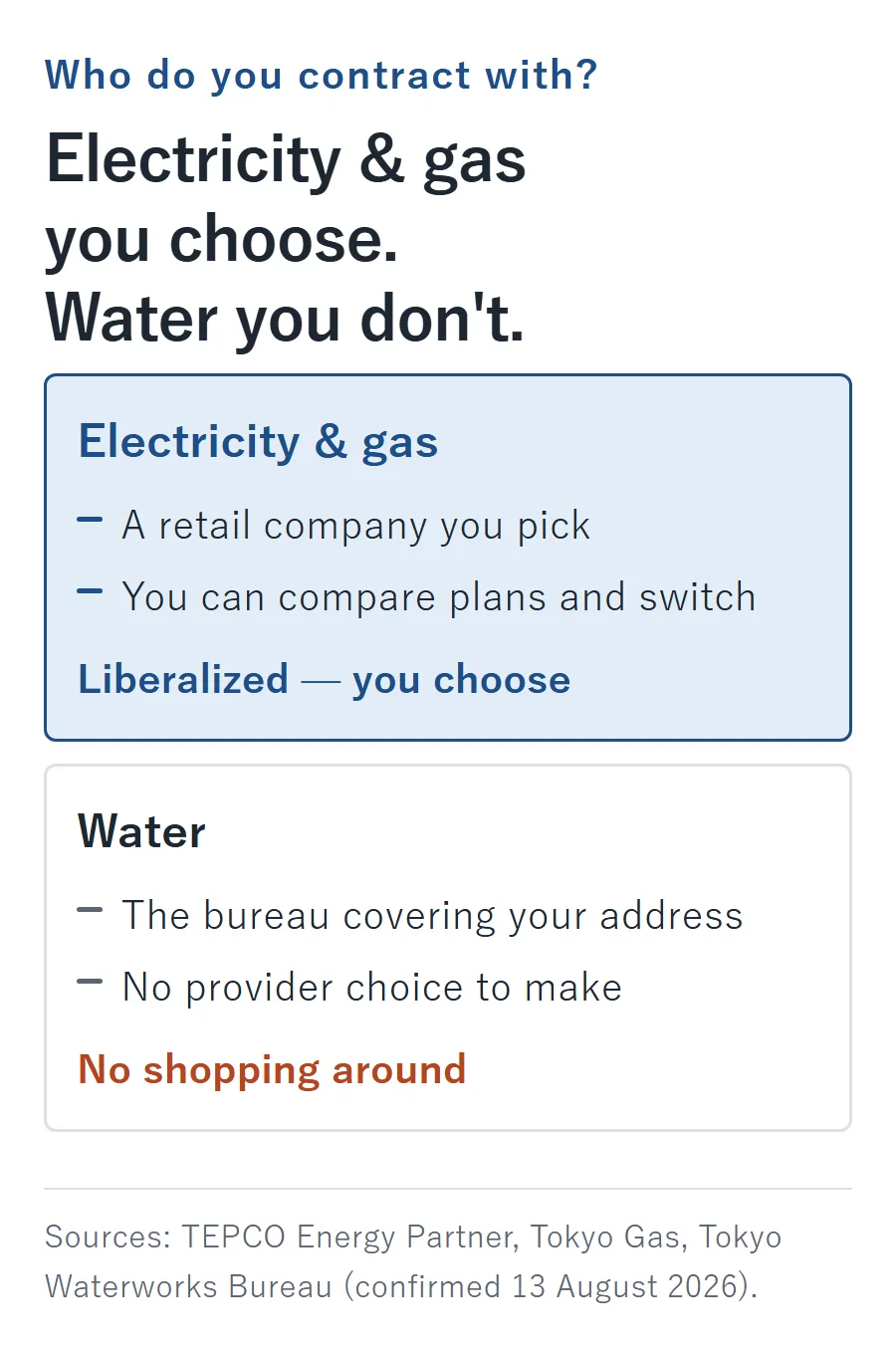
Electricity, gas, and water are three different systems
Treat the three utilities as separate appointments rather than one registration.
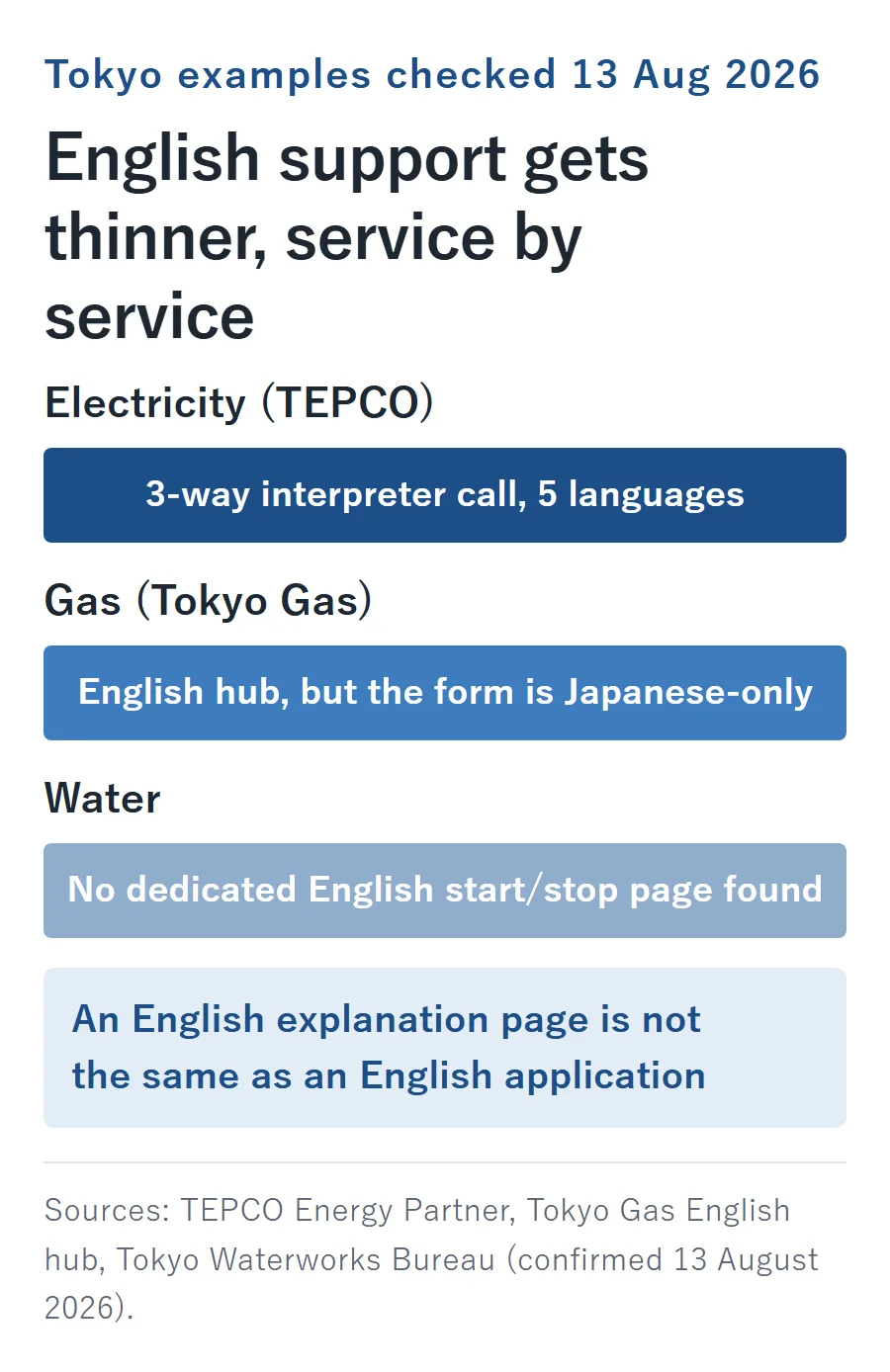
| Utility | Who you contract with | Provider choice | Tokyo English support checked on 13 August 2026 |
|---|---|---|---|
| Electricity | A retail electricity company | Yes | TEPCO EP has an English page and a three-way interpreter call; its member portal is Japanese only |
| Gas | A retail gas company | Yes | Tokyo Gas has an English hub, but the linked application form is Japanese only |
| Water | The water bureau covering your municipality | No | No dedicated English page for starting or stopping Tokyo Waterworks service was found |
Liberalization means the structure allows a resident to choose an electricity retailer and a gas retailer. It does not mean this article can identify the cheapest company: specific rates, fuel-cost adjustments, surcharges, and provider comparisons were not included in the official research pack. Current electricity charges should be checked in the provider’s own current materials; for TEPCO, consult its monthly press releases rather than relying on an older unit price quoted elsewhere.
Water follows a local boundary instead. You do not compare water companies for the same address; you contact the bureau responsible for that municipality. This is similar to how garbage rules in Japan are decided locally, although the two services have different procedures.
The rest of this guide uses TEPCO Energy Partner, Tokyo Gas, and the Tokyo Waterworks Bureau as documented Tokyo examples. It should not be read as confirmation that utilities elsewhere in Japan use the same phone numbers, forms, support languages, or procedures.
Electricity: TEPCO’s three-way interpreter line
TEPCO Energy Partner’s English page explicitly invites contract and moving inquiries:
“Feel free to contact us if you have any inquiries about electricity, gas, your contract plan, contract renewal, or if you are planning to move.”
The important detail is that the call does not begin in English. TEPCO describes the process this way:
“After you dial the phone number, you will hear a recorded message in Japanese. By pressing the number provided for each inquiry, you will be connected to an operator and can start a third-party call. The third-party call is available in English, Chinese, Korean, Portuguese, and Spanish.”
The published contact numbers depend on the kind of rate plan:
- Non-regulated rate plan: 0120-995-113, toll free
- Regulated rate plan: 0120-995-001, toll free
- Hours for both: Monday-Saturday, 9:00AM-5:00PM; closed Sundays, national holidays, and during the year-end/New Year period
A separate set of numbers applies when requesting that power be resumed after payment:
- Non-regulated plan: 0570-055-335
- Regulated plan: 03-6373-3596
- Regulated plan after hours: 03-6375-9797
These numbers are not interchangeable with a general moving inquiry, so identify the purpose of the call before dialing. The official page also distinguishes regulated from non-regulated plans; this article does not infer which one applies to a particular contract.
TEPCO’s English support has a practical limit online. Its member portal, “Kurashi TEPCO web,” is explicitly labeled “(in Japanese only),” and the actual online application form checked during the research pass was also Japanese-only. If that language barrier blocks the move-in procedure, the guide to starting to learn Japanese as an adult resident is a useful next step, while the interpreter phone line remains the documented English-access route.
No electricity unit price is listed here because the official research did not verify one, and the relevant adjustments can change. Check TEPCO’s own monthly press releases for current figures instead of treating an older guide as a live tariff.
Gas: someone has to be home to turn it on
Gas creates the biggest scheduling difference among the three services. Tokyo Gas’s English procedure page states:
“Gas — Starting service: Apply online or by phone. You (or a representative) need to be present for the technician’s visit. The technician will do an ignition test and explain safety rules.”
A representative can therefore attend if the account holder cannot, but the appointment itself still needs someone at the property. The available attendance windows are published as:
“9:00-12:00 / 13:00-15:00 / 15:00-17:00”
Those three windows are available every day, including Sundays and holidays. A later window is also listed:
“17:00-19:00”
That final window is not available on Sundays or holidays.
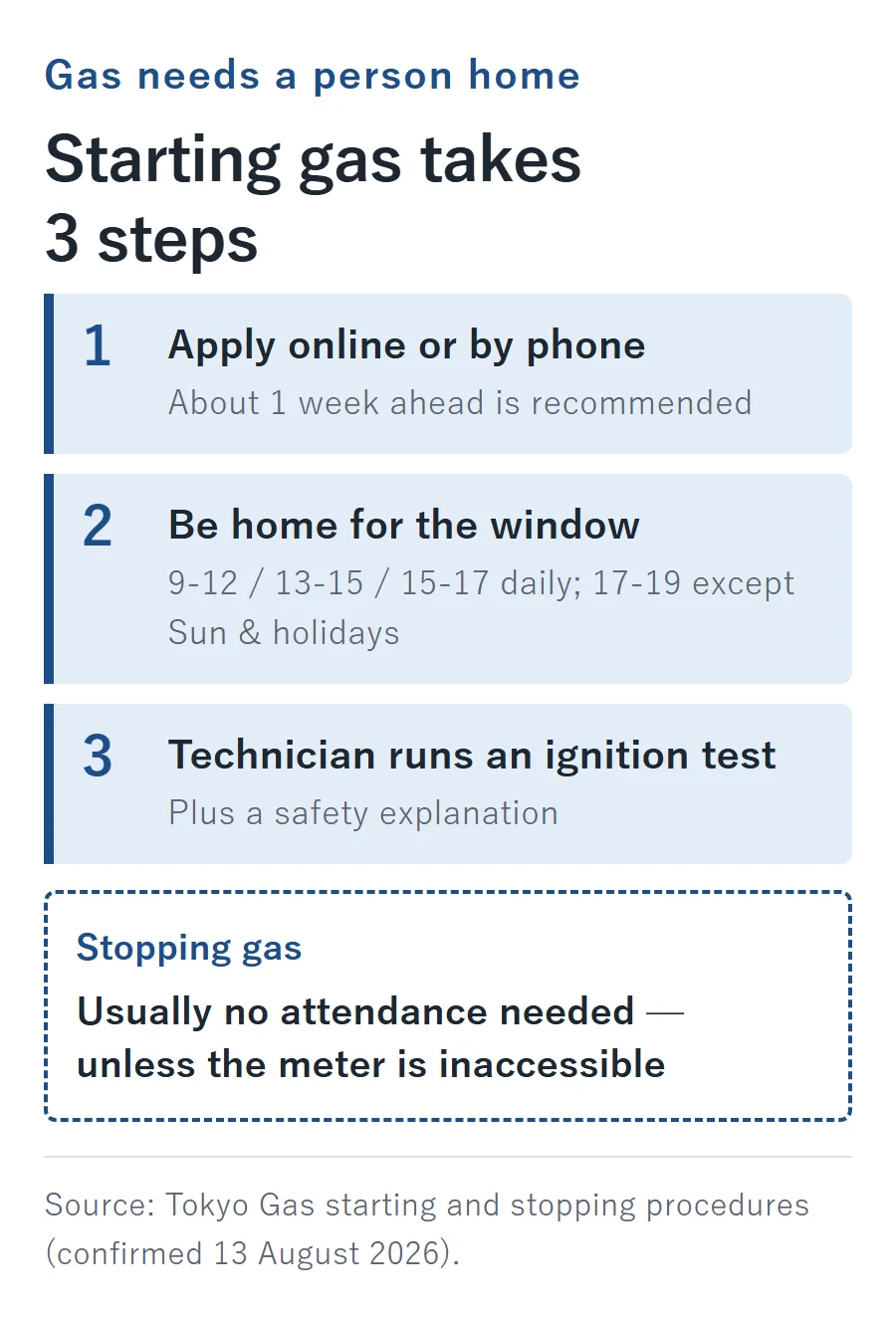
Stopping gas is usually easier, but access to the meter can change the requirement:
“Gas — Stopping service: Visit attendance is not required in general. However, attendance is required in cases where the technician cannot access the meter (such as when the building has a locked entrance).”
A resident moving out of a secured apartment building should therefore check whether the technician can reach the meter without someone opening the entrance.
Tokyo Gas recommends arranging both start and stop requests before the last minute:
“We recommend that requests to start or stop service be made at least approximately one week in advance. These requests should be made as soon as possible if planning for busy moving times (March-April, beginning/end of month, etc.).”
Its stated phone hours are:
“Monday-Saturday 9:00-19:00 / Sunday & national holidays 9:00-17:00.”
For an online request that has already been made, the published deadline for modifying or canceling a gas appointment is:
“11:59 a.m. of the day immediately preceding the scheduled work date”
For an electricity request through Tokyo Gas, the corresponding deadline is:
“11:59 a.m. of the business day”
preceding the scheduled work date.
The English hub explains procedures, payment, and emergencies, but the application pages repeatedly display this warning:
“Note: The webpage linked is available in Japanese only.”
That distinction matters: the instructions may be readable in English while the form where a resident enters the application is not. Tokyo Gas customer numbers use a four-digit, three-digit, four-digit pattern, such as 1001-001-0020, which helps identify the number when a procedure asks for it.
The English hub also includes a “Resetting Your Meter” menu item for the gas microcomputer meter’s safety shutoff after an earthquake. Use Tokyo Gas’s own English hub for that procedure. The research pass confirmed the menu’s existence but did not verify the detailed button sequence, so no reset steps are reproduced here.
Water: no choice of provider, and the thinnest English support
Water is the least complicated in terms of choosing a company because there is no choice to make. A resident applies to the water bureau that covers the address. For a Tokyo address covered by the Tokyo Waterworks Bureau, that bureau is the relevant provider; this article did not check other municipal water bureaus.
The harder part is language access. No standing English page dedicated to starting or stopping Tokyo water service was found in the official research pass. The English-language Tokyo Metropolitan Government directory page is a general introduction to the bureau’s public-relations and international-cooperation work, not a service-start application guide.
The Tokyo Waterworks site appeared to offer an “English” option that may be a machine-translation gateway, but what that link actually does was not verified. It would therefore be inaccurate to describe it as a dedicated English application page. It would also go too far to claim that no English support exists at all; the confirmed point is narrower: no standing English how-to page for starting or stopping service was found on 13 August 2026.
One billing claim deserves a specific correction. Tokyo Waterworks had a page concerning a measure that made the basic charge free, but the official page stated “本措置は終了しました” — the measure has ended — when checked on 13 August 2026. Do not plan a household budget on the assumption that Tokyo water currently has a free basic charge.
How to actually pay each bill
Payment choices depend on the utility and provider. Do not assume that a method documented for Tokyo Gas automatically applies to an electricity retailer or municipal water bureau.
For Tokyo Gas, the official English payment page lists four routes in one passage:
“Payment Methods: Credit card / Direct debit (kouza furikae) / Digital billing (‘My Payment’) — A barcode for payment is texted (SMS) to your smartphone, which you present at a convenience store counter to pay your charges in cash. / Paper bill — mailed to you, which can be paid at a convenience store or financial institution counter or via a smartphone payment app.”
In practical terms, those are:
- Credit card
- Direct debit, called kouza furikae
- Digital billing through “My Payment”, with an SMS barcode shown at a convenience-store counter and paid in cash
- A paper bill, payable at a convenience store or financial institution counter, or through a smartphone payment app
Direct debit is not immediate after the application, and the wait depends on how you apply. For a paper application, Tokyo Gas states:
“Following application, it will take around one to two months before payments start to be drawn from the designated account.”
An online direct-debit application is processed faster — Tokyo Gas’s own payment page gives a turnaround of 2 to 5 business days for that route. Either way, a resident choosing direct debit needs another way to cover bills until the withdrawal actually begins, since the page also notes that customers should keep paying by their current method during the processing period. Direct debit also normally depends on having a suitable account, so see the separate guide to opening a Japanese bank account as a foreign resident if that part of the move is not settled yet.
For credit-card billing, Tokyo Gas states:
“Your credit card account will be charged on the Tokyo Gas meter reading date or billing date. Bills and receipts are not issued.”
That makes the card statement important for keeping a payment record.
Tokyo Waterworks lists three payment methods on its Japanese official page: direct debit, credit card, and the bureau’s own app. A web version of the app also exists. Because no dedicated English service-start page was found, a resident may encounter a Japanese-language interface while arranging or managing those payments.
The research pack did not verify a complete list of TEPCO electricity payment methods. Rather than transfer Tokyo Gas’s list to a different contract, check the electricity retailer’s own current payment page when applying.
What to do before moving day
The main scheduling rule is to start early enough for a gas appointment. Tokyo Gas recommends submitting start or stop requests approximately one week in advance and applying sooner for March-April, the beginning of a month, or the end of a month. These are the periods its own page identifies as busy.
A simple Tokyo move-in sequence is:
- Identify all three providers separately. Confirm the chosen electricity retailer and gas retailer, then identify the municipal water bureau covering the new address.
- Submit the applications about a week ahead where possible. The official one-week recommendation quoted above comes from Tokyo Gas, especially for gas scheduling; this article does not assign the same deadline to every water bureau or electricity retailer.
- Reserve a gas attendance window. The account holder or a representative must be home for the technician’s ignition test and safety explanation.
- Prepare for Japanese-only forms. TEPCO and Tokyo Gas had English explanatory pages, but the actual application forms checked were Japanese-only.
- Choose a payment route and bridge any delay. A paper direct-debit application with Tokyo Gas takes around one to two months to begin; an online direct-debit application is faster, at 2 to 5 business days. Either way, do not assume the first bill will be withdrawn automatically.
- Keep the relevant phone numbers and customer number accessible. Tokyo Gas customer numbers follow the 1001-001-0020-style four-three-four digit structure.
Electricity normally does not require a person to wait for a technician. Tokyo Gas’s procedure page says:
“Electricity — Your presence is not required for technician visits when starting or stopping service. If moving out of a home, please switch off your main breaker (ampere breaker) before vacating.”
That instruction concerns electricity handled through Tokyo Gas’s published procedure. The broader useful contrast remains: starting gas needs attendance, while starting or stopping electricity does not require it under this documented Tokyo Gas process.
If plans change after an online application, remember the different cutoffs. Tokyo Gas publishes 11:59 a.m. on the day immediately before scheduled gas work, while electricity changes close at 11:59 a.m. on the preceding business day. A locked building entrance may also turn a normally unattended gas stop into an appointment requiring someone on site.
FAQ
Can I choose my electricity, gas, and water providers in Japan? You can choose among retail electricity and gas companies because those markets are liberalized. You cannot choose the water bureau for an address; you apply to the municipality’s bureau that serves it. The provider examples and support details in this guide were checked only for Tokyo, not other regions.
Can I start TEPCO electricity service in English? TEPCO EP has an English information page and a three-way interpreter call in English, Chinese, Korean, Portuguese, and Spanish. The call begins with a recorded Japanese message before connecting to an operator and interpreter. The online application form and “Kurashi TEPCO web” portal checked in the research pass were Japanese-only.
Does someone have to be home when Tokyo Gas starts service? Yes. Tokyo Gas says the account holder or a representative must be present while the technician performs an ignition test and explains safety rules. Attendance is generally unnecessary when stopping gas unless the technician cannot access the meter, such as behind a locked building entrance.
How far ahead should I arrange utilities before moving in Japan? Tokyo Gas recommends making start or stop requests approximately one week in advance and applying sooner for busy moving periods such as March-April and the beginning or end of a month. This guide did not verify one universal deadline for every electricity retailer or municipal water bureau.
How can I pay a Tokyo Gas bill? Tokyo Gas lists credit card, direct debit, digital billing through “My Payment” using an SMS barcode paid in cash at a convenience store, and a paper bill payable at a convenience store or financial institution counter or through a smartphone payment app. Direct debit takes around one to two months to begin after a paper application, or 2 to 5 business days after an online application.
Is Tokyo water’s basic charge currently free? No. The Tokyo Waterworks page for that measure stated that it had ended when checked on 13 August 2026. Current payment methods listed by the bureau are direct debit, credit card, and its own app, including a web version.
What to remember
Start with the structural difference. Electricity and gas are retail contracts where a resident can choose a company; water belongs to the municipal bureau covering the address. Do not spend time shopping for a water provider that the address cannot use.
Then plan around gas. Tokyo Gas requires the account holder or a representative to be present when service starts and recommends applying approximately one week ahead, earlier during March-April and other busy moving periods. Electricity, under the documented Tokyo Gas procedure, does not require attendance, and someone moving out should switch off the main breaker before leaving.
Finally, separate English guidance from an English application. TEPCO has the strongest documented language route here through its five-language three-way call. Tokyo Gas has a useful English hub but Japanese-only linked forms. For Tokyo Waterworks, no dedicated English start-or-stop page was found. All of those support findings, phone details, and procedures reflect official pages checked on 13 August 2026; other regions were not researched, and current provider pages should be checked before acting.
Sources: TEPCO Energy Partner official English page (confirmed 2026-08-13); Tokyo Gas starting and stopping procedures (confirmed 2026-08-13); Tokyo Gas English customer center hub (confirmed 2026-08-13); Tokyo Gas payment methods (confirmed 2026-08-13); Tokyo Waterworks Bureau payment page (confirmed 2026-08-13); Tokyo Metropolitan Government directory page for Waterworks (confirmed 2026-08-13).