Renting an apartment in Japan as a foreigner: costs and rules

Verdict
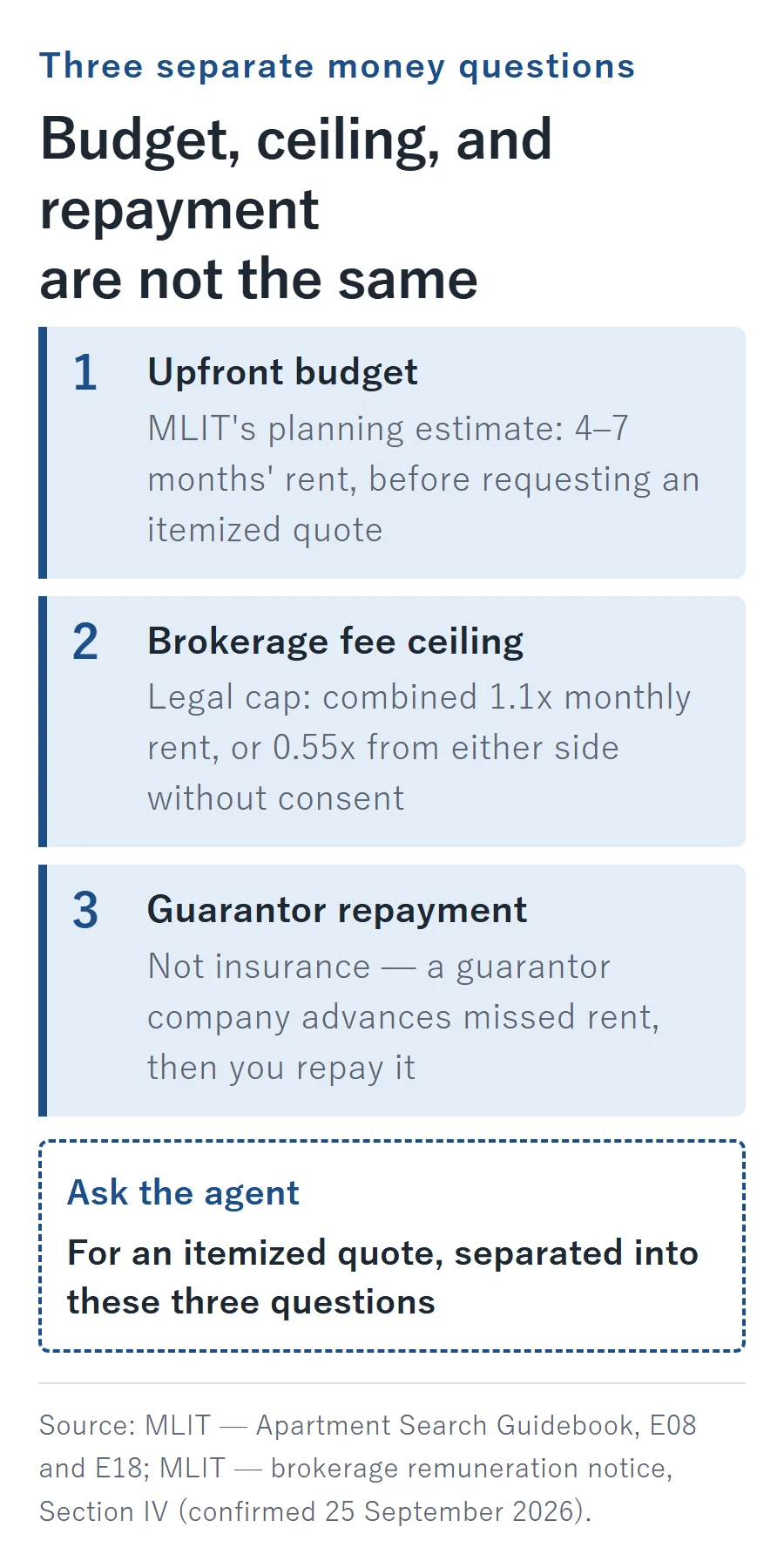
When renting an apartment in Japan as a foreigner, budget 4–7 months’ rent upfront using MLIT’s planning estimate, then request an itemized quote. Separate the brokerage ceiling in MLIT’s fee notice from charges established through your agreement. A guarantor company does not insure you against unpaid rent: MLIT explains that you repay what it advances.
Source: MLIT – Apartment Search Guidebook, E08 and E18; MLIT – brokerage remuneration notice, Section IV (confirmed 25 September 2026).
The useful distinction is not Japanese versus foreign tenants. It is money you spend, money held against obligations, and payments that remain your responsibility even after someone advances them. The official materials below were checked as of September 2026.
How does the apartment search become a signed lease?
MLIT’s Apartment Search Guidebook puts screening between the application and the contract. It gives approximately 1–2 weeks from applying to moving in, not a promise that finding a suitable apartment takes that long.
Source: MLIT – Apartment Search Guidebook, E03 (confirmed 25 September 2026).
Work through the stages rather than treating a viewing as a commitment:
- Set your requirements. Be ready to discuss work, income, household size, Japanese ability, and why you are moving.
- View the property. MLIT says viewings cost nothing and do not oblige you to apply.
- Submit the application. Bring a passport or residence card, since an agent can ask for an application that day. MLIT also lists earnings evidence and employment or student documentation among application materials.
- Wait for screening. An application precedes approval; keep those stages distinct when planning the move.
- Review, sign, and pay. The explanation of important terms comes before signing and payment; receiving the keys follows.
Source: MLIT – Apartment Search Guidebook, E03, E06 and E08 (confirmed 25 September 2026).
Expect questions about staying reachable. MLIT’s landlord guidance, Chapter 2 Q4, asks agents to establish whether an applicant has a mobile usable in Japan and a Japanese bank account. Its concern about a residence period shorter than the proposed lease is guidance for agents, not a statutory prohibition on renting. Prepare your contact details using the guide to resident voice SIMs and Japanese phone numbers.
Source: MLIT – foreign-tenant guidance, Chapter 2 Q4 (confirmed 25 September 2026).
Which upfront costs should you separate?
Start with MLIT’s 4–7 months of rent as a budgeting range, not a fixed invoice. Ask the agent to separate deposits, fees, advance rent, and shared-building charges so you can compare actual offers.
Source: MLIT – Apartment Search Guidebook, E08 (confirmed 25 September 2026).
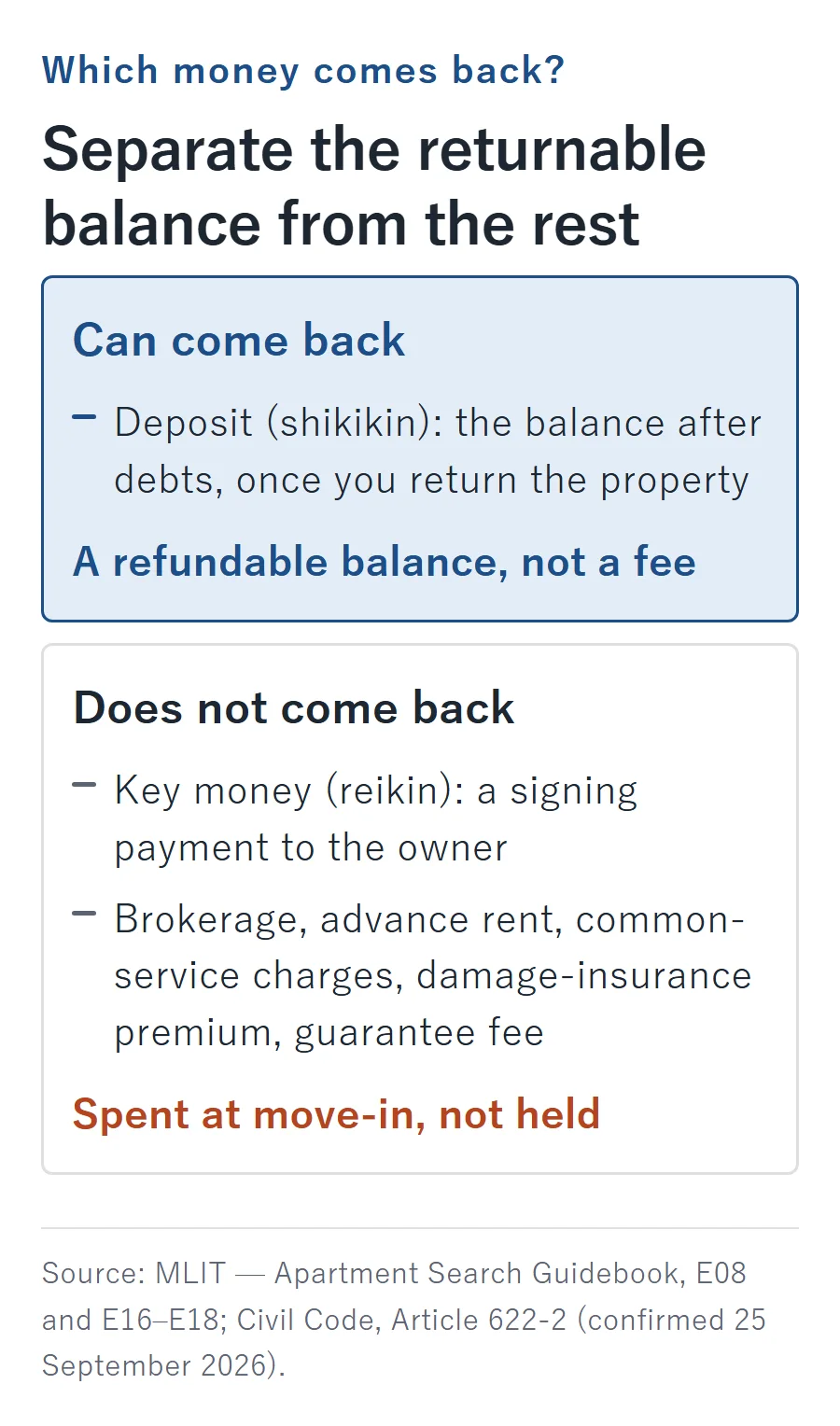
For money handed to the owner, the return rules distinguish these categories. A deposit, or shikikin, secures obligations; key money, or reikin, is a signing payment to the owner.
| Item | What it is | Law or contract? | Refundable? |
|---|---|---|---|
| Deposit | Money held against unpaid obligations | Amount in the agreement; return governed by Civil Code Article 622-2 | Remaining balance after debts, once the lease ends and the property is returned |
| Key money | Payment to the owner when signing | A charge in the agreement | No, according to MLIT's guidebook |
| Fixed deposit deduction | Shikibiki: an amount designated in advance to be kept | A clause to identify before signing | The designated deduction is retained |
Source: MLIT – Apartment Search Guidebook, E08 and E16–E18; Civil Code – Article 622-2 (confirmed 25 September 2026).
Also identify each payment that buys a service or covers occupancy:
- Brokerage: the agent’s remuneration, subject to the ceiling explained below.
- Advance rent and common-service charges: separate lines for occupancy and shared-building upkeep.
- Damage-insurance premium: MLIT describes taking out cover at signing for damage the tenant causes through fire or leaking water.
- Guarantee fee: an additional charge when using a guarantor company, distinct from damage insurance.
MLIT describes cash and bank transfers as the usual payment routes. If you intend to pay by transfer, prepare the banking side with opening a Japanese bank account as a foreign resident.
Source: MLIT – Apartment Search Guidebook, E08 and E16–E18 (confirmed 25 September 2026).
How does the law cap the agent’s fee?
The ceiling limits the agent’s remuneration, not your entire move-in bill. Article 46 of the Real Estate Brokerage Act authorizes the ministerial limits; Ministry of Construction Notice No. 1552 (1970), last revised by MLIT Notice No. 949 (2024), supplies the calculation in Section IV.
- Combined ceiling: fees collected from owner and tenant together cannot exceed monthly rent multiplied by 1.1, including consumption tax.
- Residential fee from either client: the ceiling is monthly rent multiplied by 0.55, including tax, unless that client consented when commissioning the brokerage.
Source: Real Estate Brokerage Act – Article 46; MLIT – Notice No. 1552, Section IV, revised 21 June 2024 (confirmed 25 September 2026).
Ask what the quoted brokerage amount covers and what consent the agent is relying on. Do not treat a full-month charge as the unavoidable default, or confuse the combined ceiling with a separate allowance for each side.
Renewal charges belong elsewhere in your comparison. MLIT’s guidebook describes them as provisions in the agreement: record whether one applies and its amount before signing, rather than treating the brokerage rule as a rule for every fee.
Source: MLIT – Apartment Search Guidebook, E08 and E16–E18 (confirmed 25 September 2026).
What does a guarantor company do, and what does it not do?
A guarantor company advances missed rent to the owner and then seeks repayment from you. MLIT’s guidebook makes the distinction explicit:
“this is not insurance.”
Source: MLIT – Apartment Search Guidebook, E18 (confirmed 25 September 2026).
A guarantee fee therefore does not erase rent debt. MLIT’s guidebook describes 35–50% of monthly rent, for a guarantee that runs two years, as a frequent arrangement; use that attributed illustration, not a universal market price, when reading a quote.
Source: MLIT – Apartment Search Guidebook, E18 (confirmed 25 September 2026).
If you can choose the company, use MLIT’s register to identify it. The voluntary registration scheme began on 25 October 2017, and businesses can operate without joining it. Registration is not a promise of approval or protection from every problem.
Source: MLIT – rent-guarantee registration scheme; MLIT – scheme outline (confirmed 25 September 2026).
As of September 2026, MLIT’s lists record 123 registered businesses on 13 August 2026 and 52 offering foreign-language assistance on 30 June 2026. Those are separate dated snapshots. Match the firm’s registration details and available language to your needs, then read its fee and repayment terms.
Source: MLIT – registered businesses; MLIT – registered businesses with language assistance (confirmed 25 September 2026).
MLIT also describes the individual-guarantor route. For that arrangement, its application checklist includes evidence of the guarantor’s income and a certificate of registered seal: prepare those documents with the person, rather than assuming their name alone completes the requirement.
Source: MLIT – Apartment Search Guidebook, E07–E08 (confirmed 25 September 2026).
What can be deducted from your deposit when you leave?
Civil Code Article 622-2 requires the owner to return the deposit balance after subtracting tenant debts when the lease has ended and the property has been handed back. That is a balance calculation, not a promise of receiving the original amount in full.
Source: Civil Code – Article 622-2 (confirmed 25 September 2026).
Civil Code Article 621 excludes deterioration from age and ordinary use from the tenant’s restoration duty; it also excludes damage not attributable to the tenant. MLIT’s restoration leaflet illustrates the distinction: furniture impressions differ from scratches made while shifting furniture, and ordinary aging differs from mold allowed to spread through neglected condensation.
Source: Civil Code – Article 621; MLIT – move-out restoration guidance (confirmed 25 September 2026).
Read cleaning clauses separately. MLIT explains that agreed additional clauses can allocate professional room or air-conditioner cleaning to the tenant regardless of use. Its guidebook also says restoration expenses exceeding the deposit leave a further amount to pay; the deposit is not a cap on liability.
Source: MLIT – move-out restoration guidance; MLIT – Apartment Search Guidebook, E15 (confirmed 25 September 2026).
For a Tokyo residential property brokered or represented by an agent, the Ordinance for the Prevention of Residential Rental Disputes in Tokyo requires a written explanation covering restoration, repair responsibilities, special tenant charges, and repair contacts. The ordinance took effect on 1 October 2004 and was revised on 13 October 2017. It covers Tokyo properties even with an agent based elsewhere, but not direct landlord contracts or business premises.
Source: Tokyo Metropolitan Government – Guidelines for Preventing Tenant-Landlord Disputes, English edition (confirmed 25 September 2026).
Should you choose a regular or fixed-term lease?
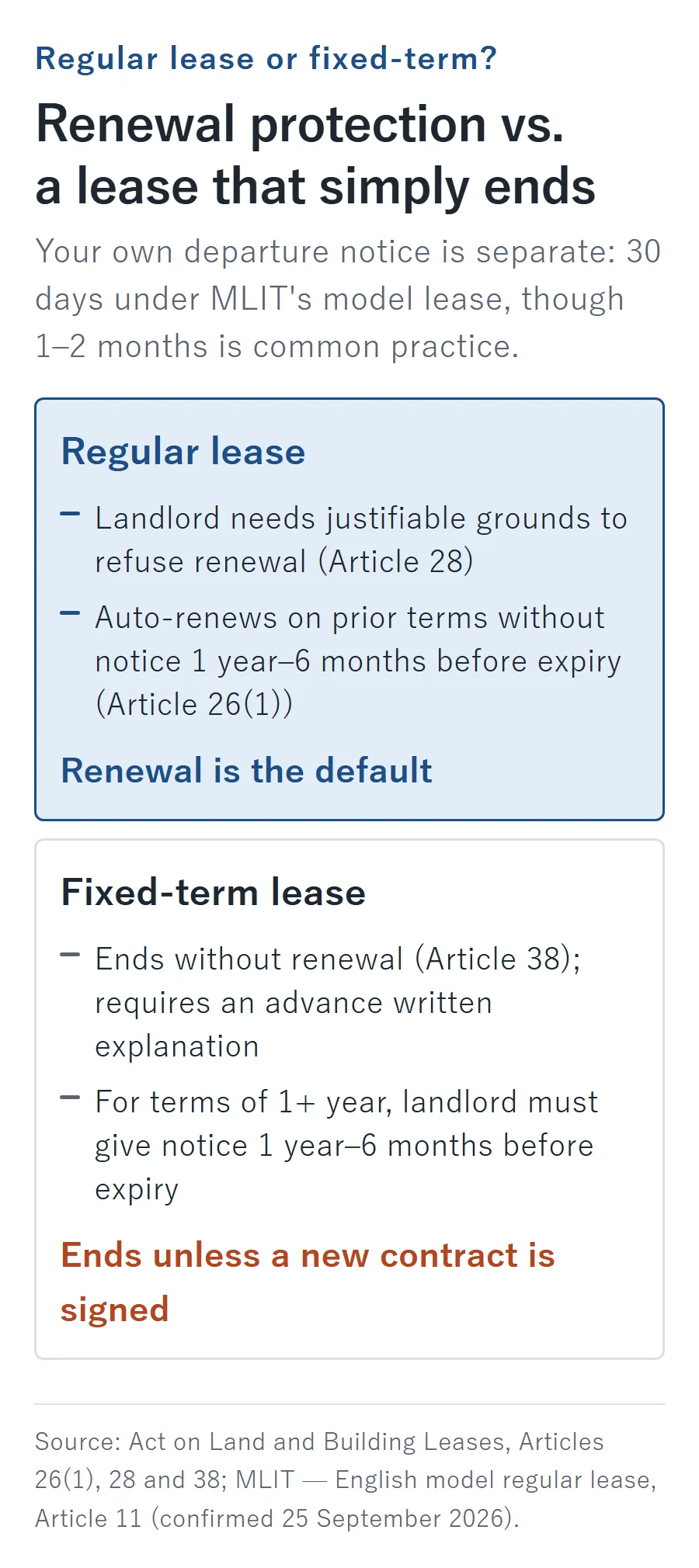
Choose with renewal and your own exit plans in mind. Under the Act on Land and Building Leases, Article 28 requires justifiable grounds for a landlord to refuse renewal of a regular lease; Article 38 provides for fixed-term leases ending without renewal, and MLIT’s guidebook notes that the two parties can still agree on a fresh contract.
Source: Act on Land and Building Leases – Article 28; Article 38; MLIT Apartment Search Guidebook (confirmed 25 September 2026).
Article 26(1) treats a regular lease as renewed on its previous terms if no notice of non-renewal is given between one year and six months before expiry.
Source: Act on Land and Building Leases – Article 26(1) (confirmed 25 September 2026).
Article 38 requires a fixed-term agreement in writing or electronic form, plus an advance written explanation that expiry ends the tenancy without renewal. Paragraph 5 states that omitting that explanation makes the no-renewal provision ineffective. For a term of at least one year, paragraph 6 requires the landlord’s ending notice between one year and six months before expiry; after late notice, the landlord must wait six months from that notice to assert termination.
Source: Act on Land and Building Leases – Article 38, paragraphs 1–6 (confirmed 25 September 2026).
Your own departure needs separate attention. MLIT’s regular-lease model provides notice of 30 days, while its guidebook describes 1–2 months as common practice and calls for written notice. The model is not proof of what your actual agreement says.
Source: MLIT – English model regular lease, Article 11; MLIT – Apartment Search Guidebook, E16–E18 (confirmed 25 September 2026).
For a fixed-term residential home smaller than 200 square meters, Article 38(7) lets the tenant end the lease one month after giving notice if a job transfer, medical treatment, family care, or another unavoidable circumstance prevents its use as their principal home. That exception is not a general cancellation right for every fixed-term renter.
Source: Act on Land and Building Leases – Article 38(7) (confirmed 25 September 2026).
What should you do after signing and moving in?
For mid- to long-term residents, the Immigration Control and Refugee Recognition Act sets different starting events for the address-notification deadline:
- New arrival, Article 19-7: report within 14 days after establishing your residence, presenting your residence card at the municipality.
- Changed address, Article 19-9: report within 14 days after moving to the new residence, through the same municipal route with your card.
Source: Immigration Control and Refugee Recognition Act – Article 19-7; Article 19-9 (confirmed 25 September 2026).
At key handover, follow MLIT’s inspection advice: mark existing scratches and stains on a simple floor plan and take dated photos, preferably with the agent present. Keep that record for the eventual deposit settlement.
Source: MLIT – Apartment Search Guidebook, E09 (confirmed 25 September 2026).
After you get the keys, use the separate guide to starting electricity, gas, and water, then plan furniture purchases and eventual disposal. Read the resident guide to garbage sorting and bulky waste alongside those moving-in tasks.
Where can you turn if private applications keep failing?
MLIT’s Safety Net Housing system lists homes registered to accept people facing housing barriers, and its guidebook directs foreign applicants toward that route. Prefecture-designated housing-support corporations also provide housing information, consultation, guarantees, and living support. The revised housing safety-net system took effect on 1 October 2025; these routes do not promise an approved application.
Source: MLIT – housing safety-net system; MLIT – housing-support corporations; MLIT – revised law’s commencement (confirmed 25 September 2026).
Is UR housing an alternative to key money and a guarantor?
Yes: UR’s English leaflet, with information dated September 2022, removes key money, brokerage and renewal charges, and the need to nominate a guarantor. It describes a deposit of two months’ rent, plus rent and shared-area charges calculated by the day for the move-in month.
Source: UR – Information About UR Rental Housing, September 2022 leaflet (confirmed 25 September 2026).
Eligibility still matters. UR’s requirements as of September 2026 include foreigners with Permanent Resident, Diplomat, or Official status; special permanent residents; or mid- to long-term residents under Immigration Control Act Article 19-3. Applicants must understand the tenancy agreement, need a continuing home, and satisfy UR’s other conditions: qualifying income, living alone or with relatives including intended cohabitants, everyone moving in within one month of the available start date, harmonious shared living, and exclusion of organized-crime members.
Source: UR – application qualifications (confirmed 25 September 2026).
These income thresholds were cross-checked against UR’s current Japanese requirements as of September 2026:
| Applicant | Monthly rent | Required monthly income |
|---|---|---|
| Single | Below 62,500 yen | Four times the rent |
| Single | 62,500 yen to below 200,000 yen | 250,000 yen |
| Single | 200,000 yen or more | 400,000 yen |
| Household | Below 82,500 yen | Four times the rent |
| Household | 82,500 yen to below 200,000 yen | 330,000 yen |
| Household | 200,000 yen or more | 400,000 yen |
Source: UR – application qualifications and income thresholds (confirmed 25 September 2026).
UR generally calculates the applicant’s monthly average from the previous year’s total divided by 12, using provable taxable income. Its savings route requires at least 100 times monthly rent in savings. Another route permits 1–10 years of advance rent payments without an income requirement, but generally disallows early cancellation. Treat that commitment separately from the ordinary move-in budget.
Source: UR – income assessment, savings and advance-payment routes (confirmed 25 September 2026).
FAQ
Will an application payment come back if the rental does not proceed?
Establish that before paying it. MLIT’s guidebook tells applicants to ask about repayment if the deal falls through; it does not supply a universal refund promise.
Source: MLIT – Apartment Search Guidebook, E16–E18 (confirmed 25 September 2026).
Can a friend move in after I sign?
MLIT’s guidebook says to declare co-occupants when contracting. Letting another person live there without permission can result in being required to leave, so obtain the owner’s agreement before changing who lives there.
Source: MLIT – Apartment Search Guidebook, E16–E18 (confirmed 25 September 2026).
Can I choose my own contractor when something breaks?
MLIT’s restoration leaflet directs tenants to the repairer selected by the owner as the usual arrangement. Booking independently at a price above the owner’s contractor’s estimate can leave you paying the difference.
Source: MLIT – move-out restoration guidance, repair FAQ (confirmed 25 September 2026).
Can I demand that the deposit cover my last unpaid rent?
Civil Code Article 622-2 does not give the tenant a right to demand that the owner apply the deposit to unpaid rent. Keep ongoing rent payments separate from the later deposit settlement.
Source: Civil Code – Article 622-2 (confirmed 25 September 2026).
What to remember
Compare the full move-in quote, distinguishing money held against debts from fees and prepaid occupancy. Read the guarantee’s repayment terms, lease renewal rules, departure notice, and cleaning clauses before signing. Keep your move-in condition record, act on the address-notification deadline, and compare UR’s eligibility before committing.