Furnishing a Japanese Apartment: Buying, Selling, and Disposal

Furnishing an apartment in Japan has three stages: buying what you need, living with it, and eventually deciding what happens to it when you move or replace it. The first stage is relatively easy to research. The last is where the surprises begin.
A sofa may qualify for a retailer’s takeback service, an IKEA item may be eligible for buyback, and a working secondhand item may find another owner. A covered home appliance being discarded follows a different system, with a recycling fee set by maker and item, a separate collection-and-transport fee, and a ticket that tracks the appliance to the manufacturer.
Verdict
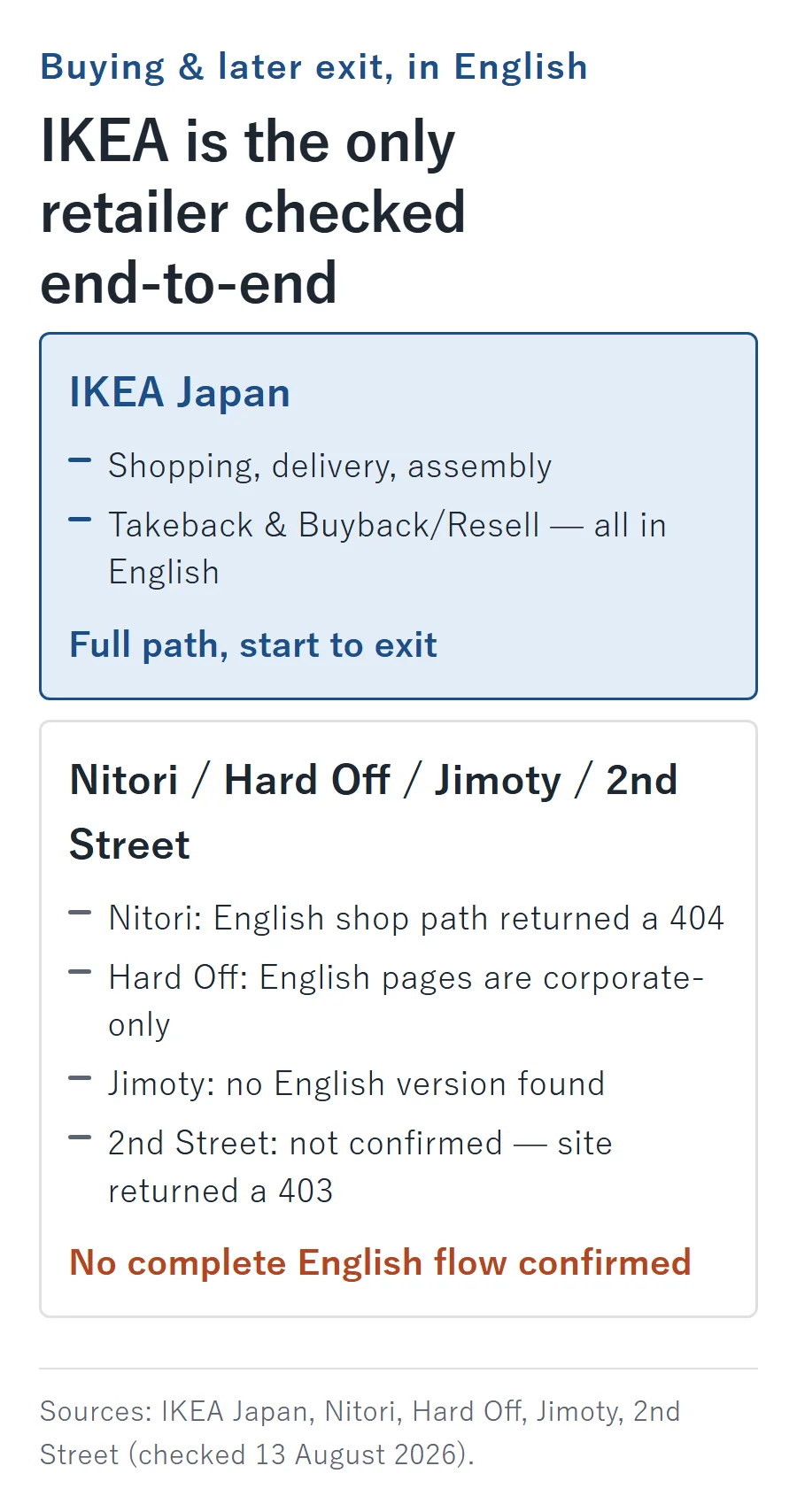
IKEA Japan is the only retailer checked for this guide that offers a complete English-language path covering shopping, delivery, assembly, Takeback, and Buyback & Resell. Nitori, Hard Off, and Jimoty do not provide a complete English shopping flow, and 2nd Street’s policies were not confirmed.
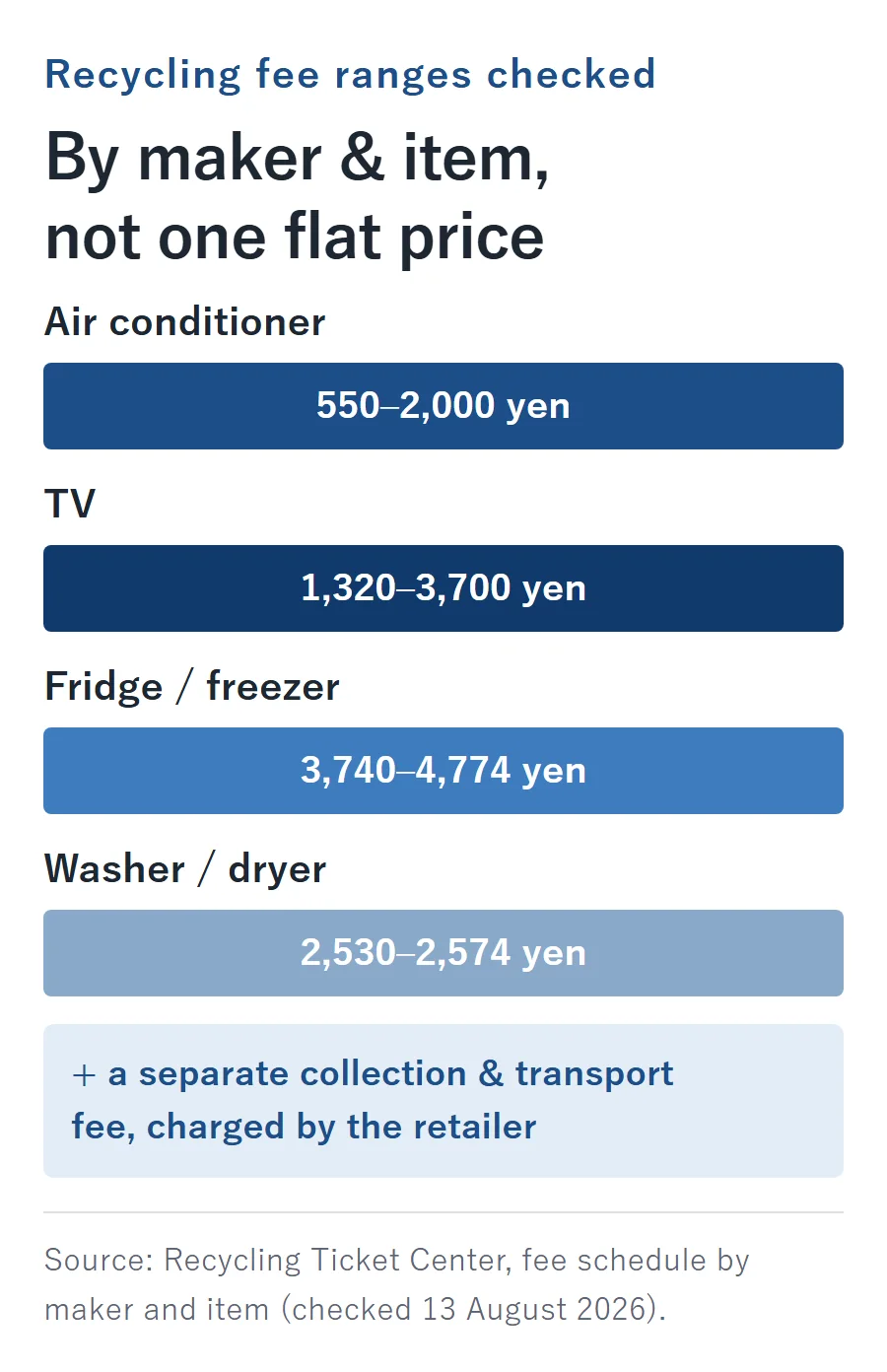
Japan’s home-appliance recycling fee is not one flat national price. It is set by maker and item category. Among the makers checked, the listed fee ranges from 550 to 2,000 yen for an air conditioner and from 3,740 to 4,774 yen for a refrigerator or freezer. A retailer’s collection-and-transport charge is separate.
Selling an item for reuse and handing it over as waste are legally different activities requiring different licenses. A truck offering free pickup is not automatically authorized to collect household waste. If the operator will take the item as waste, ask your municipality whether that operator has the required general waste disposal license or a municipal contract.
Buying new: IKEA is the one retailer that works end-to-end in English
Among the retailers checked on 13 August 2026, IKEA Japan was the only one with a complete English-language experience extending beyond product browsing. Its English site covers delivery and assembly as well as two ways of dealing with furniture later: Takeback when qualifying new furniture is delivered, and Buyback & Resell for eligible IKEA furniture.
Nitori did not offer the same English path. Its English pages contained corporate and investor information, while the English path on its shopping site returned a 404 during the research check. Some in-store signage also stated that service was available in Japanese only. That does not describe Nitori’s product range or prices; it means this guide could not verify a complete English shopping process there.
| Retailer | English shopping experience | What was confirmed |
|---|---|---|
| IKEA Japan | Full English site | English information for shopping, delivery, assembly, Takeback, and Buyback & Resell |
| Nitori | No complete English shopping flow confirmed | English corporate pages were available; the shopping site’s English path returned a 404, and some in-store signage stated “Japanese language only” |
| Hard Off | No English shopping flow | Its English corporate site describes a reuse business and provides store information |
| Jimoty | No English version found | A local-classifieds category exists for items offered free of charge |
| 2nd Street | Not confirmed | The site returned a 403 during the research pass, so its policies are not described here |
This is a language-and-service comparison, not a retailer ranking. No claim is being made here about which store has lower prices, better stock, or better furniture.
Furnishing often happens alongside the rest of the moving-in checklist. The separate guide to setting up electricity, gas, and water covers those services, while opening a bank account in Japan explains another part of establishing day-to-day life as a resident.
Buying secondhand: reuse shops and local listings
Secondhand furniture can come through a reuse shop or a local listing, but the English support confirmed for these routes is limited.
Hard Off’s English corporate site says, “We operate reuse stores that buy unwanted items from customers and sell them.” The chain has stores in all 47 prefectures. Its English pages provide corporate and store-location information rather than a complete English shopping flow, so the practical transaction should not be assumed to work end-to-end in English.
Jimoty is a local-classifieds option with a real category for items that can be received free of charge. No English version was found during the research pass. The existence of that category confirms the type of listing available, but not an English interface or English support.
2nd Street is deliberately not included as a service comparison. Its site returned a 403 during research, so this guide did not confirm its buying, selling, collection, language-support, or disposal policies.
The important distinction starts when an item leaves your home. Passing along an item for continued use is not the same legal activity as asking an operator to collect it as waste. A reuse shop buying an unwanted item and a waste collector taking an appliance for disposal operate under different licensing systems. The label used for the handover—sale, giveaway, or disposal—therefore matters more than whether a truck or shop describes the item as “unwanted.”
Once the basic furniture is in place, disaster preparation for residents is an adjacent part of setting up the apartment rather than something to leave until moving day.
When it’s time to get rid of it: the four appliances with a real fee
Japan’s general municipal bulky-waste process and the appliance categories that cannot be put out through that process are covered in the site’s guide to garbage and bulky-waste rules. This article does not repeat the application, sticker, and collection-day steps. The point here is what the separate home-appliance recycling system costs and why the total is not one universal figure.
The Recycling Ticket Center, operated by the Association for Electric Home Appliances, publishes tax-included recycling fees by maker and item category. The following figures were confirmed from its official schedule on 13 August 2026.
| Maker | Air conditioner | CRT TV (small / large) | LCD/OLED/plasma TV (small / large) | Fridge/freezer (small / large) | Washer/dryer |
|---|---|---|---|---|---|
| Panasonic | 550 yen | 1,320 / 2,420 yen | 1,870 / 2,970 yen | 3,740 / 4,730 yen | 2,530 yen |
| Hitachi Global Life | 990 yen | 1,870 / 2,970 yen | 1,870 / 2,970 yen | 3,740 / 4,730 yen | 2,530 yen |
| Sharp | 990 yen | 1,870 / 2,970 yen | 1,870 / 2,970 yen | 3,740 / 4,730 yen | 2,530 yen |
| Mitsubishi Electric | 990 yen | 1,870 / 2,970 yen | 1,870 / 2,970 yen | 3,740 / 4,730 yen | 2,530 yen |
| Aqua | 1,034 yen | — | — | 3,784 / 4,774 yen | 2,574 yen |
| Iris Ohyama | 2,000 yen | — | 3,700 yen | — | — |
Two details matter when reading this table.
First, the fee follows the manufacturer as well as the item category. The same type of refrigerator can cost a different amount to recycle depending on who made it: an Aqua unit is listed at 3,784 yen in the small category, compared with 3,740 yen for a Panasonic unit. Iris Ohyama is another visible outlier in this checked group, with a 2,000-yen air-conditioner fee and a 3,700-yen television fee.
Second, the ranges below describe only the makers actually checked for this article. They are not the range for every maker on the market:
- Air conditioners: roughly 550–2,000 yen
- TVs: roughly 1,320–3,700 yen
- Refrigerators and freezers: roughly 3,740–4,774 yen
- Washing machines and dryers: roughly 2,530–2,574 yen
Do not estimate from the range alone. Use the RKC recycling-fee lookup for the specific maker and item, because the full maker list is large and the schedule changes yearly.
The listed recycling fee is only one part of the amount paid when an appliance is collected. The retailer or other authorized collector charges a separate collection-and-transport fee, and that charge varies by retailer. A quote that mentions only “recycling” may therefore omit part of the amount due for pickup.
Who is actually allowed to take it away
The Ministry of the Environment separates household-waste collection from the secondhand trade. The licenses are not interchangeable.
- Household waste: collecting it requires a municipal general waste disposal business license (ippan haikibutsu shori-gyo kyoka) or a contract with the municipality.
- Industrial waste: an industrial waste disposal license covers factory or corporate waste. It does not authorize the collection of household items.
- Used goods for resale: a secondhand dealer license (kobutsu-sho kyoka) covers buying and reselling used goods. It does not authorize waste collection.
In plain terms, an operator receiving an item for resale and an operator taking it away for disposal are doing different things. A secondhand dealer license does not become a household-waste license merely because the same truck can carry both kinds of item. An industrial waste license also does not fill that gap.
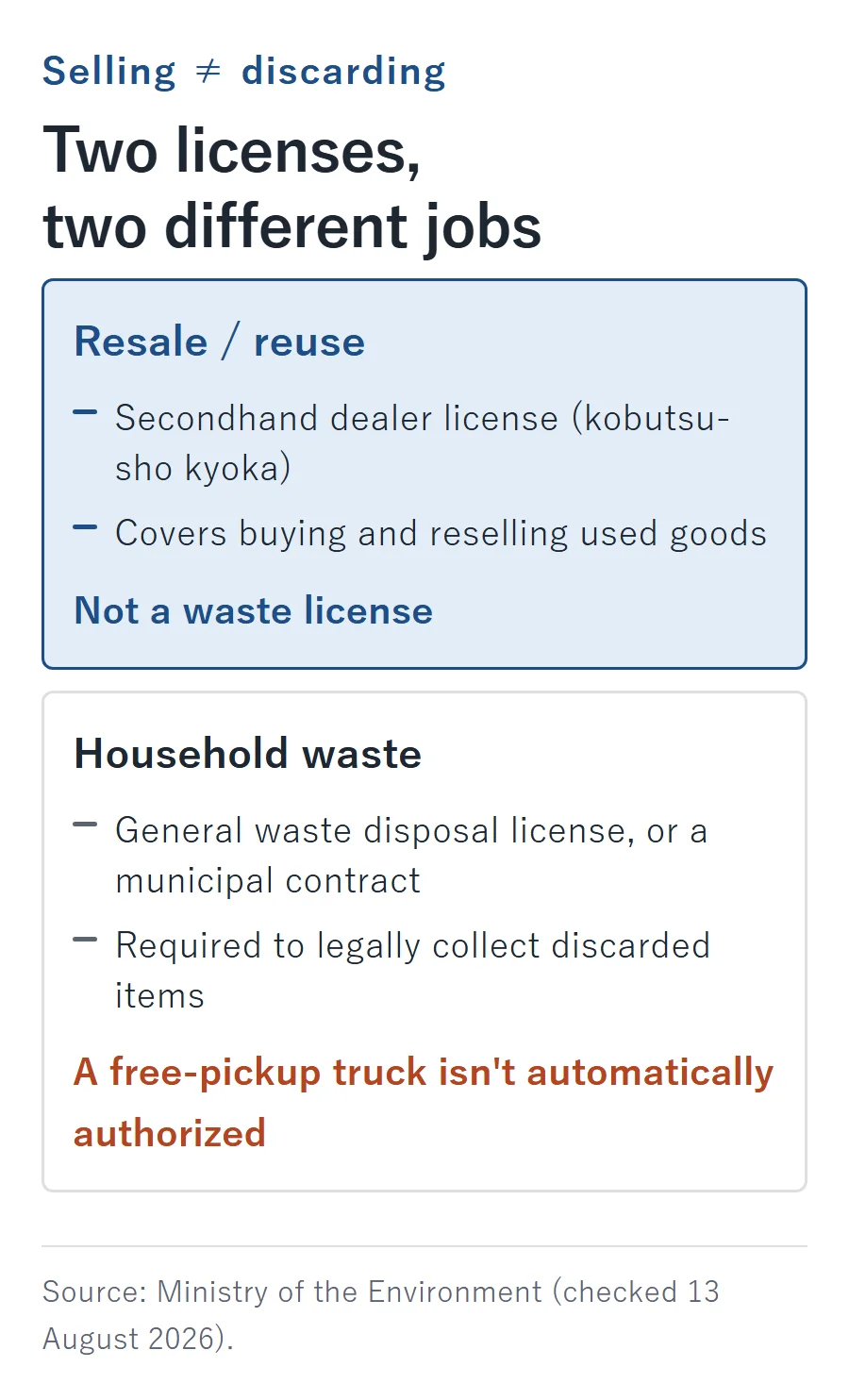
This is why “free pickup” is not enough information. The Ministry’s source does not say that every free-collection truck is illegal, and this guide does not make that claim. It says lawful household-waste collection requires the specific municipal authorization described above. If the appliance is being discarded rather than sold, check with your municipality whether the operator holds a general waste disposal license or works under a municipal contract.
For a covered appliance handed over for disposal, the expected paper trail matters too. You pay the maker-and-item recycling fee plus the separate collection-and-transport fee. In return, you should receive a Home Appliance Recycling Ticket with a tracking number. That number lets you confirm that the appliance reached the manufacturer.
A practical way to frame the conversation is to ask what transaction the operator proposes. Are they buying the item for resale, accepting it as a reusable good, or collecting it as household waste? If it is waste collection, verify the municipal authorization. If it is appliance recycling, ask about both fee components and the Recycling Ticket rather than accepting a single unexplained pickup price.
IKEA’s own Takeback and Buyback services
IKEA Japan publishes both services in English, but they solve different problems and have different conditions.
Takeback when qualifying furniture is delivered
IKEA describes the service this way:
“If you purchase a sofa or mattress and use the delivery service, we will take back the unnecessary equivalent goods at the time of delivery.”
The pickup fee is listed as free, but only when the customer purchases a sofa worth 30,000 yen or more or a mattress worth 15,000 yen or more. It is not available for IKEA online-store or phone purchases. The application must be made in a store at the time of purchase; it cannot be added afterward or requested on the delivery day.
The item must also be ready to remove. IKEA states:
“If the items cannot be removed in their current state, please disassemble them yourself. Delivery staff will not perform disassembly.”
Picked-up items cannot be returned under any circumstances, and the service is limited to individual customers. The key planning point is timing: eligibility depends on the qualifying purchase and delivery service, while the request itself has to be completed in-store before delivery.
Buyback & Resell for IKEA furniture
Buyback & Resell is not the same as Takeback. IKEA states:
“Bring them back to us any time of the year and we’ll buy them back. You’ll then get in-store credit.”
The process uses a quotation tool, and items are graded at three condition levels: like new, very good, and good. The outcome is in-store credit rather than the delivery-linked removal described under Takeback.
These two services are why IKEA is the only retailer checked here with an English-language path covering both acquisition and a later exit route. They do not remove the need to read the conditions: Takeback has purchase-price, product, delivery, application-channel, timing, and disassembly limits, while Buyback & Resell is a quotation-and-credit process for items IKEA accepts.
FAQ
Is Japan’s home-appliance recycling fee one flat national amount? No. The fee is set by maker and item category. Among the makers checked here, for example, a small Aqua refrigerator or freezer is listed at 3,784 yen while Panasonic’s corresponding fee is 3,740 yen. Check the RKC lookup for the maker of your own appliance, and remember that collection and transport cost extra.
Can I give an appliance to a truck offering free pickup? A free-pickup offer does not by itself show whether the operator has the right authorization. If the item is being taken as household waste, ask your municipality whether the operator holds the required general waste disposal license or has a municipal contract. Do not treat an industrial waste license or secondhand dealer license as a substitute.
Should I receive proof when a covered appliance is collected for disposal? Yes. You should receive a Home Appliance Recycling Ticket with a tracking number after paying the recycling fee and the separate collection-and-transport fee. The number lets you confirm that the appliance reached the manufacturer.
Can IKEA take back a sofa or mattress bought online? Not under the Takeback terms confirmed here. The service is not available for IKEA online-store or phone purchases, and the request must be made in-store when buying the qualifying sofa or mattress. It cannot be added later or requested on delivery day.
Do Nitori, Hard Off, Jimoty, or 2nd Street offer a complete English shopping service? No complete English shopping flow was confirmed for Nitori, Hard Off, or Jimoty. Nitori’s English shopping path returned a 404, Hard Off’s English pages were corporate and store information, and no English Jimoty version was found. No conclusion is given for 2nd Street because its site returned a 403 during research.
What to remember
Plan the exit while choosing how to furnish the apartment. IKEA was the only retailer checked with an English-language route spanning shopping, delivery, assembly, Takeback, and Buyback & Resell. Nitori, Hard Off, and Jimoty may still be routes a resident considers, but this research did not confirm a complete English transaction for them, and it did not confirm 2nd Street’s policies at all.
For a covered appliance, look up the fee by maker and item rather than relying on a flat estimate. Add the separate collection-and-transport charge, and keep the Home Appliance Recycling Ticket and tracking number.
Most importantly, do not blur reuse and disposal. An operator buying goods for resale needs a different license from an operator collecting household waste. A free-pickup truck is not automatically unauthorized, but the offer alone proves nothing. When the handover is disposal, the municipality is the place to confirm whether the collector has the required authorization.
Everything above reflects the official pages checked on 13 August 2026. Recycling schedules and retailer services can change, so use the current RKC maker lookup and the retailer’s current conditions before arranging collection.
Sources: Recycling Ticket Center: recycling fees by maker and item, Recycling Ticket Center: compact recycling-fee schedule, Ministry of the Environment: do not use unlicensed collectors to dispose of waste, IKEA Japan: English shopping site, Nitori Holdings: English corporate site, Nitori shopping-site English path, Hard Off: English corporate and store information, IKEA Japan: Takeback service, IKEA Japan: Buyback & Resell (all checked 13 August 2026).