Whetstone Grit Progression: Which Stones to Buy First

The simplest answer is to buy a #1000 Japanese whetstone first. It is the only grit that Shapton, King, and Suehiro all place in their medium-sharpening range, making it the strongest point of agreement across the three manufacturers.
The second stone depends on the problem you need to solve. Add a coarse stone if your knife is chipped, badly dulled, or needs a new edge profile. Add a finishing stone if the edge is already sound and you want a smoother, more refined finish. Many owners of ordinary stainless kitchen knives may not need that finishing stone at all.
That answer is less tidy than the familiar “start with #1000 and #3000” advice, but it is better supported by official manufacturer material. None of the three makers reviewed for this guide presents #1000 plus #3000 as the standard beginner set.
If you are choosing the knife as well as the stones, start with our Japanese chef knife buyer’s guide before building a sharpening kit. Steel, blade thickness, and intended use all affect what a sensible progression looks like.
Verdict
Buy a #1000 stone first. It is the one grit that Shapton, King and Suehiro all place in the working middle of their ranges — medium for Shapton, medium-finishing for the other two — which makes it the right stone for a knife that has simply gone dull.
Let the second stone solve a problem rather than complete a set. Go coarser for chips, severe dullness or reshaping: Shapton labels #120, #220 and #320 coarse, and Suehiro separates #60 to #100 for chip repair from #150 to #240 for edge adjustment. Go finer only once the edge is sound, where roughly #4000 to #5000 is the cleanest overlap between the three systems — and note that Suehiro says ordinary stainless kitchen knives can be finished within #500 to #1500.
The familiar “#1000 plus #3000” pair is not published as a shared standard by any of these makers, and a Japanese stone number should not be read as its US sandpaper equivalent, because none of the official pages provides a conversion.
The short buying order
For most home kitchens, this is the practical order:
- Buy a #1000 stone first. Use it for routine sharpening and restoring an edge that has become dull through normal use.
- Add a coarse stone only when you need faster metal removal. This is the next purchase for chips, severe dullness, or major edge correction.
- Add a finishing stone only when you can identify what it improves for your knife. A finer stone can refine the edge, but it is not automatically necessary for an everyday stainless blade.
- Do not buy by category labels alone. One maker’s “medium” stone can overlap another maker’s “finishing” range.
- Stay within one maker’s published system when possible. That avoids pretending that every printed grit number follows a universal progression.
This order is a synthesis of manufacturer classifications, not a claim that the manufacturers publish one shared starter kit.
Why the grit number does not tell the whole story
A lower number generally indicates a coarser stone that removes material faster. A higher number generally indicates a finer stone used to refine the edge. The difficulty is that manufacturers do not draw the boundaries between “coarse,” “medium,” and “finishing” at the same places.
The official Shapton product range classifies #120, #220, and #320 as coarse; #1000, #1500, and #2000 as medium; and #5000, #8000, and #12000 as finishing stones. It reserves #30000 for a mirror-finishing category.
The official King whetstone product listings label #800 through #2000 as medium-finishing stones, #4000 as finishing, #6000 as super-finishing, and #8000 as final super-finishing. The product page reviewed for this article did not show King’s coarse range, so it would be wrong to infer that King does not make coarse stones.
Suehiro draws the lines differently in its official whetstone selection and sharpening guide. It places #320 through #800 in the medium category, #1000 through #1500 in medium-finishing, #2000 through #6000 in finishing, and #8000 through #20000 in super-finishing.
The disagreement becomes clear when the same numbers are placed side by side:
| Printed number | Shapton | King | Suehiro |
|---|---|---|---|
| #800 | No stone in cited range | Medium-finishing | Medium |
| #1000 | Medium | Medium-finishing | Medium-finishing |
| #2000 | Medium | Medium-finishing | Finishing |
| #4000–#5000 | Finishing at #5000 | Finishing at #4000 | Finishing |
| #8000 | Finishing | Final super-finishing | Super-finishing |
The useful lesson is not that one maker is right. It is that the label is part of the manufacturer’s own product system. A #2000 stone can be sold as medium by one company and finishing by another without either description creating a universal rule.
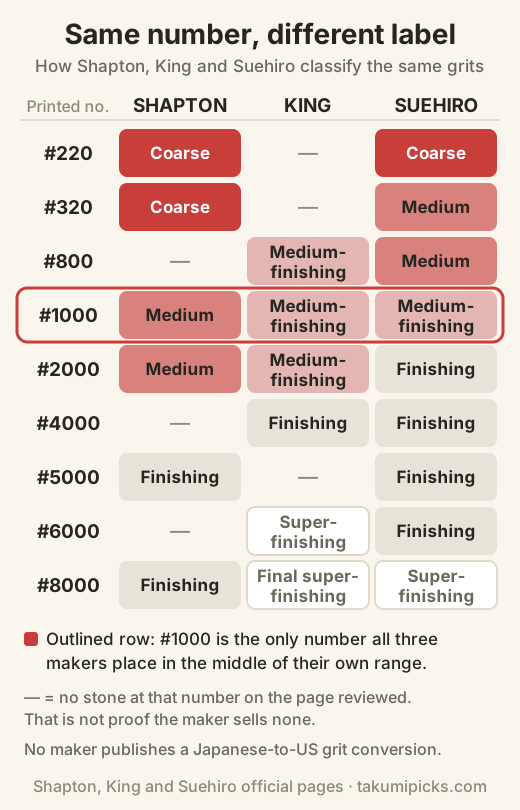
Figure sources: Shapton product range, King whetstone product listings, Suehiro whetstone selection and sharpening guide (all accessed 10 August 2026).
There is a second complication for US buyers: the Japanese # number should not be casually converted into a US sandpaper grit. The official pages reviewed here do not provide a JIS-to-US conversion table, and this research did not find an authoritative primary-source conversion. Treat a conversion chart from a retailer, forum, or marketplace listing as that source’s interpretation rather than an official equivalence.
Which stone should you buy first?
Start with #1000 for normal kitchen sharpening
Across the three manufacturers, #1000 is the clearest common ground. Shapton calls it medium, while King and Suehiro call it medium-finishing. The wording changes, but all three place it in the working middle of the progression rather than at either extreme.
That makes #1000 a sensible first purchase for a kitchen knife that has lost normal cutting performance but does not have major chips or a badly deformed edge. It is coarse enough to do real sharpening work without pushing a beginner immediately into a specialized repair stone or a high-grit polishing step.
A nearby medium stone can also make sense within a particular product line. King lists #800, #1000, and #1200 for similar medium-finishing use, while Suehiro gives stainless kitchen knives a medium range of #500 to #1500. The point is not that #1000 is a magic number. It is that #1000 is the one number for which the three official systems most clearly overlap.
Before buying, check the maker’s directions for that exact stone. Water preparation, maintenance, and intended blade types can differ by product even when two boxes display similar grit numbers.
What should the second stone be?
The second purchase should expand what your first stone can do. It should not merely make the set look complete.
Add a coarse stone for damage or major correction
Choose the coarse direction when the knife has visible chips, has become extremely dull, or needs substantial edge reshaping. A coarse stone removes metal faster, which saves time compared with asking a #1000 stone to perform heavy repair work.
Shapton’s official range labels #120, #220, and #320 as coarse. Suehiro separates coarse stones into #60–#100 for chip repair and #150–#240 for edge adjustment, then begins its medium range at #320. Those boundaries are not identical, but both makers distinguish repair work from ordinary medium-stone sharpening.
A practical two-stone repair set is therefore:
- Coarse stone selected from the maker’s repair range
- #1000 medium stone to establish and refine the working edge after the repair step
Do not buy the most aggressive stone simply because it is faster. Faster metal removal also means less room for error. If the damage is deep, the knife is expensive, or the bevel geometry is unfamiliar, professional repair may be more appropriate than learning on that blade.
Add a finishing stone for refinement
Choose the finishing direction when the knife is already in good condition, the #1000 stone produces a reliable edge, and you want a finer finish. Based on the three official systems, roughly #4000 to #5000 is the cleanest area of overlap for a conventional finishing step: King labels #4000 finishing, Shapton labels #5000 finishing, and Suehiro includes both numbers in its #2000–#6000 finishing range.
That does not make #4000 or #5000 mandatory. Suehiro’s knife-specific guidance says stainless kitchen knives can be finished in the #500–#1500 range and generally do not require a finishing stone. For forged Japanese kitchen knives, Suehiro lists #3000 and above as an optional finishing step for a more refined cutting feel.
This gives two very different two-stone paths:
- Repair-focused: coarse stone + #1000
- Refinement-focused: #1000 + a finishing stone in the maker’s published finishing range
The first path solves damage and severe dullness. The second polishes an already functional sharpening routine. A buyer who rarely encounters chips and uses an ordinary stainless knife may reasonably stop after the #1000 stone.
Three sensible starter kits
One-stone kit: routine home maintenance
Buy one #1000 stone from a maker whose instructions and replacement products are easy to obtain. This is the lowest-cost way to learn pressure control, burr formation, and consistent blade placement without switching between several stones.
Best fit: an intact kitchen knife that needs ordinary sharpening rather than repair.
Two-stone kit: repair first
Buy a coarse repair stone from the same manufacturer’s system, then a #1000 stone. Follow the maker’s categories rather than mixing numbers from unrelated charts.
Best fit: inexpensive practice knives, visible edge damage, or a blade that takes too long to restore on a medium stone.
Two-stone kit: refine a good edge
Buy a #1000 stone, learn to produce a consistent working edge, then add a finishing stone around the #4000–#5000 area within the chosen maker’s range.
Best fit: a sound knife, repeatable technique, and a clear preference for a more refined finish. It is a discretionary upgrade, not a prerequisite for making a kitchen knife sharp.
A three-stone set—coarse, medium, and finishing—matches the broad coarse/medium/finishing framework used by all three makers. Suehiro explicitly recommends having at least one of each type for comprehensive edge work, although its same page also says ordinary stainless kitchen knives may finish at the medium stage. That apparent tension is useful: a complete workshop and a minimal home kit are not the same purchasing problem.
Why “#1000 plus #3000” is not a universal standard
The pairing is common in online advice, but it does not appear as a shared starter recommendation in the official Shapton, King, and Suehiro material reviewed for this guide.
Shapton’s cited product line does not include a #3000 stone. King’s cited list jumps from #2000 to #4000. Suehiro places #3000 inside its broader finishing range and specifically mentions #3000 or higher for forged kitchen knives, but it also says many stainless kitchen knives can finish at #500–#1500.
So #1000 plus #3000 may be a workable combination in a particular brand or for a particular blade. It should not be presented as the manufacturer-backed default for every Japanese knife owner. A more defensible rule is to choose one medium stone first, then add either repair capability or finishing capability based on the knife’s actual condition.
Sharpening angle is a guide, not a fixed number
Our knife guide discusses the commonly cited difference between Japanese and Western edge angles. For whetstone work, however, the important point is consistency rather than forcing every knife to one number.
Suehiro’s official guide says there is no single correct sharpening method for every blade. It describes an angle in the teens as a household guide, then notes that the appropriate angle changes with blade thickness and hardness. That does not contradict the familiar approximate figures; it puts them in context.
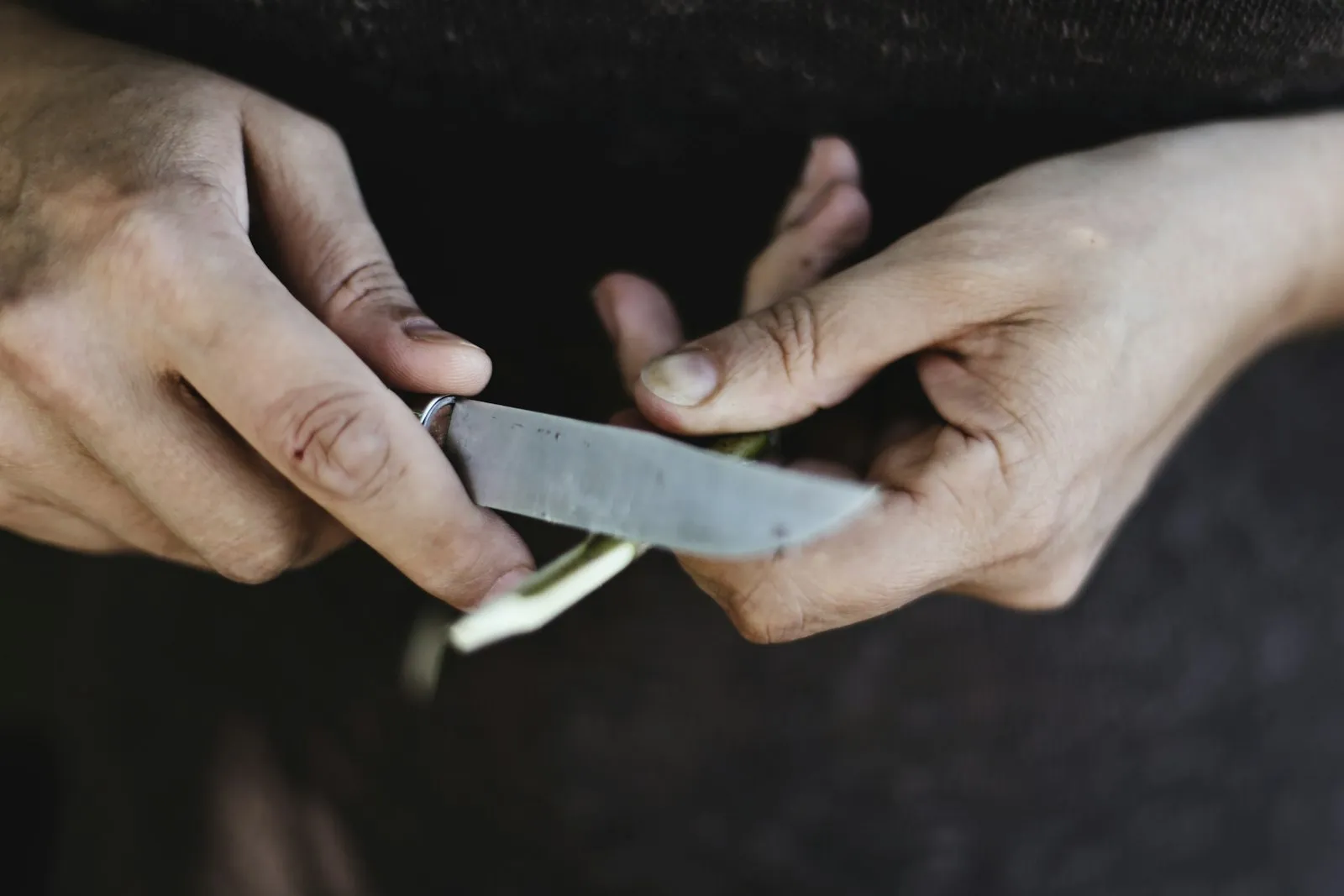
Check the knife maker’s instructions when available, preserve the existing bevel unless you have a reason to change it, and avoid treating a general angle chart as a specification for every blade.
Buying a whetstone in Japan and flying home
If you plan to buy stones while shopping for knives in Japan, do not assume a whetstone has the same TSA treatment as a knife. As of the research date, “whetstone” does not have its own entry in the TSA’s complete What Can I Bring list. Confirm with TSA and your airline before travel rather than stating that it is permitted in either carry-on or checked baggage.

For a shopping trip, having mobile data helps with manufacturer instructions, store hours, and translation. Our Japan eSIM comparison covers the setup options before arrival. If you order a stone from Japan instead, compare the landed cost rather than only the listed price; our Japanese snack box comparison explains why small international shipments can involve costs beyond the storefront price.
FAQ
Is #1000 enough for a Japanese kitchen knife?
For many intact kitchen knives, yes. All three manufacturers reviewed place #1000 in a medium or medium-finishing category, and Suehiro says ordinary stainless kitchen knives can be finished within #500–#1500. A coarse stone becomes useful for damage or major correction; a finishing stone is an optional refinement for many home users.
Should the second stone be #3000, #5000, or #6000?
There is no manufacturer-wide answer. Suehiro includes all three within its finishing range, Shapton’s cited line moves from #2000 medium to #5000 finishing, and King labels #4000 finishing and #6000 super-finishing. Choose within the specific maker’s progression and match the stone to the blade and the finish you want.
Can I compare a Japanese #1000 stone directly with US 1000-grit sandpaper?
Do not assume they are equivalent. The official manufacturer pages used here do not provide a conversion between Japanese whetstone numbers and US abrasive ratings, and this research did not find an authoritative primary-source conversion table. Compare stones by maker, product line, and stated use rather than by an unofficial one-to-one conversion.
Summary
For most home cooks, #1000 is the first stone to buy because it is the one grit consistently placed in the medium range by Shapton, King, and Suehiro. The next purchase should solve a specific limitation: go coarser for repair and faster metal removal, or go finer for edge refinement after the knife is already sharp.
The manufacturer’s progression matters more than a generic label. #2000 can be medium or finishing, while #6000 can be finishing or super-finishing depending on the maker. The familiar #1000-plus-#3000 set is not a shared official standard, and Japanese stone numbers should not be translated into US grit ratings without an authoritative conversion.
A smaller kit that matches the condition of your knives is more useful than a large set bought in numerical order.
Sources: Shapton product range, King whetstone product listings, Suehiro whetstone selection and sharpening guide, TSA complete What Can I Bring list (all accessed 10 August 2026).