Japanese green tea types: sencha vs matcha and how to brew

Verdict
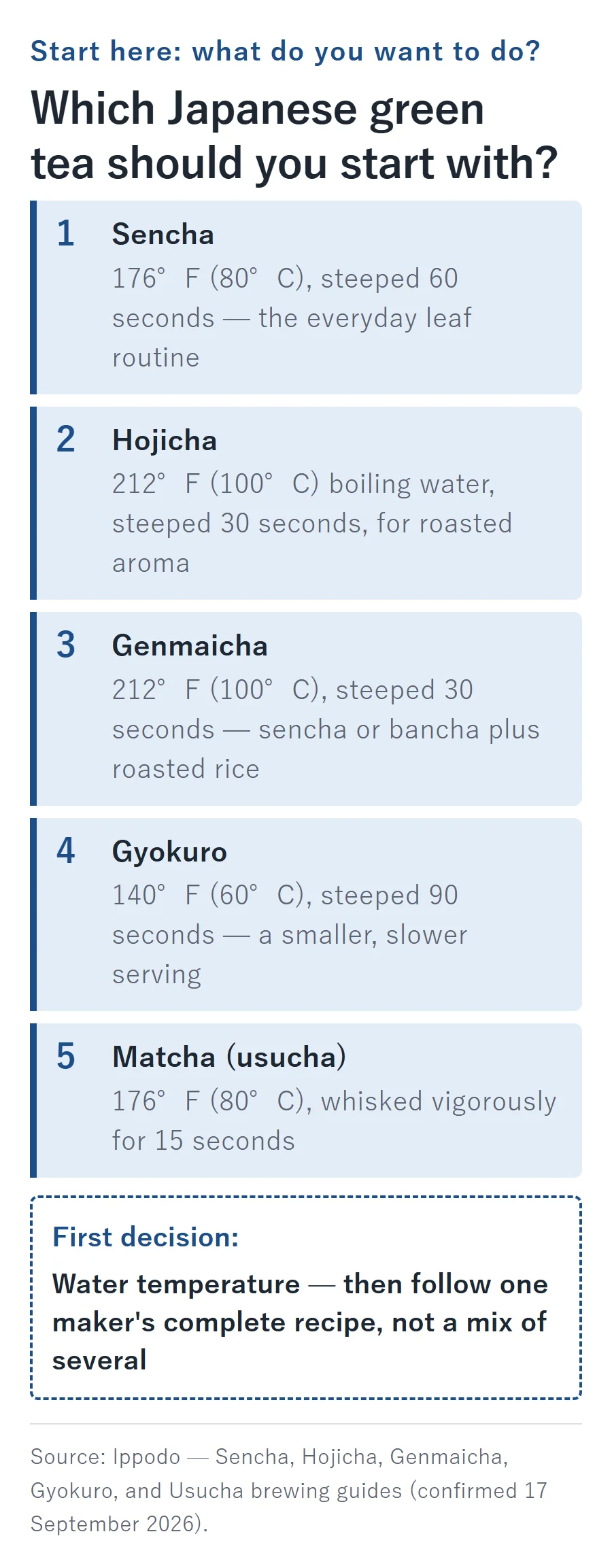
Start with sencha for everyday leaf brewing, hojicha for roasted aroma, or genmaicha for a roasted-rice blend; choose gyokuro for a small, deliberate serving and matcha when you want to whisk a bowl. Make water temperature your first brewing decision, then follow a complete recipe from the maker rather than applying the same setting to every Japanese green tea.
How are Japanese green tea types defined?
The names describe how the tea is grown or processed, not a ladder from ordinary to superior. Separate the production method from the brewing recipe: the former identifies the tea, while the latter tells you what to do with it.
The Japanese tea industry’s labelling standard provides the distinctions below. These quotations are English glosses of the Japanese definitions, not an official English translation; the document is an industry labelling standard, not a government regulation.
Sencha: “Steamed, rolled and dried.”
Gyokuro: “From gardens shaded about 20 days, blocking sunlight almost completely; then processed like sencha.”
Matcha: “Tencha (shade-grown leaves dried without rolling) ground to a fine powder with a stone mill.”
Hojicha: “Made by roasting sencha or bancha over high heat.”
Genmaicha: “Made by adding roasted rice to sencha or bancha.”
Source: Japanese tea industry — Labelling standard, Japanese-language PDF (confirmed 17 September 2026).
Read those definitions as a shopping checklist. For gyokuro, shading is part of the identity; for matcha, the starting material and milling matter. For hojicha and genmaicha, distinguish roasting the tea itself from adding roasted rice to tea. That distinction is more useful than choosing whichever package looks more traditional.
The practical split at home is between steeping leaves in a teapot and mixing matcha in a bowl. Decide which routine you want before choosing utensils, then use the maker’s directions for the tea you bought.
Why start with sencha, and how should you brew it?
Choose sencha to establish an everyday teapot routine before adding the separate equipment and technique for matcha. It also makes a useful starting point for learning how temperature changes the result without switching tea types.
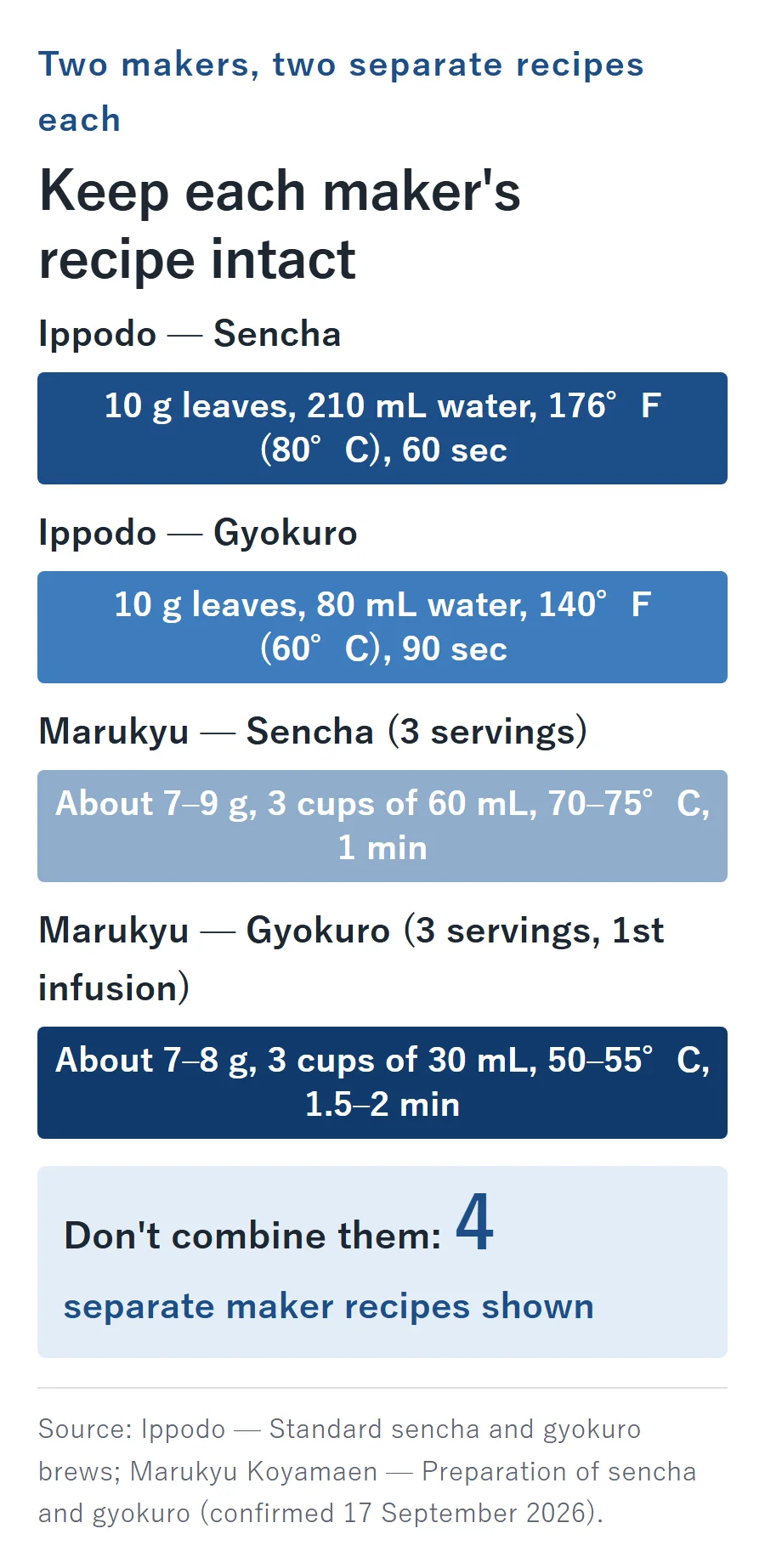
Ippodo’s standard sencha recipe uses 10 g of leaves, 210 mL of water at 176°F (80°C), and 60 seconds. Marukyu Koyamaen’s recipe for 3 servings instead uses about 7–9 g, with 3 small cups of about 60 mL each, water cooled to 70–75°C, and one minute of brewing.
Source: Ippodo — Standard sencha brew, Marukyu Koyamaen — Preparation of sencha (confirmed 17 September 2026).
Those are separate recipes, not endpoints to combine into a new standard. Start with a complete set of instructions, including the leaf amount and water volume. Taking the temperature from one maker and the remaining measurements from another would no longer reproduce either published recipe.
Temperature deserves particular attention because Marukyu Koyamaen explains its effect directly:
“A lower temperature will produce a milder and rounder taste, while higher temperatures will make the tea taste more sharp.”
Source: Marukyu Koyamaen — Preparation of sencha (confirmed 17 September 2026).
Use that distinction to describe what you want from the next brew: milder and rounder, or sharper. Keep a note of the recipe used so the next adjustment responds to a particular result rather than to a vague impression that sencha is not for you.
When should you choose gyokuro instead?
Choose gyokuro when a small serving and a deliberate brewing routine appeal more than filling a large mug. The preparation changes substantially from sencha, even within the same maker’s instructions.
Ippodo uses 10 g of gyokuro with 80 mL of water at 140°F (60°C), brewed for 90 seconds. Marukyu Koyamaen’s first-infusion recipe for 3 servings uses about 7–8 g, 3 cups of 30 mL each, water at 50–55°C, and 1.5–2 minutes.
Source: Ippodo — Standard gyokuro brew, Marukyu Koyamaen — Preparation of gyokuro (confirmed 17 September 2026).
The water amount is not a minor detail to replace with whatever fits your cup. Put a serving vessel beside the recipe before brewing so the intended amount is clear. Follow the chosen maker’s complete preparation rather than treating gyokuro as sencha with a different label.
The differing instructions are useful choices, not a reason to invent a universal compromise. Marukyu Koyamaen explicitly frames its method as a starting point:
“This is a standard way to prepare Gyokuro. However, it is very much up to personal taste.”
Source: Marukyu Koyamaen — Preparation of gyokuro (confirmed 17 September 2026).
Should you choose hojicha for roasted aroma?
Choose hojicha when roasted aroma is the direction you want to explore. Its defining step is roasting the tea, and Ippodo’s preparation deliberately uses boiling water rather than the cooling required in its sencha and gyokuro recipes.
Ippodo states why:
“Use hot water that is boiling vigorously to bring out the full aroma of this tea.”
Source: Ippodo — Standard hojicha brew (confirmed 17 September 2026).
Its recipe calls for 4 tablespoons of hojicha, weighing 10 g, with 240 mL of water at 212°F (100°C) for 30 seconds. The spoon measure matters: Ippodo’s sencha recipe also uses 10 g, but gives 2 tablespoons, not the hojicha measure.
Source: Ippodo — Standard hojicha brew, Ippodo — Standard sencha brew (confirmed 17 September 2026).
Do not copy a spoonful count from a different tea. Keep the named tea, spoon measure, and weight together when writing a recipe card for the kitchen.
Bancha in the definition is a material category, not a shorthand for poor quality. The industry’s definition includes the following, given here as an English gloss:
“From coarser mature leaves, older leaves and stems, and from leaves picked between the main harvests.”
Source: Japanese tea industry — Labelling standard, Japanese-language PDF (confirmed 17 September 2026).
How is genmaicha different from hojicha?
Choose genmaicha when you specifically want tea blended with roasted rice. Hojicha points to roasting the tea itself; the names answer different questions about what is in the package.
Source: Japanese tea industry — Labelling standard, Japanese-language PDF (confirmed 17 September 2026).
Ippodo’s genmaicha recipe uses 2 tablespoons, or 10 g, with 240 mL of water at 212°F (100°C) for 30 seconds. The shared temperature and timing with its hojicha recipe do not make the teas interchangeable: the ingredients and spoon measures still differ.
Source: Ippodo — Standard genmaicha brew, Ippodo — Standard hojicha brew (confirmed 17 September 2026).
For a tea-and-snack break, choose the tea separately from the subscription decision. The Bokksu, Sakuraco, and TokyoTreat comparison discusses tea pairings alongside the snack-box choices; it is a separate buying guide, not a brewing instruction for the tea on your table.
What changes when you choose matcha rather than sencha?
Choose matcha when you want the preparation to involve sifting and whisking a bowl rather than steeping leaves and pouring out the tea. The tencha and milling distinction identifies the product; the next decision is which matcha preparation to follow.
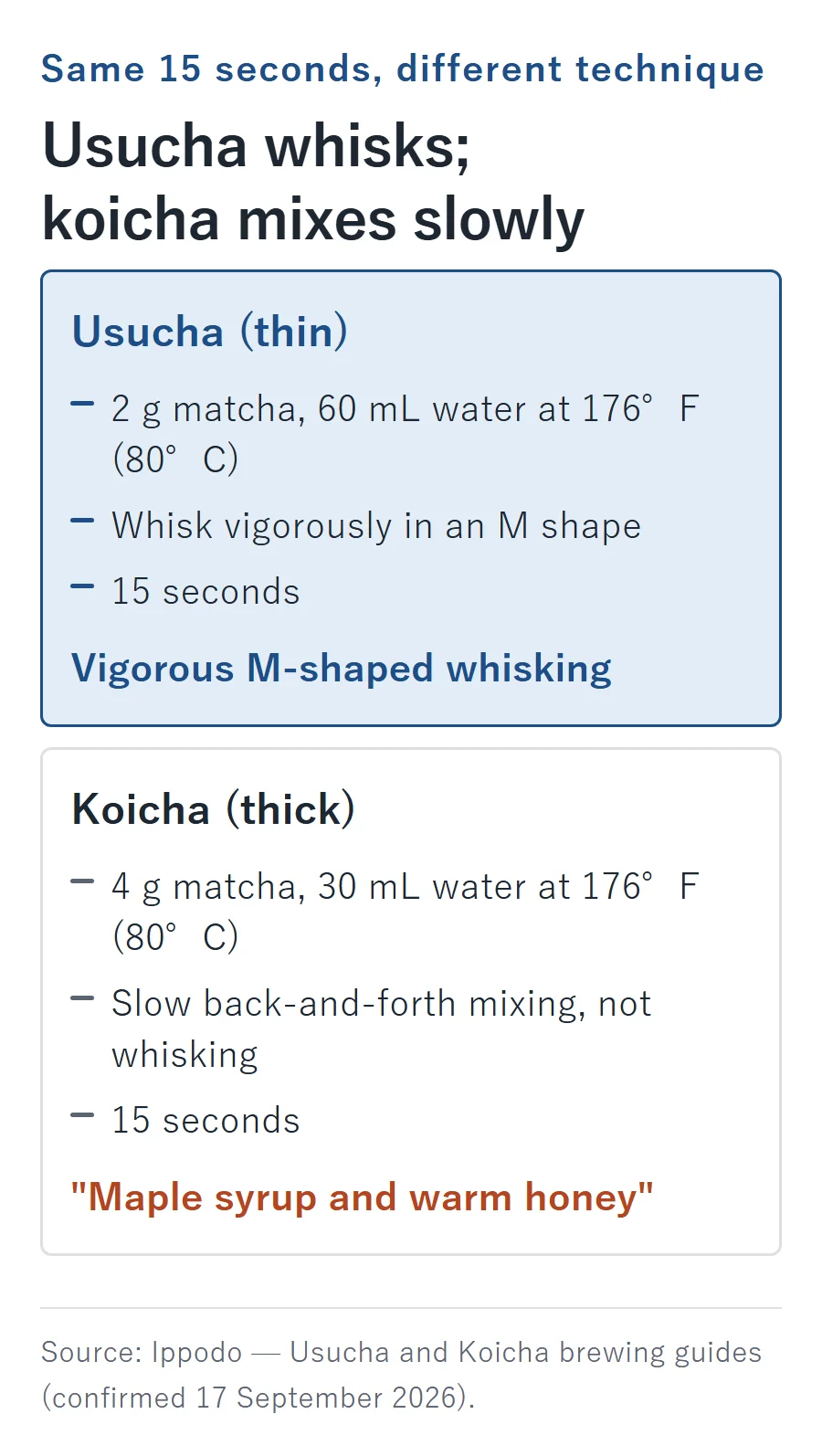
Ippodo separates usucha, a thin matcha preparation, from koicha, a thick preparation. Its usucha recipe uses 2 g with 60 mL of water at 176°F (80°C) and vigorous whisking for 15 seconds; its koicha recipe uses 4 g with 30 mL at the same 176°F (80°C) and slow mixing for 15 seconds.
Source: Ippodo — Usucha, Ippodo — Koicha (confirmed 17 September 2026).
Start with usucha if your goal is to learn the whisked-bowl routine. Koicha is not simply the same bowl whisked harder: both the proportions and movement change. Treat the recipe name as part of the instructions, not a decorative term on the menu.
Marukyu Koyamaen provides another bowl recipe: approximately 1.5 g of matcha with 70 mL, about 2.4 oz, of previously boiled water. It specifies 167–185°F (75–85°C) in winter and 158–176°F (70–80°C) in summer. Keep each seasonal range attached to its condition rather than merging them into an all-season range.
Source: Marukyu Koyamaen — Preparation of matcha (confirmed 17 September 2026).
Which brewing recipe should you follow?
Use the row for your tea and maker as a complete starting recipe. The tables retain the makers’ separate measurements and published volume rounding as of September 2026; they do not turn differing recipes into an averaged recommendation.
What does Ippodo specify for each preparation?
Ippodo’s recipes distinguish both the tea amount and the action: leaf teas steep, usucha is whisked, and koicha is mixed slowly. Water volume stays beside the tea amount so the temperature is not mistaken for a complete recipe.
| Tea | Tea amount / water | Water temperature | Time / method | Source maker |
|---|---|---|---|---|
| Sencha | 2 tbsp (10 g / 0.35 oz); 210 mL (7 oz) water | 176°F (80°C) | 60 seconds; steep | Ippodo |
| Gyokuro | 2 tbsp (10 g / 0.35 oz); 80 mL (3 oz) water | 140°F (60°C) | 90 seconds; steep | Ippodo |
| Hojicha | 4 tbsp (10 g / 0.35 oz); 240 mL (8 oz) water | 212°F (100°C) | 30 seconds; steep | Ippodo |
| Genmaicha | 2 tbsp (10 g / 0.35 oz); 240 mL (8 oz) water | 212°F (100°C) | 30 seconds; steep | Ippodo |
| Matcha: usucha | 1 level tsp (2 g / 0.07 oz); 60 mL (2 oz) water | 176°F (80°C) | 15 seconds; whisk vigorously | Ippodo |
| Matcha: koicha | 2 level tsp (4 g / 0.14 oz); 30 mL (1 oz) water | 176°F (80°C) | 15 seconds; mix slowly | Ippodo |
Source: Ippodo — Sencha, Gyokuro, Hojicha, Genmaicha, Usucha, Koicha (confirmed 17 September 2026).
How do Marukyu Koyamaen’s leaf-tea recipes differ?
Marukyu Koyamaen gives the following preparations for 3 servings, including a first-infusion specification for gyokuro. Read each cup amount literally rather than substituting a US measuring cup or a household mug.
| Tea | Tea amount / water | Water temperature | Time / method | Source maker |
|---|---|---|---|---|
| Sencha: 3 servings | 2 tablespoons (about 7–9 g); 3 small cups, about 60 mL each | 70–75°C | 1 minute; steep | Marukyu Koyamaen |
| Gyokuro: 3 servings | 3 full teaspoons (about 7–8 g); 3 cups, 30 mL each | 50–55°C | 1.5–2 minutes; first infusion | Marukyu Koyamaen |
Source: Marukyu Koyamaen — Preparation of sencha, Preparation of gyokuro (confirmed 17 September 2026).
For Ippodo’s leaf-tea method, the handling instruction is as important as the timer:
“Brew without stirring or disturbing the tea leaves.”
“Pour out every last drop.”
Source: Ippodo — Standard sencha brew (confirmed 17 September 2026).
For a Japanese kitchen at home, keep the tea setup and appliance decisions separate. The guide to Japanese rice cookers and US voltage compatibility addresses the equipment question without turning it into a requirement for brewing tea.
Matcha: how should you use the whisk and bowl?
Set out matcha, a sifter or fine-meshed strainer, a tea bowl, and a chasen tea whisk. A chashaku tea spoon or measuring spoon is used in Marukyu Koyamaen’s sifting instructions; Ippodo also gives level-teaspoon measures for its matcha recipes.
Source: Marukyu Koyamaen — Preparation of matcha, Ippodo — Usucha (confirmed 17 September 2026).
The useful buying distinction is the job each tool performs: a sifter addresses lumps, a spoon measures or helps press powder through the mesh, and a whisk performs the mixing. A matching decorative set is not the decision to make before learning those jobs.
Marukyu Koyamaen explains the reason for sifting:
“Since Matcha is a very fine powder it tends to coalesce over time. It is therefore highly recommended to sift the tea in a fine-meshed strainer before use to avoid lumps.”
Source: Marukyu Koyamaen — About matcha (confirmed 17 September 2026).
For Ippodo’s usucha, keep the sequence straightforward:
- Sift the matcha. Measure 2 g, or 1 level teaspoon, for this recipe.
- Add the measured water to the tea bowl: 60 mL, or 2 oz, at 176°F (80°C).
- Whisk vigorously for 15 seconds in an M shape. This is a whisking action, not a leaf-steeping interval.
Source: Ippodo — Usucha (confirmed 17 September 2026).
Marukyu Koyamaen’s technique provides a useful contrast to stirring in circles:
“Raise then the chasen a little from the bottom and whip vigorously back and forth with the wrist and arm and avoid swivelling the tea around.”
Source: Marukyu Koyamaen — Preparation of matcha (confirmed 17 September 2026).
For Ippodo’s koicha, the instruction is slow back-and-forth mixing for 15 seconds, rather than vigorous whisking. The maker describes the intended consistency as:
“somewhere in-between maple syrup and warm honey”
Source: Ippodo — Koicha (confirmed 17 September 2026).
Use matcha suited to that preparation. Marukyu Koyamaen explains the requirement:
“Since koicha is quite thick, it requires matcha that is less astringent than standard matcha for usucha.”
Source: Marukyu Koyamaen — About matcha (confirmed 17 September 2026).
If utensils are part of a wider shopping trip, keep the tea list distinct from the separate decisions covered in buying Japanese kitchen knives in Japan. That guide concerns knife shopping and transport, not permission to carry or import tea.
Storage: how should you protect the tea after opening?
Give tea a place protected from heat, moisture, and transferred odors. The Japanese industry’s storage wording is summarized by this English gloss:
“Avoid high temperature and humidity, and beware of odor transfer.”
Source: Japanese tea industry — Labelling standard, Japanese-language PDF (confirmed 17 September 2026).
For matcha, Marukyu Koyamaen additionally identifies light and air among the factors that affect quality. Apply that guidance to the storage location as well as the container: an attractive display beside hot cooking equipment is not the same objective as protecting the tea.
Source: Marukyu Koyamaen — About matcha (confirmed 17 September 2026).
Marukyu Koyamaen recommends refrigeration for matcha and specifically says its opened pull-top cans should be refrigerated and consumed as soon as possible. Its cold-storage instruction also includes a step that belongs on the container, not just in a buying guide:
“To prevent Matcha that was stored in the refrigerator or freezer from clumping when exposed to air, it should be allowed to warm up to room temperature before the package is opened.”
Source: Marukyu Koyamaen — About matcha (confirmed 17 September 2026).
The sequence is bring the still-closed package to room temperature, then open it. Keep the maker’s matcha guidance separate from the general tea-storage wording rather than turning it into an instruction to refrigerate every tea product.
FAQ
Can you brew the same sencha leaves again?
Yes: Marukyu Koyamaen gives a separate second-infusion method. Use slightly hotter water than the first time and steep for just 10 seconds. That is its instruction for a later infusion, not a replacement for the initial brewing time.
Source: Marukyu Koyamaen — Preparation of sencha (confirmed 17 September 2026).
How does the method change for later gyokuro infusions?
Marukyu Koyamaen specifies 55–60°C and 30 seconds for the second infusion. For the third infusion, it calls for still hotter water and only 15 seconds. It describes the first infusion as full-bodied and the later infusions as lighter.
Source: Marukyu Koyamaen — Preparation of gyokuro (confirmed 17 September 2026).
Does the water itself matter, beyond its temperature?
Marukyu Koyamaen recommends soft water for Japanese green tea. When choosing water for the tea setup, use that characteristic rather than treating the words “mineral water” as a sufficient description.
Source: Marukyu Koyamaen — Preparation of sencha (confirmed 17 September 2026).
Is any powdered green tea automatically matcha?
No: the industry standard separately describes powder sifted out during finishing and tea powdered by a grinder. Matcha’s definition specifies tencha and stone milling instead. Treat “powdered green tea” alone as an incomplete description when the product you want is matcha.
Source: Japanese tea industry — Labelling standard, Japanese-language PDF (confirmed 17 September 2026).
What to remember
Choose by the preparation and taste direction you want: sencha for routine steeping, hojicha for roasted aroma, genmaicha for roasted rice, gyokuro for a small serving, or matcha for whisking.
Keep each maker’s temperature, tea amount, water volume, and timing together instead of constructing a universal recipe.
Protect stored tea from heat, moisture, and odors; let refrigerated matcha reach room temperature before opening its package.